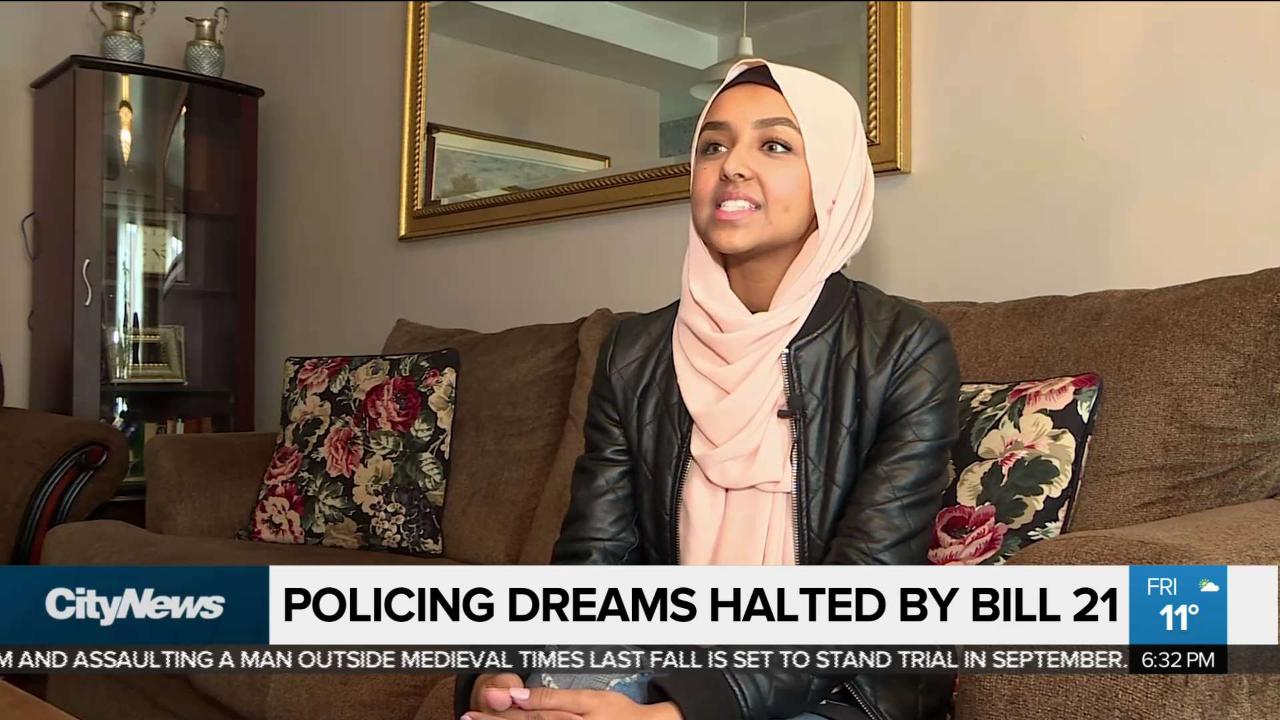
Perhaps in response to Bill 21 all other Canadian provinces should ban Quebec MPs from entering their territories unless these MPs only communicate in English while in those territories. Certainly, this is no more discriminatory than what the government of Quebec is proposing in their prohibition of individuals wearing religious icons while in the employ of the Quebec government. Each province can use the Notwithstanding Clause to overrule the Official Languages of Canada section of the Charter to enforce this reactive discrimination.
As the Supreme Court of Canada has already noted, “the secular is the realm of competing belief systems… [including atheism and agnosticism].” per Justice Gonthier. For those who have deeply held religious beliefs, the open display of certain icons or emblems are fundamental to, and inseparable from, their belief systems and to outlaw such icons or emblems while working in a government job is clearly a blatant form of discrimination. The Quebec government is in fact saying, you cannot be a government employee because you are… Muslim, Sikh, Hindu, Jewish, etc. – pick one. It is the most blatant form of government discrimination one can imagine.
Secularism means that governments should remain neutral on the matter of religion and should not enforce nor prohibit the free exercise of religion, leaving religious choice to the liberty of the people.
One manifestation of secularism is asserting the right to be free from religious rule and teachings, or, in a state declared to be neutral on matters of belief, from the imposition by government of religion or religious practices upon its people. This is not what is happening. Obviously, if a Sikh removes his turban while at work, while it may violate his religiously held beliefs, it will not separate his Sikh-held beliefs from his interpretation of his working environment. The same can be said for a Moslem woman being forced to remove her hijab, or a Jewish man forced to remove his kippah.
Canada is a democracy with a Charter of Rights and Freedoms. The Charter reads in part: Everyone has the following fundamental freedoms: (a) freedom of conscience and religion [that is freedom of – not freedom from]; (b) freedom of thought, belief, opinion and expression, including freedom of the press and other media of communication;…”.
Canada is a nation founded of Christian principles and Judaeo-Christian law. Indeed, the very first words written in the Canadian Charter are, “Whereas Canada is founded upon the principles that recognize the supremacy of God:” According to Statistics Canada (2011 Census) persons who identified themselves as specifically atheist or agnostic were 0.11% and 0.14% respectively. In the same census report 67% identified themselves as being Christian (all flavours) and 24% identified themselves as having no religious affiliation without expressing a belief in God one way or the other.
The Supreme Court has defined ‘The essence of the concept of the freedom of religion is: the right to declare religious beliefs openly and without fear of hindrance or reprisal; and the right to manifest religious belief by worship and practice or by teaching and dissemination.’ This is where the Quebec government is picking its fight.
Secularism is not the realm of unbelief. In 2002, the Supreme Court of Canada (Chamberlain v. Surrey School District No. 36) clearly agreed that “secular principles” must include—and not exclude—religious believers, because the secular is the realm of competing belief systems and atheism and agnosticism are belief systems. Justice Gonthier wrote 137 Re: assumption that “secular” effectively meant “non‐religious”. This is incorrect since nothing in the Charter, political or democratic theory, or a proper understanding of pluralism demands that atheistically based moral positions trump religiously based moral positions on matters of public policy. I note that the preamble to the Charter itself establishes that “. . . Canada is founded upon principles that recognize the supremacy of God and the rule of law”. According to the reasoning espoused by Saunders J., if one’s moral view manifests from a religiously grounded faith, it is not to be heard in the public square, but if it does not, then it is publicly acceptable. The problem with this approach is that everyone has “belief” or “faith” in something, be it atheistic, agnostic or religious. To construe the “secular” as the realm of the “unbelief” is therefore erroneous. Given this, why, then, should the religiously informed conscience be placed at a public disadvantage or disqualification? To do so would be to distort liberal principles in an illiberal fashion and would provide only a feeble notion of pluralism. The key is that people will disagree about important issues, and such disagreement, where it does not imperil community living, must be capable of being accommodated at the core of a modern pluralism.”
**Also from the 2011 Census (other major religions): Buddhist 1.1%, Hindu 1.5%, Jewish 1.0%, Muslim 3.2% and Sikh 1.4%.
 David's Thoughts