What we have seen and experienced in the past several days in Israel and Gaza is the epitome of evil. Is there another word for it? But do people understand, or even want to understand, what is happening?
The most important thing to appreciate is that, if you don’t know the ancient history of Israel and Palestine, you will never be able to understand current history.
Because territories and designated lands are so relevant to today’s conflicts, I have included Google Maps links wherever possible, and where not, I have included Wikipedia references.
One thing I learned on my visit to Israel and the West Bank in 2010 is, that the Bible is the only tour guide you really need to the Middle East. It is utterly amazing that most of the places referenced, even from the Book of Genesis, you can still visit today.
When God created mankind, He gave His Creation free will. What is free will, you may ask? Fundamentally, it distills down to the freedom to choose good or the freedom to choose evil. If you are one who argues that there is no God, or you follow a ‘manmade god’, then you have no reference to morality – it is whatever you conceive it to be. Ask the members of Hamas for their definition of morality; they just put it on public display for all to see.
In my book, IF GOD, THEN, I noted, “Logically, if all one’s actions are good, then evil does not exist. Good and evil are actions, but evil is the action of man, not of God. If you do a word search in the King James Version of the Bible, you will, sadly, find 592 references to evil—either God saying, “Do not…” or a record of mankind doing.
Before I get too far into discussing the present crisis, I need to state that God, even as mankind abuses the free will He has granted us, is constantly wooing us back into a relationship with Himself. Sadly, the bloody free will we see exercised today in the Middle East today has been going on for hundreds of generations.
We can start our journey of exploration back 3,200 years ago – give or take – to Abram (later to be named Abraham).
Our story begins in Genesis 11:31. A special note, many of the countries, cities, towns, and regions identified can still be visited today. Additionally, most of the Scripture I quote, copies of which were made more than 200 years B.C., can be found almost word-for-word, in the Dead Sea Scrolls, No, in case you are wondering, the essence of what you read in the Bible today has not changed over time or through translation into other languages.
Terah took his son Abram, his grandson Lot son of Haran, and his daughter-in-law Sarai, the wife of his son Abram, and together they set out from Ur of the Chaldeans to go to Canaan. But when they came to Harran, they settled there.
Next in Genesis Chapter 12, we read of God’s call on Abraham.
The Lord had said to Abram, “Go from your country, your people and your father’s household to the land I will show you.
So Abram went, as the Lord had told him; and Lot went with him. Abram was seventy-five years old when he set out from Harran. He took his wife Sarai, his nephew Lot, all the possessions they had accumulated and the people they had acquired in Harran, and they set out for the land of Canaan, and they arrived there.
Abram travelled through the land as far as the site of the great tree of Moreh at Shechem. At that time the Canaanites were in the land. The Lord appeared to Abram and said, “To your offspring I will give this land.” So he built an altar there to the Lord, who had appeared to him.
“I will make you into a great nation,
and I will bless you;
I will make your name great,
and you will be a blessing.
I will bless those who bless you,
and whoever curses you I will curse;
and all peoples on earth
will be blessed through you.”
From there he went on toward the hills east of Bethel and pitched his tent, with Bethel on the west and Ai on the east. There he built an altar to the Lord and called on the name of the Lord.
Then Abram set out and continued toward the Negev.
When discussing the people who would become the nation of Israel, you will notice a consistent theme where God states,
“I will bless those who bless you, and whoever curses you I will curse.”
Very obviously, Hamas, Hezbollah, Iran, etc., have not taken this passage of Scripture to heart.
In Genesis 13:12-18 we find,
Abram lived in the land of Canaan, while Lot lived among the cities of the plain and pitched his tents near Sodom. Now the people of Sodom were wicked and were sinning greatly against the Lord.
The Lord said to Abram after Lot had parted from him, “Look around from where you are, to the north and south, to the east and west. All the land that you see I will give to you and your offspring forever. I will make your offspring like the dust of the earth, so that if any could count the dust, then your offspring could be counted. Go, walk through the length and breadth of the land, for I am giving it to you.”
So Abram went to live near the great trees of Mamre at Hebron, where he pitched his tents. There he built an altar to the Lord.
It is especially important to note that God says he will give the lands specified to Abraham’s offspring forever. Even though the people of Israel frequently turned their backs on God, leading His people to be carried off into exile, God never revoked His promise to Abraham, that these lands would belong to Abraham’s descendants “forever”.
The Lord’s Covenant With Abram – Genesis Chapter 15
After this, the word of the Lord came to Abram in a vision:
“Do not be afraid, Abram.
I am your shield,
your very great reward.”
But Abram said, “Sovereign Lord, what can you give me since I remain childless and the who will inherit my estate is Eliezer of Damascus?” And Abram said, “You have given me no children; so a servant in my household will be my heir.”
Then the word of the Lord came to him: “This man will not be your heir, but a son who is your own flesh and blood will be your heir.” He took him outside and said, “Look up at the sky and count the stars—if indeed you can count them.” Then he said to him, “So shall your offspring be.”
Abram believed the Lord, and he credited it to him as righteousness.
He also said to him, “I am the Lord, who brought you out of Ur of the Chaldeans to give you this land to take possession of it.”
_______________
On that day the Lord made a covenant with Abram and said, “To your descendants, I give this land, from the Wadi of Egypt to the great river, the Euphrates— the land of the Kenites, Kenizzites, Kadmonites, Hittites, Perizzites, Rephaites, Amorites, Canaanites, Girgashites and Jebusites.”

Notice all the lands God promised to Abraham included: all of modern-day Israel, all of Jordan, all of Lebanon, most of Syria, parts of Iraq, parts of Saudi Arabia, parts of Egypt, parts of Kuwait and parts of Turkey. Sadly, the people of Izrael have never fully realized God’s promise because of their disbelief and disobedience that continues to this day.
Although Abraham was credited as having faith in God, it seems Abraham had his limits at certain times. Taking matters into his own hands, Abraham ‘sowed a whirlwind’ that is still whirling today, the ‘big split’, Hebrews [Jews] vs. Islam (and by default Palestine and the Arab nations). Although Islam was not recognized as a religion until Mohamed declared it such in 622 A.D., 1,401 years ago. When comparing Judaism to Islam, Judaism has an additional 1,800 years of history.
Genesis 16, Hagar and Ishmael
Now Sarai, Abram’s wife, had borne him no children. But she had an Egyptian slave named Hagar; so she said to Abram, “The Lord has kept me from having children. Go, sleep with my slave; perhaps I can build a family through her.”
Abram agreed to what Sarai said. So after Abram had been living in Canaan ten years, Sarai his wife took her Egyptian slave Hagar and gave her to her husband to be his wife. He slept with Hagar, and she conceived.
When she knew she was pregnant, she began to despise her mistress. Then Sarai said to Abram, “You are responsible for the wrong I am suffering. I put my slave in your arms, and now that she knows she is pregnant, she despises me. May the Lord judge between you and me.”
“Your slave is in your hands,” Abram said. “Do with her whatever you think best.” Then Sarai mistreated Hagar; so she fled from her.
The angel of the Lord found Hagar near a spring in the desert; it was the spring that is beside the road to Shur. And he said, “Hagar, slave of Sarai, where have you come from, and where are you going?”
“I’m running away from my mistress Sarai,” she answered.
Then the angel of the Lord told her, “Go back to your mistress and submit to her.” The angel added, “I will increase your descendants so much that they will be too numerous to count.”
The angel of the Lord also said to her:
“You are now pregnant
and you will give birth to a son.
You shall name him Ishmael,
for the Lord has heard of your misery.
He will be a wild donkey of a man;
his hand will be against every
and every’s hand against him,
and he will live in hostility
toward all his brothers.”
She gave this name to the Lord who spoke to her: “You are the God who sees me,” for she said, “I have now seen the One who sees me.” That is why the well was called Beer Lahai Roi; it is still there, between Kadesh and Bered.
So Hagar bore Abram a son, and Abram gave the name Ishmael to the son she had borne. Abram was eighty-six years old when Hagar bore him Ishmael.
One of the key proofs of the God of the Bible is the staggering number of detailed prophecies it contains.
Ishmael (Arabic: إِسْمَاعِيْل, romanized: ʾIsmāʿīl) is regarded as a prophet and messenger and the ancestor to the Ishmaelites in Islam. He is the son of Ibrahim, born to Hajar. Ismail is also associated with Mecca and the construction of the Kaaba. Ismail is considered the ancestor to Muhammad.
But pay attention to what God prophesied about Ishmael,
“He will be a wild donkey of a man; his hand will be against everyone and everyone’s hand against him, and he will live in hostility toward all his brothers.”
If Ishmael was the ‘father of Islam’, was ever a truer word ever spoken? Note: In the Bible, when an individual is identified, it often refers to the individual and his descendants.
Ignoring Abram’s doubts, God proceeded to fulfil His promise.
Genesis 17
When Abram was ninety-nine years old, the Lord appeared to him and said, “I am God Almighty; walk before me faithfully and be blameless. Then I will make my covenant between me and you and will greatly increase your numbers.”
Abram fell facedown, and God said to him, “As for me, this is my covenant with you: You will be the father of many nations. No longer will you be called Abram; your name will be Abraham, for I have made you a father of many nations. I will make you very fruitful; I will make nations of you, and kings will come from you. I will establish my covenant as an everlasting covenant between me and you and your descendants after you for the generations to come, to be your God and the God of your descendants after you. The whole land of Canaan, where you now reside as a foreigner, I will give as an everlasting possession to you and your descendants after you; and I will be their God.”
_________________
God also said to Abraham, “As for Sarai your wife, you are no longer to call her Sarai; her name will be Sarah. I will bless her and will surely give you a son by her. I will bless her so that she will be the mother of nations; kings of peoples will come from her.”
Abraham fell facedown; he laughed and said to himself, “Will a son be born to a man a hundred years old? Will Sarah bear a child at the age of ninety?” And Abraham said to God, “If only Ishmael might live under your blessing!”
Then God said, “Yes, but your wife Sarah will bear you a son, and you will call him Isaac. I will establish my covenant with him as an everlasting covenant for his descendants after him. And as for Ishmael, I have heard you: I will surely bless him; I will make him fruitful and will greatly increase his numbers. He will be the father of twelve rulers, and I will make him into a great nation. But my covenant I will establish with Isaac, whom Sarah will bear to you by this time next year.” When he had finished speaking with Abraham, God went up from him.
_________________
Genesis 21: The Birth of Isaac
Now the Lord was gracious to Sarah as he had said, and the Lord did for Sarah what he had promised. Sarah became pregnant and bore a son to Abraham in his old age, at the very time God had promised him. Abraham gave the name Isaac to the son Sarah bore him. When his son Isaac was eight days old, Abraham circumcised him, as God commanded him. Abraham was a hundred years old when his son Isaac was born to him.
Sarah said, “God has brought me laughter, and everyone who hears about this will laugh with me.” And she added, “Who would have said to Abraham that Sarah would nurse children? Yet I have borne him a son in his old age.”
Hagar and Ishmael Sent Away
The child grew and was weaned, and on the day Isaac was weaned Abraham held a great feast. But Sarah saw that the son whom Hagar the Egyptian had borne to Abraham was mocking, and she said to Abraham, “Get rid of that slave woman and her son, for that woman’s son will never share in the inheritance with my son Isaac.”
The matter distressed Abraham greatly because it concerned his son. But God said to him, “Do not be so distressed about the boy and your slave woman. Listen to whatever Sarah tells you, because it is through Isaac that your offspring will be reckoned. I will make the son of the slave into a nation also, because he is your offspring.”
Early the next morning Abraham took some food and a skin of water and gave them to Hagar. He set them on her shoulders and then sent her off with the boy. She went on her way and wandered in the Desert of Beersheba.
Here we find the split in the two lineages. While the exercise of man’s free will may ‘throw a spanner in the works’, ultimately, God’s plans and promises will prevail. The same is true today.
Genesis 25: Ishmael’s Sons
This is the account of the family line of Abraham’s son Ishmael, whom Sarah’s slave, Hagar the Egyptian, bore to Abraham.
These are the names of the sons of Ishmael, listed in the order of their birth: Nebaioth the firstborn of Ishmael, Kedar, Adbeel, Mibsam, Mishma, Dumah, Massa, Hadad, Tema, Jetur, Naphish and Kedemah. These were the sons of Ishmael, and these are the names of the twelve tribal rulers according to their settlements and camps. Ishmael lived a hundred and thirty-seven years. He breathed his last and died, and he was gathered to his people. His descendants settled in the area from Havilah to Shur, near the eastern border of Egypt, as you go toward Ashur. And they lived in hostility toward all the tribes related to them.
Again, we read of the hostilities of Ishmael’s descendants, specifically, ‘those related to them’. “And they lived in hostility toward all the tribes related to them.”
Continuing in the same chapter, we read of the beginning of Abraham’s lineage. C. 1850 B.C.
This is the account of the family line of Abraham’s son Isaac.
Abraham became the father of Isaac, and Isaac was forty years old when he married Rebekah daughter of Bethuel the Aramean from Paddan Aram and sister of Laban the Aramean.
Isaac prayed to the Lord on behalf of his wife, because she was childless. The Lord answered his prayer, and his wife Rebekah became pregnant. The babies jostled each other within her, and she said, “Why is this happening to me?” So she went to inquire of the Lord.
The Lord said to her,
“Two nations are in your womb,
and two peoples from within you will be separated;
one people will be stronger than the other,
and the older will serve the younger.”
When the time came for her to give birth, there were twin boys in her womb.
The firstborn of Isaac’s sons was Esau, and the second was named Jacob. Jacob would fight with God and his name would be changed to Israel. The two nations referenced were Israel and Edom. Edom was an area immediately south of the Dead [Salt] Sea.
Jacob Wrestles With God
That night Jacob got up and took his two wives, his two female servants and his eleven sons and crossed the ford of the Jabbok. After he had sent them across the stream, he sent over all his possessions. So Jacob was left alone, and a man wrestled with him till daybreak. When the man saw that he could not overpower him, he touched the socket of Jacob’s hip so that his hip was wrenched as he wrestled with the man. Then the man said, “Let me go, for it is daybreak.”
But Jacob replied, “I will not let you go unless you bless me.”
The man asked him, “What is your name?”
“Jacob,” he answered.
Then the man said, “Your name will no longer be Jacob, but Israel, because you have struggled with God and with humans and have overcome.”
Jacob said, “Please tell me your name.”
But he replied, “Why do you ask my name?” Then he blessed him there.
So Jacob called the place Peniel, saying, “It is because I saw God face to face, and yet my life was spared.”
Prior to Jacob’s name being changed to Israel, we read the account of the birth of his son, Joseph.
Then God remembered Rachel; he listened to her and enabled her to conceive. She became pregnant and gave birth to a son and said, “God has taken away my disgrace.” She named him Joseph, and said, “May the Lord add to me another son.”
Next, to cut a 400-year story very short, Jacob, now Israel, would lead his family into Egypt. There they would eventually end up as captive slaves, Moses would lead them out of Egypt and, because they did not believe God would actually give them their ‘promised lands’, they wandered the desert for an additional 40 years. God then appointed Joshua to lead the Hebrews into the promised land, Israel.
Joshua 1.
After the death of Moses the servant of the Lord, the Lord said to Joshua son of Nun, Moses’ aide: “Moses my servant is dead. Now then, you and all these people, get ready to cross the Jordan River into the land I am about to give to them—to the Israelites. I will give you every place where you set your foot, as I promised Moses. Your territory will extend from the desert to Lebanon, and from the great river, the Euphrates—all the Hittite country—to the Mediterranean Sea in the west. No one will be able to stand against you all the days of your life. As I was with Moses, so I will be with you; I will never leave you nor forsake you. Be strong and courageous, because you will lead these people to inherit the land I swore to their ancestors to give them.
“Be strong and very courageous. Be careful to obey all the law my servant Moses gave you; do not turn from it to the right or to the left, that you may be successful wherever you go. Keep this Book of the Law always on your lips; meditate on it day and night, so that you may be careful to do everything written in it. Then you will be prosperous and successful. Have I not commanded you? Be strong and courageous. Do not be afraid; do not be discouraged, for the Lord your God will be with you wherever you go.”
After they crossed the Jordan River, we find this account:
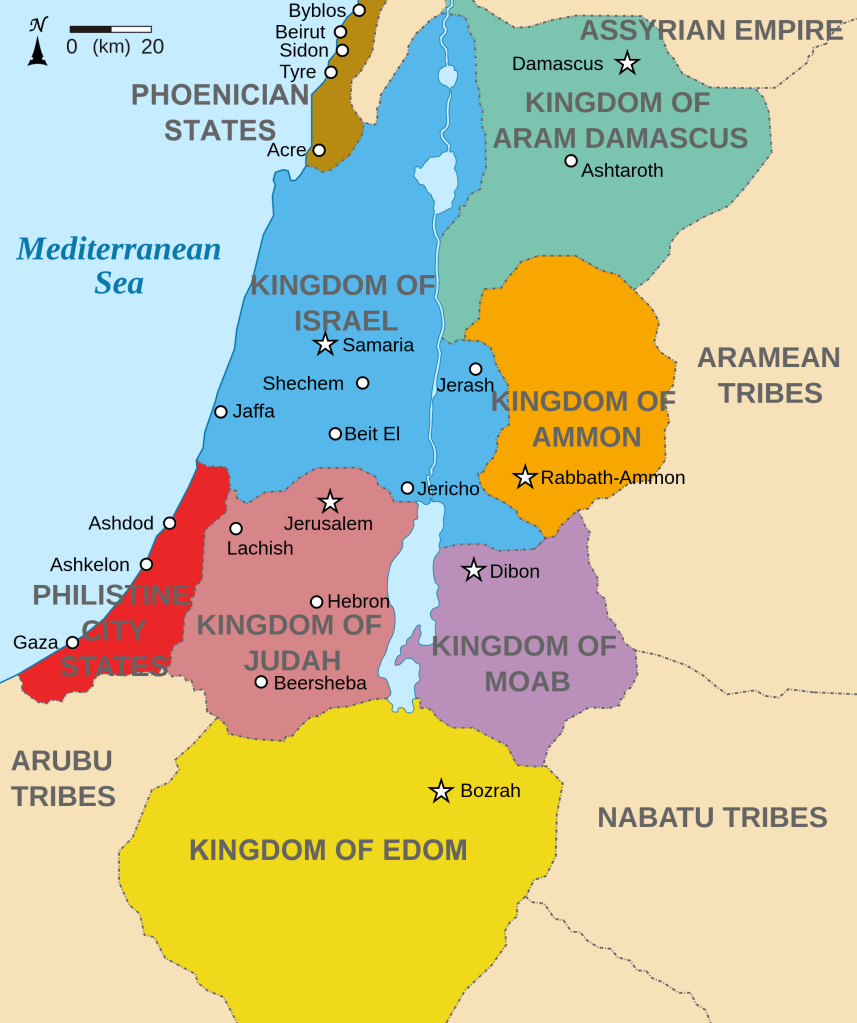
Here is a list of the kings of the land that Joshua and the Israelites conquered on the west side of the Jordan, from Baal Gad in the Valley of Lebanon to Mount Halak, which rises toward Seir. Joshua gave their lands as an inheritance to the tribes of Israel according to their tribal divisions. The lands included the hill country, the western foothills, the Arabah, the mountain slopes, the wilderness and the Negev. These were the lands of the Hittites, Amorites, Canaanites, Perizzites, Hivites and Jebusites. These were the kings:
the king of Jericho
the king of Ai (near Bethel)
the king of Jerusalem
the king of Hebron
the king of Jarmuth
the king of Lachish
the king of Eglon
the king of Gezer
the king of Debir
the king of Geder
the king of Hormah
the king of Arad
the king of Libnah
the king of Adullam
the king of Makkedah
the king of Bethel
the king of Tappuah
the king of Hepher
the king of Aphek
the king of Lasharon
the king of Madon
the king of Hazor
the king of Shimron Meron
the king of Akshaph
the king of Taanach
the king of Megiddo
the king of Kedesh
the king of Jokneam in Carmel
the king of Dor (in Naphoth Dor)
the king of Goyim in Gilgal
the king of Tirzah
thirty- kings in all.
Joshua 13 – Land Still to Be Taken
When Joshua had grown old, the Lord said to him, “You are now very old, and there are still very large areas of land to be taken over.
“This is the land that remains: all the regions of the Philistines and Geshurites, from the Shihor River on the east of Egypt to the territory of Ekron on the north, all of it counted as Canaanite though held by the five Philistine rulers in Gaza, Ashdod, Ashkelon, Gath and Ekron; the territory of the Avvites on the south; all the land of the Canaanites, from Arah of the Sidonians as far as Aphek and the border of the Amorites; the area of Byblos; and all Lebanon to the east, from Baal Gad below Mount Hermon to Lebo Hamath.
“As for all the inhabitants of the mountain regions from Lebanon to Misrephoth Maim, that is, all the Sidonians, I myself will drive them out before the Israelites. Be sure to allocate this land to Israel for an inheritance, as I have instructed you, and divide it as an inheritance among the nine tribes and half of the tribe of Manasseh.”
Here we find Gaza listed as being occupied by the Philistines. Back in Genesis 10:19, we read that Gaza was inhabited by the Canaanites. The dispute over who Gaza belongs to has been argued for since the years immediately following The Flood.
In subsequent chapters of the Book of Joshua, we find highly detailed lists of the towns, cities, and boundaries that were ascribed to each of the twelve tribes of Israel.
Sadly, through disobedience by the Israelite leaders who followed Joshua, they chose to forgo much of the land God had promised them.
In Judges, Chapter 2, we read,
Joshua son of Nun, the servant of the Lord, died at the age of a hundred and ten. And they buried him in the land of his inheritance, at Timnath Heres in the hill country of Ephraim, north of Mount Gaash.
After that whole generation had been gathered to their ancestors, another generation grew up who knew neither the Lord nor what he had done for Israel. Then the Israelites did evil in the eyes of the Lord and served the Baals. They forsook the Lord, the God of their ancestors, who had brought them out of Egypt. They followed and worshiped various gods of the peoples around them. They aroused the Lord’s anger because they forsook him and served Baal and the Ashtoreths. In his anger against Israel, the Lord gave them into the hands of raiders who plundered them. He sold them into the hands of their enemies all around, whom they were no longer able to resist. Whenever Israel went out to fight, the hand of the Lord was against them to defeat them, just as he had sworn to them. They were in great distress.
In the millenia that followed, to this present day, the people of Israel have swung between earnestly seeking and following God and committing evil in the eyes of The Lord.
In Isaiah, Chapter 66, God passes judgment on Israel.
They have chosen their own ways,
and they delight in their abominations;
so I also will choose harsh treatment for them
and will bring on them what they dread.
For when I called, no one answered,
when I spoke, no one listened.
They did evil in my sight
and chose what displeases me.”
But God is a God of promises – and He always keeps them. In the same chapter of Isaiah, God foretells how the nation of Israel will be reborn,
Who has ever heard of such things?
Who has ever seen things like this?
Can a country be born in a day
or a nation be brought forth in a moment?
Yet no sooner is Zion in labour
than she gives birth to her children.
This prophecy was fulfilled on May 14, 1948.
In 1947-1948 there was a civil war in Palestine.
The day after modern Israel’s establishment, on May 15, 1948, the civil war transformed into a conflict between Israel and the Arab states. This was the 1948 Arab–Israeli War.
Concerning Israel, you will note a recurring theme; each time they are attacked by the surrounding nations, they end up expanding their territorial borders. There is an age-old adage, “To the victor goes the spoils.” Under international law, when the aggressor nations lose territory it has no legal claim to the lands they lose.
Then came the 1949 Armistice Agreement between Israel and Egypt, Lebanon, Jordan, and Syria. They formally ended the hostilities of the 1948 Arab–Israeli War and also demarcated the Green Line, which separated Arab-controlled territory (i.e., the Jordanian-annexed West Bank and the Egyptian-occupied Gaza Strip) from Israel until the latter’s victory in the 1967 Arab–Israeli War.
Again, in 1967, a coalition of Arabic states attacked Israel (the belligerents included Egypt, Syria, Jordan, Iraq, Saudi Arabia and Kuwait). This was known as the Six-Day War. The outcome of this war saw Israel expand its borders to include Gaza, the West Bank, the Golan Heights, and the Sanai Peninsula.
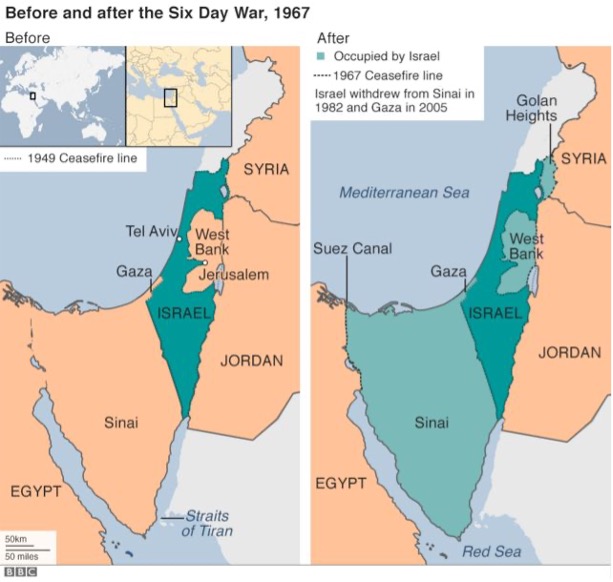
Egypt and Jordan agreed to a ceasefire on 8 June, and Syria on 9 June, and it was signed with Israel on 11 June. The Six-Day War resulted in more than 20,000 fatal Arab casualties, while Israel suffered fewer than 1,000 fatal casualties. Around 280,000 to 325,000 Palestinians and 100,000 Syrians fled or were expelled from the West Bank and the Golan Heights, respectively.
But true peace has eluded the nation of Israel. Aggression against Israel has included:
Palestinian Fedayeen insurgency (1950s–1960s)
Suez Crisis, War of Attrition (1967–1970)
Yom Kippur War (October 1973)
Palestinian insurgency in South Lebanon (1971–1982)
South Lebanon conflict (1985–2000)
First Intifada (1987–1993)
Second Intifada (2000–2005)
2006 Lebanon War (summer 2006)
Gaza War or Operation Cast Lead (December 2008 – January 2009)
2012 Israeli operation in the Gaza Strip
2014 Gaza War or Operation Protective Edge (July–August 2014)
Syrian Civil War and the Iran–Israel conflict during the Syrian civil war,
2021 Israel–Palestine crisis or Operation Guardian of the Walls (May 2021)
2023 Israel–Hamas war (October 2023- )
Some ask, “Is there a connection between the Philistines and the Palestinians?” The answer is, “No.” The Philistines and Palestinians are not the same people referred to in the Bible. The Philistines were an ancient people who lived in the coastal regions of present-day Israel and Palestine during the time of the Israelites. The Palestinians, on the other hand, are a modern people who have been inhabitants of the region for many centuries.
The name Palestine is not referenced anywhere in the Bible. The term “Palestine” first appeared in the 5th century BCE when the ancient Greek historian Herodotus wrote of a “district of Syria, called Palaistinê” between Phoenicia and Egypt.
In the early 2nd century AD, the term “Syria Palaestina” (literally, “Palestinian Syria”) was given to the Roman province of Judaea.
Following the Muslim conquest of Judea (634 – 638 A.D.), place names that were in use by the Byzantine administration generally continued to be used in Arabic.
If you thought the history of Palestine is complicated, “you aint see nothing yet!”
The Hashemite Kingdom of Jordan was officially established on May 25, 1946.
The Formation of Transjordan (Jordan): After World War I and the collapse of the Ottoman Empire, Britain took control of Palestine under the League of Nations mandate system. The territory east of the Jordan River was separated from the mandate and became known as Transjordan, which later became the Hashemite Kingdom of Jordan.
1948 Arab-Israeli War: Following the establishment of Israel in 1948, Jordan, along with other Arab states, entered the conflict. By the war’s end, Jordan had control of the West Bank and East Jerusalem, areas with significant Palestinian populations.
Jordan’s Annexation of the West Bank: In 1950, Jordan formally annexed the West Bank, incorporating a large Palestinian population. This decision was controversial and was not widely recognized internationally. Palestinians living in the West Bank became Jordanian citizens.
The Palestinian Liberation Organization (PLO): Founded in 1964, the PLO sought an independent Palestinian state and often clashed with the Jordanian government, which saw the organization as a threat to its rule over the West Bank.
Black September: In 1970, tensions between the PLO and the Jordanian government escalated into a civil conflict known as Black September. The Jordanian army eventually expelled the PLO’s armed forces from Jordan, and they relocated to Lebanon.
Disengagement from the West Bank: In 1988, King Hussein of Jordan renounced claims to the West Bank in favour of the PLO, relinquishing Jordan’s role in the territory and recognizing the PLO as the legitimate representative of the Palestinian people. This was partly a response to the First Intifada (Palestinian uprising) and the complexities of trying to manage the situation from Amman.
Palestinians in Jordan: Palestinians make up a significant portion of Jordan’s population, with estimates ranging from one-third to over half. While many Palestinians in Jordan have full citizenship rights, those who fled Gaza in 1967 (which was controlled by Egypt before the Six-Day War) often have more limited rights, given their refugee status.
Peace with Israel: In 1994, Jordan became the second Arab country (after Egypt) to sign a peace treaty with Israel. The agreement has occasionally been a source of tension, as many Palestinians demand the right to return to their ancestral homes.
Current Relations: Today, the relationship between Jordan and the Palestinians is multifaceted. While the Jordanian government supports the Palestinian right to statehood and often advocates for Palestinian rights at international forums, there are also internal concerns about the potential implications of a Palestinian state for Jordan’s stability.
What about Gaza? After the era of the Israelite kingdoms, Gaza was controlled by a succession of empires, including the Babylonians, Persians, Hellenistic dynasties (like the Ptolemies and Seleucids), Romans, Byzantines, Islamic Caliphates, Crusaders, Mamluks, and Ottomans.
In the 20th century, following the end of World War I, Gaza became part of the British Mandate of Palestine. After the 1948 Arab-Israeli War, Egypt administered the Gaza Strip but didn’t annex it formally. In the Six-Day War of 1967, Israel occupied the Gaza Strip. Israel then unilaterally disengaged from Gaza in 2005, evacuating all Israeli settlements, though it maintains control of its airspace, territorial waters, and several border crossings.
What is (or who are) Palestinian?
Over millennia, the region saw a succession of empires and peoples, including the Israelites, Egyptians, Assyrians, Babylonians, Persians, Greeks, Romans, Byzantines, and various Arab and Islamic empires. Each of these empires and groups left a mark on the region, and in many cases, settlers, soldiers, and administrators would have integrated into local populations.
The 7th century CE Arab-Muslim conquest of the region led to the Arabization and Islamization of much of the local population. Over time, many of the inhabitants adopted Arabic as their language and Islam as their primary religion, though significant Christian communities remained (and still exist today). The genetic makeup of Palestinians reflects this mixture of ancient populations with the various groups that migrated or conquered the region over millennia.
Over the past few centuries, Palestine saw migrations from various parts of the Arab world, including Egypt, Yemen, and the greater Levant. There were also migrations of Circassians, Kurds, and others. Some Jewish families in Palestine converted to Christianity or Islam over the centuries and assimilated into Palestinian society.
Unlike the Jewish populace, Palestinians cannot trace their ancestry back to a specific, identifiable people or nation.
WHAT ABOUT TODAY?
I refer you back to the list of hostilities against Modern Israel. The latest attack on Israel is the fifteenth since May 14, 1948.
Is there hope of a peaceful solution to the ongoing conflicts? Logically, no. As long as countries like Iran, and terrorist groups like Hezbollah and Hamas call for the complete annihilation of the Jewish people, there cannot be a resolution.
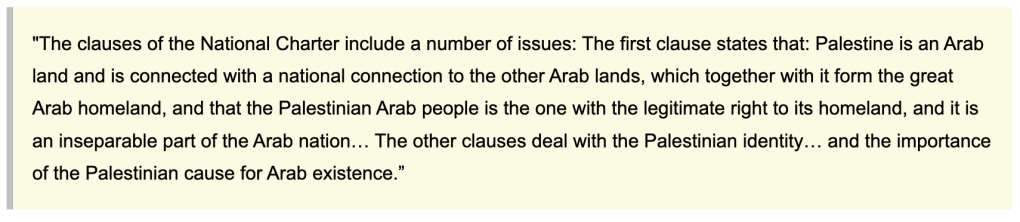
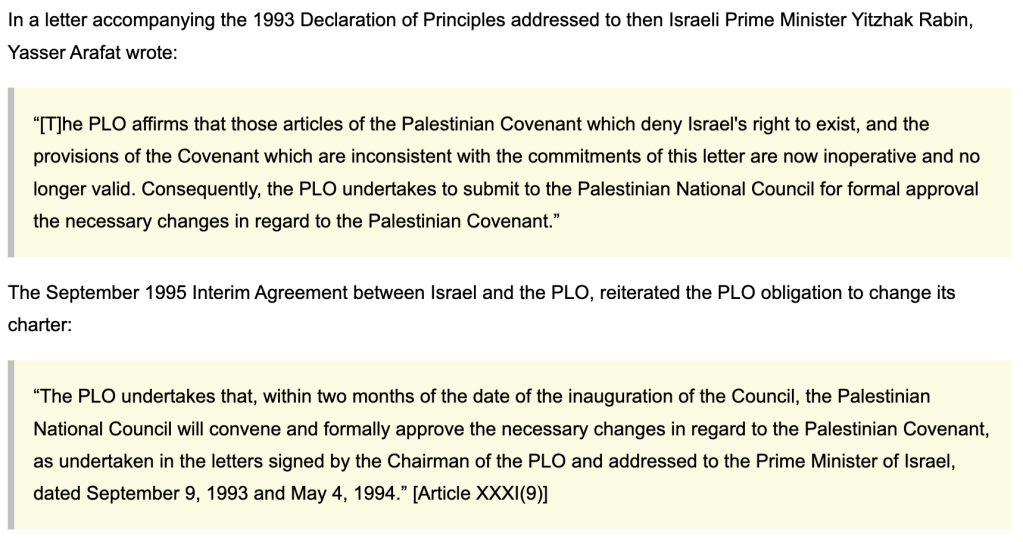
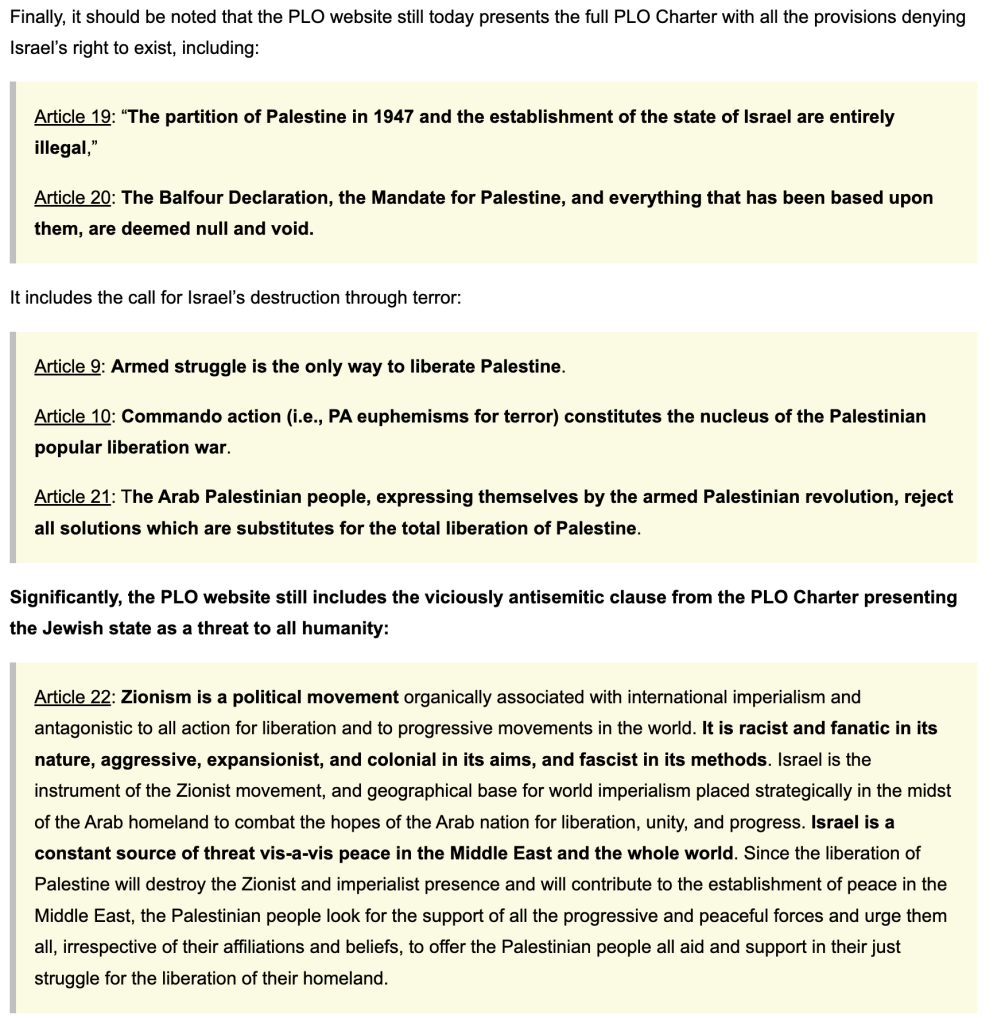
In the Palestinian Charter, we read:

The question that must be answered, based on the Word of God and the ancient history of the region, is who stole what from whom?
As you can see below, the possibility of a peaceful resolution, even with a so-called ‘Two State Solution’, is extremely remote.
 David's Thoughts