Author Archives: David's Thoughts

WHY OVERTAXING THE RICH IS A BAD IDEA – A PARABLE

Is this a fair statement?

I felt it was so important that people understand why a socially conservative approach to taxation is not only the fairest approach, but also the essential approach, that I am reproducing a feature article from the Globe and Mail by Tim Cestnick:

The nice thing about an election year that’s accompanied by federal budget surpluses is that it’s fertile ground for tax cuts – and both the Conservatives and Liberals have promised that tax savings are on the way. But who should really benefit from tax cuts? While it might not seem politically correct to suggest that the rich should get the lion’s share of tax breaks, let me share a story that I first shared many years ago that provides food for thought here.

The cost of dinner – A parable

Each and every day, 10 men go to a restaurant for dinner together. The bill for all 10 comes to $100 each day. If the bill were paid the way we pay our taxes, the first four would pay nothing; the fifth would pay $1; the sixth would pay $3; the seventh $7; the eighth $12; the ninth $18. The 10th man – the richest – would pay $59. Although the 10 men didn’t share the bill equally, they all seemed content enough with the arrangement – until the restaurant owner threw them a curve.

“You’re all very good customers,” the owner said, “so I’m going to reduce the cost of your daily meal by $20. I’m going to charge you just $80 in total.” The 10 men looked at each other and seemed genuinely surprised, but quite happy about the news.

The first four men, of course, are unaffected because they weren’t paying anything for their meals anyway. They’ll still eat for free. The big question is how to divvy up the $20 in savings among the remaining six in a way that’s fair for each of them. They realized that $20 divided by six is $3.33, but if they subtract that amount from each person’s share, then the fifth and sixth men would end up being paid to eat their meals. The restaurant owner suggested that it would be fair to reduce each person’s bill by roughly the same percentage, and he proceeded to work out the amounts that each should pay.

The results? The fifth man paid nothing, the sixth pitched in $2, the seventh paid $5, the eighth paid $9, the ninth paid $14, leaving the 10th man with a bill of $50 instead of $59. Outside the restaurant, the men began to compare their savings. “I only got one dollar out of the $20,” said the sixth man, pointing to the 10th man, “and he got $9!” “Yeah, that’s right,” exclaimed the fifth man. “I only saved a dollar, too! It’s not fair that he got nine times more than me!” “That’s true,” shouted the seventh man. “Why should he get back $9 when I only got $2? The rich get all the breaks!” “Wait a minute,” yelled the first four men in unison. “We didn’t get anything at all. The system exploits the poor!”

The nine outraged men surrounded the 10th and brutally assaulted him. The next day, he didn’t show up for dinner, so the nine sat down and ate without him. But when it came time to pay the bill, they faced a problem that they hadn’t faced before. They were $50 short.

The moral

There are a couple of lessons to be learned here. The first is an observation from my wife: If the 10 individuals had been women, they probably would have figured things out. But in all seriousness, I’m going to suggest that the approach taken by the restaurant owner in the story is exactly the right approach to divvying up tax cuts. It’s how our system should work. The people who pay the highest taxes should get the greatest relief from a tax cut, in absolute dollars.

The fact is, if you overtax the rich, they just might not show up for dinner next time. After all, there are plenty of good restaurants around the world.

This story is relevant today because both the Conservatives and the Liberals have proposed to cut taxes – in different ways. The Liberals have said that they would offer no tax cuts to the rich, but would instead increase the tax burden on the highest earners. The problem with this, of course, is that pushing any taxpayer’s marginal tax rate to 50 per cent or higher (which would be the case for many Canadians, particularly in provinces that also have taken steps to increase the marginal tax rate for the highest earners) will absolutely cause those folks to explore new ways to bring the tax burden down. And in the end, it may drive some to leave.

Tim Cestnick is managing director of Advanced Wealth Planning, Scotiabank Global Wealth Management, and founder of WaterStreet Family Offices.



Blatant Religious Discrimination: Quebec Bill 21 Bans Religious Symbols for Frontline Government Employees

Perhaps in response to Bill 21 all other Canadian provinces should ban Quebec MPs from entering their territories unless these MPs only communicate in English while in those territories.  Certainly, this is no more discriminatory than what the government of Quebec is proposing in their prohibition of individuals wearing religious icons while in the employ of the Quebec government.  Each province can use the Notwithstanding Clause to overrule the Official Languages of Canada section of the Charter to enforce this reactive discrimination.

As the Supreme Court of Canada has already noted, “the secular is the realm of competing belief systems… [including atheism and agnosticism].” per Justice Gonthier.  For those who have deeply held religious beliefs, the open display of certain icons or emblems are fundamental to, and inseparable from, their belief systems and to outlaw such icons or emblems while working in a government job is clearly a blatant form of discrimination.  The Quebec government is in fact saying, you cannot be a government employee because you are… Muslim, Sikh, Hindu, Jewish, etc. – pick one.  It is the most blatant form of government discrimination one can imagine.

Secularism means that governments should remain neutral on the matter of religion and should not enforce nor prohibit the free exercise of religion, leaving religious choice to the liberty of the people. 

One manifestation of secularism is asserting the right to be free from religious rule and teachings, or, in a state declared to be neutral on matters of belief, from the imposition by government of religion or religious practices upon its people.  This is not what is happening.  Obviously, if a Sikh removes his turban while at work, while it may violate his religiously held beliefs, it will not separate his Sikh-held beliefs from his interpretation of his working environment.  The same can be said for a Moslem woman being forced to remove her hijab, or a Jewish man forced to remove his kippah.

Canada is a democracy with a Charter of Rights and Freedoms.  The Charter reads in part: Everyone has the following fundamental freedoms: (a) freedom of conscience and religion [that is freedom of – not freedom from]; (b) freedom of thought, belief, opinion and expression, including freedom of the press and other media of communication;…”.

Canada is a nation founded of Christian principles and Judaeo-Christian law.  Indeed, the very first words written in the Canadian Charter are, “Whereas Canada is founded upon the principles that recognize the supremacy of God:”  According to Statistics Canada (2011 Census) persons who identified themselves as specifically atheist or agnostic were 0.11% and 0.14% respectively.  In the same census report 67% identified themselves as being Christian (all flavours) and 24% identified themselves as having no religious affiliation without expressing a belief in God one way or the other.

The Supreme Court has defined ‘The essence of the concept of the freedom of religion is: the right to declare religious beliefs openly and without fear of hindrance or reprisal; and the right to manifest religious belief by worship and practice or by teaching and dissemination.’  This is where the Quebec government is picking its fight.

Secularism is not the realm of unbelief.  In 2002, the Supreme Court of Canada (Chamberlain v. Surrey School District No. 36) clearly agreed that “secular principles” must include—and not exclude—religious believers, because the secular is the realm of competing belief systems and atheism and agnosticism are belief systems.  Justice Gonthier wrote 137 Re: assumption that “secular” effectively meant “non‐religious”. This is incorrect since nothing in the Charter, political or democratic theory, or a proper understanding of pluralism demands that atheistically based moral positions trump religiously based moral positions on matters of public policy. I note that the preamble to the Charter itself establishes that “. . . Canada is founded upon principles that recognize the supremacy of God and the rule of law”. According to the reasoning espoused by Saunders J., if one’s moral view manifests from a religiously grounded faith, it is not to be heard in the public square, but if it does not, then it is publicly acceptable. The problem with this approach is that everyone has “belief” or “faith” in something, be it atheistic, agnostic or religious. To construe the “secular” as the realm of the “unbelief” is therefore erroneous. Given this, why, then, should the religiously informed conscience be placed at a public disadvantage or disqualification? To do so would be to distort liberal principles in an illiberal fashion and would provide only a feeble notion of pluralism. The key is that people will disagree about important issues, and such disagreement, where it does not imperil community living, must be capable of being accommodated at the core of a modern pluralism.” 

**Also from the 2011 Census (other major religions): Buddhist 1.1%, Hindu 1.5%, Jewish 1.0%, Muslim 3.2% and Sikh 1.4%.

BLOG INDEX

POLITICAL POLARIZATION – WHY HAS IT BECOME SO EXTREME?

Polarization

A few years ago I was watching a television interview with a member of the new Trudeau government making the comment that they hoped there would be less partisanship and more cooperation in the next parliament.

I am a ‘social conservative’ and as such I foresee more partisanship, not less. “Why?” you ask. If I may be so bold, I suggest the answer lies with the left-leaning, liberal segments of society.

As a social conservative my viewpoint has for the most part been passed down from generation to generation. The basic principles of what I deem to be right and appropriate are no different from my father’s or grandfather’s generations. My sense of morality is based on absolutes rather than public or personal whim. My sense of a civilized society is based upon respect for public order and the inherent responsibility that each individual has to the common good. My sense of right and wrong are based on Judaeo-Christian principles that date back thousands of years.

Before someone throws in red-herring arguments, no, slavery is not acceptable to the social conservative.

A social conservative, who uses the Bible as his or her guide, has the privilege of being able to drive a stake in the ground to define a boundary beyond which he or she will strive not to venture.

A social liberal, on the other hand, has no such ideological point of reference; he or she will be swayed and motivated by personal or public opinion without the benefit of any [moral] constant (ref. footer).

Issues that would have been deemed socially and morally unacceptable by the majority of the Canadians just forty years ago are now promoted as ideals of modern liberalism; the demeaning of traditional marriage and family values, contempt for the sacred, sexual promiscuity, adultery, mass abortion, euthanasia, legalization of recreational drugs, celebration of homosexuality and transgenderism, rampant pornography, legalization of prostitution, and on the list goes. The logical end for the social liberal’s ideal is total hedonism* and/or anarchy** – “The only person in the world that matters is me and you have no right to impose your values and opinions on me.”

Meanwhile I doggedly try and point out how far society is straying from the stake in the ground which safely tethers me to a righteous morality – not a relative morality.

On this basis, I propose that it is the social liberals who are turning the polarizing filter. The further they turn the filter of liberalism the greater the degree of partisanship there will be.

Partisanship occurs when two parties move farther and farther away from each other. If the social conservative is firmly tethered to a stake in the ground, it must be the social liberal who is increasing the distance from that stake and correspondingly increasing the level of partisanship. I don’t see that it can be explained any other way.

*Hedonism: the ethical theory that pleasure (in the sense of the satisfaction of desires) is the highest good and proper aim of human life.

**Anarchy: a state of disorder due to absence or non-recognition of authority.

In a recent public online survey, more than 7,500 Canadians responded to the following multiple choice statement: “Morality is defined as the differentiation of intentions, decisions and actions between those that are ‘good’ (or right) and those that are ‘bad’ (or wrong). I believe morality is dictated by (check one):” A graph of their responses is shown below.

Morality

FACT CHECK… CLIMATE CHANGE AND GLOBAL WARMING – “97% OF SCIENTISTS AGREE” NO, THEY DON’T!!!

Screen+Shot+2019-01-21+at+3.09.17+PM.png

“You can fool some of the people all of the time, and all of the people some of the time, but you can’t fool all the people all of the time.”  Attributed to Abraham Lincoln.  I decided I don’t want to be in any of these three categories.  I am only interested in one thing, truth.

Theories abound when it comes to the topics of climate change and global warming.  Many are not knowledgeable enough to even distinguish between the two.  So much of what we hear from the politicians, the media, what read online, much of the [supposed] scientific community, the ‘tree-huggers’ and the ‘conspiracy theorists’ (deniers), etc. are falsehoods and distortions of fact, that it is almost impossible to know which side is up and what information can be trusted for us to form knowledgeable opinions.

If hard, physical, scientific evidence is irrefutable, why is disagreement on the topic so polarizing?  Are the disagreements valid?  Which [side] is right, the Climate Change Deniers or the Chicken Littles who run around shouting, “The sky is falling!”?  Perhaps the truth is hidden somewhere in between?

I watched an interesting video, Climate Science and the Myths of Renewable Energy by Steve Goreham.  Goreham made numerous statements concerning climate change, global warming and renewable energy in his video, so I decided to investigate each topic, one-by-one.

This blog/article endeavours to provide FACTS; not opinions, not theories, not speculation, just simple, verifiable facts; a SNOPES of climate change and global warming, if you will.  Individuals who read this article and find verifiable errors are invited to submit suggestions so corrections can be made where warranted, so this article will constantly be a work in progress. Attribution links are embedded. So, here we go…

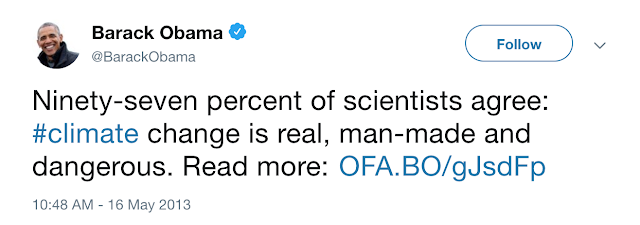
FACT CHECK No. 1  “Ninety-seven percent of scientists agree: climate change is real, man-made and dangerous.” President Barack Obama.

Screen+Shot+2019-01-21+at+12.49.47+PM.png

Is this an outrageous claim, or is there an ounce of truth?

The statistic to which Obama refers was obtained from an on-line survey conducted by Doran and Zimmerman in 2009. “An invitation to participate in the survey was sent to 10,257 Earth scientists. The database was built from Keane and Martinez [Directory of Geoscience Departments, 45th Edition, 2007] Two questions were asked:

  1. When compared with pre-1800s levels, do you think that mean global temperatures have generally risen, fallen, or remained relatively constant?

  2.  Do you think human activity is a significant contributing factor in changing mean global temperatures?”

The survey had a 30.7% response rate (90% of which were from the USA).  Of the 3,146 respondents 79 were climatologists (2.5% of respondents).  Of the climatologists,  96.2% (76 of 79) answered “risen” to question 1 and 97.4% (75 of 77) answered “yes” to question 2. No names are provided so the results are unverifiable.  This is where the “ninety-seven percent” statistic, referenced by Obama, comes from.

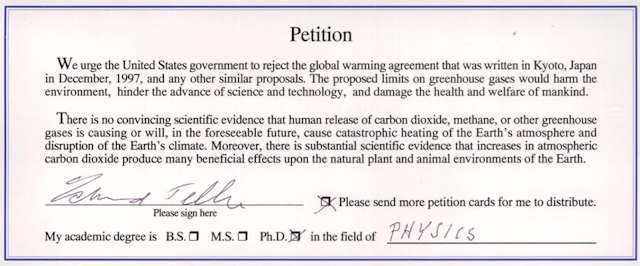
Compare this statistic to a 2007 mail-in petition organized by Frederick Seitz, Past President, National Academy of Sciences,U.S.A., President Emeritus, Rockefeller University, which 31,487 American scientists (all listed by name) responded and signed including 9,029 with PhDs.  100% of these scientists disagreed with Mr. Obama’s claim.

Screen+Shot+2019-01-21+at+1.48.21+PM.png

A summary scientific paper Environmental Effects of Increased Atmospheric Carbon Dioxide was mailed out with the petition request.

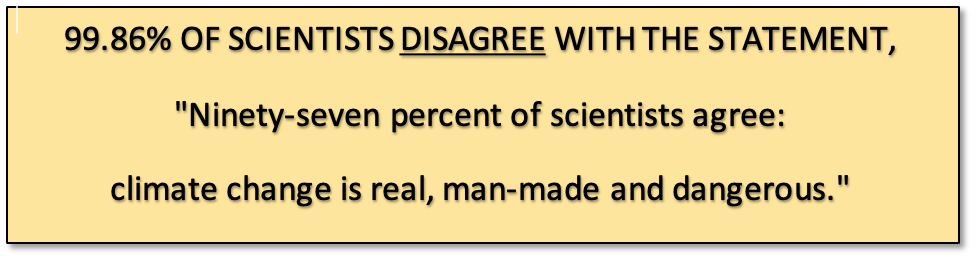
One of the biggest issues we face today is strategic manipulation of the facts. For example, for the illustration below I divided the number of scientists who signed the petition by the 76 climate scientists referenced by Barack Obama to arrive at this result.  The reality it is a meaningless number, just like the 97%.

03b20-screen2bshot2b2019-01-212bat2b5.15.142bpm

What do you think?

Disillusionment in the Ranks – The Church’s Sin of Silence

When was the last time you heard a message on the topic of morality? On the importance of keeping God’s laws?  On the importance of standing up against immoral, liberal theology?  On the importance of being intolerant towards the cry for tolerance of immorality?

The Liberal 2015 sex education program is a case in point.  As one reads the first chapter of Romans you would think Paul was addressing the provincial (and federal) legislatures this very day, “They exchanged the truth about God for a lie…”, “Even their women exchanged natural sexual relations for unnatural ones.  In the same way the men also abandoned natural relations with women and were inflamed with lust for one another. Men committed shameful acts with other men, and received in themselves the due penalty for their error.” and, “They have become filled with every kind of wickedness, evil, greed and depravity. They are full of envy, murder, strife, deceit and malice. They are gossips, slanderers, God-haters, insolent, arrogant and boastful; they invent ways of doing evil; they disobey their parents; they have no understanding, no fidelity, no love, no mercy. Although they know God’s righteous decree that those who do such things deserve death, they not only continue to do these very things but also approve of those who practice them.”


The Liberal sex-ed curriculum teaches that these ‘unnatural’, ‘shameful’ acts are the acceptable norm.  With very few exceptions, Tanya Granic Allen and her group Parents As First Educators (PAFE) being one of them, we don’t hear a beep from the evangelical church. The Moslem community puts the evangelical community to shame when it comes to standing up against those who condone immorality, ‘those who call evil good and good evil’ .  It seems the evangelical community is scared poopless of taking a public stand against that which God clearly calls evil for fear of being seen as intolerant and judgemental.


If there is any comfort to be found in all of this, it is to know that these things must happen and Christ’s return and judgement of evil-doers is imminent.  It is not for us, as Christians, to judge, that is Christ’s sole prerogative, but it is our job to call evil, evil.


To those who sell a soft-centered, lovey-dovey, tolerant Jesus, they would do well to read Revelation 14 where God says they, “…will drink the wine of God’s fury, which has been poured full strength into the cup of his wrath. They will be tormented with burning sulfur in the presence of the holy angels and of the Lamb. And the smoke of their torment will rise for ever and ever.” 

Why does God keep punishing me?

I recently finished a book, Encounters with Jesus, by Timothy Keller.  He wrote about things I knew [sort of] but he articulated them in such a way that it gave me much greater understanding and hope.  One of the topics Keller touched on was God’s justice and our fear of continual punishment.
Keller easily deflated our perception that God continues to punish us.  He pointed out that all our sins, past present, future, great and small, were laid on Jesus on the cross.  There is not a single sin, anywhere in all time and/or creation, that was not dealt with – punished on the cross.  Not a single one!  The big question is, have you acknowledged this and received God’s incredible gift of salvation?
Therefore, because of God’s perfect justice, it is impossible for God to continue to punish those of us who have acknowledged Christ’s sacrifice.  It would be unjust for God to punish us for something (sin, mistake, error, etc., deliberate or otherwise) that God has already punished Jesus for (including all our sins from this moment forward).  That would be to punish the same sin twice.  If God were to continue to punish us for a previously atoned for sin it would completely negate all of Christ’s sufferings. This is not possible!
We read the following in Colossians 1:22-23 NLT, “Yet now he has reconciled you to himself through the death of Christ in his physical body. As a result, he has brought you into his own presence, and you [insert your name here] are holy and blameless as you stand before him without a single fault.  But you must continue to believe this truth and stand firmly in it. Don’t drift away from the assurance you received when you heard the Good News.”
But this truth does not necessarily answer your question, “Why does it feel like God is punishing me?”  Jesus himself answers this question, naming satan, the great accuser.  In Revelation 12:10 NIV we read, “Then I heard a loud voice in heaven say: “Now have come the salvation and the power and the kingdom of our God, and the authority of his Messiah. For the accuser of our brothers and sisters, who accuses them before our God day and night, has been hurled down.”  In fact, Isaiah 50:8 NIV makes the following statement in this Messianic prophecy, “He who vindicates me is near. Who then will bring charges against me? Let us face each other! Who is my accuser? Let him confront me!”  Not only does God not repeatedly punish us for our sins over and over, our Saviour stands before God’s throne vindicating us!  How awesome is that!?
The original Hebrew term satan is a noun from a verb meaning primarily “to obstruct or oppose”, as it is found in Numbers 22:22, 1 Samuel 29:4, Psalms 109:6. Ha-Satan is traditionally translated as “the accuser” or “the adversary”.
If the above is true, and the Accuser shows up, as he will from time-to-time, and when we are at our lowest points, perhaps in a valley (he likes to try and kick us while we’re down), we have the perfect example of how to respond: “It is written: ‘Man shall not live on bread alone, but on every word that comes from the mouth of God.’ It is also written: ‘Do not put the Lord your God to the test.’ Away from me, Satan! For it is written: ‘Worship the Lord your God, and serve him only.’” You can also simply say, “In Jesus name, go away!”  “Then the devil left him” (Matthew 4:11).
If God is not punishing us, what about discipline?  God does discipline the ones He loves. In thinking on this we should consider: a. It is pointless to ‘discipline’ someone if they don’t know why they’re being disciplined. b. Discipline is a ‘corrective action’, it is there to provide a positive and beneficial outcome. c. God disciplines those He loves.  Whatever discipline God metes out – it will/must always be done in His divine and limitless love for us.
All this potentially leads to another question, “Why do bad things happen to me?”  This is a question for another time but meditate of this thought: What would life be like if ‘bad things’ never happened?  How would it affect your relationship with God?

Meditating on Scripture – Doing the legwork

Bible Gateway provides 55 different iterations on the full English Bible.  Some would say, See, the Bible has been changed, it cant be trusted!  The big secret that these sceptics dont know is that Gods Word is alive with meaning.  Through the intervention of the Holy Spirit, God will use a specific passage of Scripture, to speak to the believers heart, in many ways and for many different reasons.  These individuals would not understand the passion the translators and interpreters have for conveying the true meaning of the words and the heart of God.  They strive to listen to Gods voice not their own.
Having recently been challenged to continually trust God in trying times, I have been focusing on verses of Scripture such as Psalm 46:10, which 42 of the 55 translations reads, Be still, and know that I am God.  Many versions italicize the word, am to give it emphasis. A friend from our Bible Study group challenged me to understand the Hebrew meaning of this verse, all Hebrew families knew this verse like the back of their hands, but what they knew was the meaning. In Hebrew, the text of be still means to drop everything! This lead me to the exercise of looking at this verse through all the different translations on Bible Gateway. The results are below.  As always, it is good to read Scripture in context.
Psalm 46:10 21st Century King James Version (KJ21)- Full verse.
Be still, and know that I am God; I will be exalted among the heathen, I will be exalted on the earth.”
Psalm 46:10 Amplified Bible (AMP)
Be still and know (recognize, understand) that I am God.
Psalm 46:10 Christian Standard Bible (CSB)
Stop your fighting, and know that I am God,
Psalm 46:10 Common English Bible (CEB)
Thats enough! Now know that I am God!
Psalm 46:11 Complete Jewish Bible (CJB)
11 (10) Desist, and learn that I am God,
Psalm 46:10 Contemporary English Version (CEV)
Our God says, Calm down, and learn that I am God!
Psalm 46:10 Easy-to-Read Version (ERV)
God says, Stop fighting and know that I am God!
Psalm 46:10 GODS WORD Translation (GW)
Let go of your concerns! Then you will know that I am God.
Psalm 46:10 International Standard Version (ISV)
Be in awe and know that I am God.
Psalm 46:10 Living Bible (TLB)
Stand silent! Know that I am God!
Psalm 46:10 The Message (MSG)
Step out of the traffic! Take a long, loving look at me, your High God, above politics, above everything.
Psalm 46:10 Names of God Bible (NOG)
Let go of your concerns! Then you will know that I am Elohim.
Psalm 46:10 New English Translation (NET Bible)
He says, Stop your striving and recognize that I am God!
Psalm 46:10 New Life Version (NLV)
Be quiet and know that I am God.
Tehillim 46:10 Orthodox Jewish Bible (OJB)
10 (11) Be still, and know that I am Elohim:
Psalm 46:10 The Voice (VOICE)
Be still, be calm, see, and understand I am the True God.
Psalm 46:10 Wycliffe Bible (WYC)
Give ye attention, and see ye, that I am God;
Psalm 46:10 Young’s Literal Translation (YLT)
Desist, and know that I [am] God,

Can you forever change the way you read Scripture?

A SPIRITUAL EXERCISE
I was just lent Encounters with Jesus by Timothy Keller.  In the introduction, he tells of a life transforming attitude to meditating on Scripture.  His class was challenged to spend meditating on a single verse for 30-minutes and to “Write down at least thirty things you see or learn from the verse.”  Ten minutes into the exercise Keller was finished (or so he thought) and bored.  He dutifully pushed on and kept looking.  To his surprise there was more.   Virtually the whole class found their most penetrating and personally helpful insights came in the last 15-minutes of the exercise, none from the first 10-minutes.
Last night I read the following from Psalm 64:5 and decided it would be good to apply the same effort: “Let all that I am wait quietly before God, for my hope is in Him.” Fifteen words. I asked God for encouragement and insight.  For me, the exercise ended up taking 45-minutes and produced thirty-three thoughts, or revelations.  They are listed in the exact order I wrote them down.  Notice the progression.
“Let all that I am wait quietly before God, for my hope is in Him.”  
1. Let – I must allow myself to do these things.
2. Let – Do not put up obstacles that would hinder my intent and desire.
3. All – Hold nothing back.  If I hold anything back I am making room for self rather than God.
4. Let all that I am – My complete being; body mind and soul.
5. All those things that are ‘fleshly’, i.e. worry, doubt, fear, etc. are an impediment to my ‘waiting patiently’.
6.   Let all that I am wait… – This should be my continual posture.
7. If I am to have the correct posture I must not allow ‘noise’, the voice of the devil or worldly distractions to interrupt my quiet.
8. Where am I to do this waiting? Before God!  I need to wait in His presence.
9. I must not do my waiting cowered in a corner or wrap myself in a ball, hoping that my troubles will simply disappear.
10. Before God – What a privileged position!
11.Before God – I am making Him my refuge.
12. Let all that I am wait quietly before God – This reminds me of Psalm 46:10, “Be still and know that I am God.”
13. Waiting patiently before God means that I am looking to Him exclusively to bring about the desired outcome of whatever situation I find myself in – His will.
14. Waiting patiently infers that I am in no hurry.  Reminder to self: God’s timing is always perfect.
15. Waiting patiently is a deliberate denial of setting my own agenda.
16. For my hope is in Him – The reason for my ability to wait patiently.
17. My Hope – The thing that I look forward to.  Not a specific, self-dictated outcome, but a ‘God outcome’ – something greater and better than I could have hoped or imagined. See Ephesians 3:20
18. My hope is… – A statement of fact and confidence – not a ‘maybe’.
19. In Him – The place, the very heart of my confidence.  It is not to be found on the outside or anywhere else, only  inside, “in Him”.
20. Let all that I am – This is a prayer/petition in and of itself.  I am asking God to make this possible, to keep any distraction from this desired attitude at bay.
21. Quietly – A place of peace and solitude.
22. This verse should be my perpetual, submissive attitude before God; for my minute-by-minute needs, my daily needs and my lifelong needs.
23. This is a life transforming verse.  I am giving over my whole life to God, for His eternal purpose for my life – which is my hope.
24. My hope is in Him – This reminds me of Psalm 30:5 “but rejoicing comes in the morning.”
25. In Him – My joy, my purpose for being, my future is to be found nowhere else.
26. I need to be quiet in the presence of God.  Even as I write these thoughts, my mind is racing.  I need to learn to ‘Stop interrupting God.’
27. Is the good that God brings out of the struggles of the past few weeks specifically so that I may take this verse to heart?
28. My hope is in Him – Why? Because He loves me. Because He is faithful. Because He is gracious.
29. Although this verse is a ‘conversation with self’, it can be read as a promise.  God will give me patience, quietness, and hope.  It’s what He wants for me.
30. In Him – Certainty!
31. I am to live in a posture of hope.  It allows me to live in a world that seems to be falling apart, yet I am still stop and smell the roses, to take time to praise God for the beauty of His Creation – not letting worry steal my joy.
32. Sometimes we put up barriers between our head and our heart.  I can intellectually articulate all these ‘things’ [concepts and ideas], but am I willing to let them fully permeate my heart?
33. Psalm 62:5 does not give me permission to have a laissez faire attitude, ‘Don’t worry, God will take care of it.’ Rather, God is inviting us into a joint venture, a joint effort.  “My hope [my part] is in Him [His part]

May I encourage you to try this exercise for yourself?  Pick a verse…

On Tuesday Peter’s body died. Roll the stone aside! Part 2.

“Oh my, Oh, my goodness! Oh, wow!  Mom…? Dad…? Donna Jean!!! Uncle Harry, is that you?!  Oh, my! Oh, my goodness! Jesus!!! Oh, Sweet Lord! I’m really here! Thank you LORD! Thank you, thank you!”
Right now I’m trying to imagine what (my brother-in-law) Peter experienced sometime around 4:00am Tuesday morning.  As the Apostle Paul said, “That is what the Scriptures mean when they say, ‘No eye has seen, no ear has heard, and no mind has imagined what God has prepared for those who love him.’”  My focusing on Peter’s present and incomprehensible joy is a sweet distraction from my own present sadness.
Belief in God is a strange thing in many ways.  For the believing Christian, there is a certain knowledge that comes from an intimate relationship with God.  It is not a ‘hypothetical belief’ or experience, it is literal. The faith part of the relationship is simply the trust that God is all He says He is and will do all the things He says He will do.

About a year ago, after his diagnosis of brain cancer, I was walking along the road with Peter as we ventured to a local restaurant.  He suddenly broke into tears as the love of God momentarily overwhelmed him.  This was not a faith experience for Peter, this was God touching him at the very core of his being – a literal touch.

Yet, sometimes we doubt.  Is my experience unique? Are my thoughts and beliefs rational? What if I’m wrong?  I know Peter experienced similar thoughts at different times in his life.  It almost sounds like an illogical argument; sometimes we doubt, yet even in our darkest times when our doubts are greatest, we are still compelled to believe.  And then God comes alongside to reassure us.  I am His and He is mine and nothing in all Creation can separate us – He from me, or I from Him.

This past Saturday evening a group of us had the joy of listening to the Toronto Mass Choir in the magnificent sanctuary at Tyndale University.  It was a momentous expression of outrageous joy!  Seventy singers shouting and singing praises with all their being to the One to whom Peter and I have entrusted our lives and who gave His life for us.  No, my experience is not unique.  Thank you, God, for once again reassuring me in a moment of outrageous celebration!

Before God got ahold of me I thought belief in God was simply irrational.  Who would want to believe in a being that was supposedly untouchable and unknowable?  It simply did not make any sense.  Now, I view things from the other side of the curtain.  Now, I cannot comprehend why so many people choose to live ‘on the dark side’?  To me, now, living on the dark side is that which is completely irrational, when the God, who is love, invites us to experience the superlative joy of knowing Him. Forever!

For a while I will miss Peter, my older brother [in-law], BUT I can thank God for his life, for the brotherly friendship we knew and especially for the sure and certain knowledge that we will yet again embrace in the Throne Room of Heaven.