Category Archives: Uncategorized

Do You Want To Know How Old The Earth Is?

A presentation by John Lennox at Rice University.

Do you want to know how old the Earth is?

It’s quite a bit older than me.

So let’s have a look at this because it bothers many people, and I want to say, unnecessarily so.

I gave a speech at my old school two weeks ago, and my old school was founded by an archbishop and a mathematician.

The archbishop’s name was Usher, and he calculated the age of the earth. He wrote a famous letter to the Vice Chancellor of Cambridge University and he said [with Lennox’s poetic license], “Dear Sir, I have worked out that Adam was born at 9:00 a.m., on the 5th of October 4004 BC. I am sorry that I cannot give any more precise information than that.” And this has gone down in history as Archbishop Usher’s young Earth chronology.

I was standing beside his successor, who is the chairman of the governors of my school, and I turned to him and said, “Sir, Usher was a historian and so are you.” Now Usher is interesting because many people laugh at his calculation; what they don’t know is that both Newton and Kepler made an almost similar calculation at that time. We never hear of that. I said to the Archbishop, “Your Grace, I suspect you probably reckon the Earth and the universe are by seven orders of magnitude older than that. But, whatever the answer to the question is, we must not forget that he got one thing absolutely right and that is there was a creation.”

Now the most important thing about this is not when it happened, not even how it happened, but that it happened. And you know, it took centuries before people came to comprehend this.

I was at Cambridge in the ‘60s, not 1860s, the 1960s, when the first evidence, really strong evidence from the microwave background came in, that the universe was a finite age.

Do you know, and many people today don’t know that the scientific establishment resisted that concept fiercely. The chief editor of Nature, the world’s most famous scientific magazine at the time, a man called Maddox, said, “We shouldn’t go down this line, that there was a creation at a finite time in the past. It gives too much leverage to people, that believe in the Bible.” One of the most significant scientific discoveries of the 20th century was resisted because it paralleled what Scripture said.

Now come to the 21st century, and I was in a very prestigious gathering of physicists, and philosophers. I was the ‘token Christian’, and I was asked to say something about this. I got up and said something about creation.  I was heckled by a leading scientist who stopped me dead. He said, “Professor Lennox, stop! You are joking. I hope you’re joking. If you suggest the Bible has anything to say to us in the 21st century.”

Wow!

I said I wasn’t joking. In fact, I said, “It’s interesting, of course, that the Bible isn’t a textbook of science. I don’t teach algebra from Leviticus, and I never will. But, it does talk in certain places about exactly the same physical universe that scientists study.”

“In the beginning, God created the very heavens and earth that you study. And not only that, it’s got the idea, which is very new in terms of science, that Creation is finite backwards in time. There’s a huge mathematical work been done in this regard, and it is very convincing.”

“Now,” I said, “I’m going to make a suggestion. If you scientists had not been so wedded to Aristotle, and his eternal universe, you might just have looked more carefully to see if there was evidence of a finite age of the universe long before you did.”

And, of course, that was a pretty devastating thing to say, but it’s hugely important. It’s the fact of creation, that it is finite in time backwards.

Does the Bible say anything about that? No, of course not, but you can interpret the Bible as saying something about it.

So, I want to say something about this. You see if we were having this evening lecture 500 years ago, that question would not have been asked. Not once, let alone three times. But I tell you what question would have been asked three times? Somebody would have stood up and said, “Dr. Lennox, Dr. Tour, what are we to make about this crazy chap in Italy, claiming that the earth moves? When the Bible says it doesn’t. “The earth is fixed on pillars”, says the Psalms, “so that it should not be moved.” And this crazy chap is saying it does move. Help us to really get a grip of the fact that the earth doesn’t move.”

Just by a show of hands, how many of you, this audience, believe the earth doesn’t move against the background of the fixed stars?

Goodness, I thought I was in a place with some people who believe the Bible!

Now this is very interesting, you see. You do believe that the earth moves and yet the Bible says it doesn’t. How did this happen?

It happened because there was, first of all, Galileo, the first ‘moving earther’, and everybody else was a ‘fixed to earther’ – the philosophers, the Aristotelians, plus the Catholic Church. Then there were one or two more ‘moving earthers’, as they began to be convinced, and now the whole lot of you are ‘moving earthers’.

But you haven’t necessarily given up your conviction that the Bible is true. Why?

Because we can see that when the Bible speaks about the earth being fixed, it’s not talking about being geometrically or spatially fixed, it’s talking about something much deeper. And that is stability. The Bible refers to this; the harvester depends on fixed things.

The stability of the earth in its orbit, for example, depends on gas giants, the inverse square law of gravity, and everything else; and we’re happy with that. But for centuries it was difficult.

Now come with me if you can. It seems to me a very similar thing is happening with your question. You can believe if you want, that the Bible says the earth doesn’t move, you can believe it. But you don’t have to.

Now I want to argue, briefly, that you can believe that the earth is young, and the universe is young, but you don’t have to because the Bible doesn’t claim it.

Now let me try and establish that briefly.

In the beginning, God created the heavens and the earth, and then you have a sequence of days. Remember that? Six days. The seventh day is the day of rest.

Now here’s the interesting thing, in the Hebrew language, the first statement, “In the beginning”, or “the heavens and the earth” and “the earth was this and that”, is made in one Hebrew past tense. Then the tense changes to another past tense for the description of the days; you can establish that.

I asked, to be fair, the professor of Hebrew at Oxford and the Professor at Cambridge, and they agreed, amazingly. This is what it says, but what does that mean?

Well, Professor Jack Collins, who was a scientist and is now the chief translator for the English Standard Version of the Bible, which you may be aware of, says, I quote, “It means that the first statement occurs at an indefinite period before the second.”

What does the Bible say about the age of the universe and the earth? Absolutely nothing. So why fight about it, folks?

I meet people, not so many in the UK and Europe, but I do meet people who’ve been put off the gospel because they say there is a flat-out contradiction, but there isn’t in what the Bible says. There is only a contradiction between it and the dating given by cosmology these days, on the basis of certain interpretations of the Bible.

Now, I believe the Bible is the inspired word of God. I don’t believe that every interpretation of it is, and we have to separate between those two things. So, linguistically, it seems very clear that we cannot be dogmatic here.

Now there’s a lot more to be said, but people say look, the word [Hebrew word] ‘ha yom’[1] means a day at 24-hour day and that’s the finish of it.

You see, what I’ve just told you is quite subtle because it means that no matter what you think the days are, the universe isn’t young because its creation occurred an indefinite period before the days. So, the interpretation of days is not affected by the question of its age.

Now let’s come to the days. I’m amazed, frankly, that people don’t read this text. What’s the first mention of day in Genesis 1? “And God called the light day and the darkness he called night.” How long was that day? It certainly was not 24 hours. At the equator, how many hours is it? Twelve. [The earth did not yet exist] So, where does this insistence come from, that every time the Bible uses the word day, it’s 24 hours when the very first one isn’t?

Now let’s look at the second one, “And there was evening and morning, the first day.” That is usually taken to be, although there is some controversy about it, as the Hebrew way of saying, a normal 24-hour day. That’s the second meaning of ‘day’.

Now we come to the third meeting of ‘day’, “And God rested on the seventh day.” Have you noticed there’s no formula, “And there was evening and morning a seventh day.”? Why is that? Right from the early centuries of Christianity, and Jewish interpreters also, understood that to mean, that God is still resting from creating. When did God start creating again? He never did, so that Shabbat Day, the seventh day, is still going on! That’s a pretty long day, isn’t it? And it’s in the text.

So that’s three meanings for the word day.

Now we come to the fourth one. There are only one hundred words in this text. Chapter 2, verse four of Genesis says, “When God created the heavens and the earth…”, that’s what the English translation says. The Hebrew doesn’t. It says, “In the day God created.” What day was that? Tuesday or Thursday? No. You know as well as I do, you’ve heard people say, as they often say today, “Back in the day”. You know that expression? What day was that? Sunday or Wednesday? No. If I say to you, “In my younger days at Cambridge, you had to be back in your college at 10:00 at night.”, you would never say “What day was that?”, because my ‘younger days’ are an indefinite period of time in the past.

So, there are four meanings. For the same word in a text of 100 words. What does that tell me? “Be very careful.” But you need to be even more careful, because if you read most English translations, they say “the first day”, “the second day”. That’s not what the Hebrew text says. Hebrew has a definite article, “ha”.  “Ha yom”, the day, is not used for the first five.

Isn’t that interesting? The translators I’ve spoken to, professors of Hebrew, never noticed it. The definite article is only used on days six and seven, the 6th day, the 7th day. They’re special. the 6th day God created human beings in His image. On the 7th He rested. But actually, what it says is:

day one, (or, a first day)

day two, (or, a second day)

day three, (or, a third day)

day four, (or, a fourth day)

day five,  (or, a fifth day)

the sixth day,

the seventh day.

Now if you just had the text (as listed), what would you deduce logically? Well, you could say those are the six days of an ‘Earth week’. Are they? Necessarily? But suppose they were days of the sort that are of evenings and mornings, Day one, God created something, day two, God created something more. When is day two? How long after day one? The text doesn’t say. It’s a ‘creation day’. Day three?

So, you see the text itself, once you begin to think about it, opens up all kinds of possibilities. So I wouldn’t be too dogmatic about it. The thing to emphasize, though, is what these days are telling you, and it’s vitally important!

“And God said…” is repeated all the time.

This is a word-based universe that is the exact opposite of a random, unguided, evolutionary process, and it’s hugely important because this is the information age. Genesis, and John’s Gospel which packs it together in the brilliant statement, “In the beginning was the Word.”

The word is primary. The material universe is derivative.

“In the beginning was the Word.” That is, the Word already was. The Word, God, is eternal.

Now unfortunately the translators have not been strict enough. “All things were made by Him.” That is true, but it is not what it says. “All things came to be through Him.” It’s an existence statement. So, you’ve got the word which is primary and the material universe which is derivative. The basic naturalism, that we were being asked about earlier, is the exact opposite. The material universe is primary. Naturalists say that life, mind, and the idea of God, are derivative. There is no real God – the exact opposite.

And what is so important is this, that this information age we’ve come to know has come to the point where, in science, people recognize that information is, ‘a quantity irreducible to physics and chemistry’. And that’s hugely important. The Bible had seen that centuries ago. That’s one of the evidences to me, that although Scripture says very little about how God did it, it does enough to say it fits with everything we understand.

Several years ago I wrote a related blog: https://davidsthoughts.ca/2010/03/09/changing-paradigms-becoming-a-creationist/


[1] The Hebrew word יום (yom, Strong’s #3117) means a “day,” but not specifically a twenty-four hour period, but instead more generically like in “a day that something occurs.” An example would be “a day of the month” (Genesis 8:4), “in that day Yahweh made a covenant” (Genesis 15:18) and “until the day” (Genesis 19:37). This word can also refer to the light part of the day in contrast to night (see Genesis 1:5 and Exodus 13:21), but the related word יומם (yomam, Strong’s #3119) specifically means “daytime” as in Job 5:14. This word can be used for a time, age or season, but that is only when this word is in the plural form, which is ימים (yamim), and should simply be translated as “days” and not time, age or season, as this can lead to incorrect interpretations of the text. The word היום (hayom) is the word יום (yom) with the prefix ה (ha) added and it literally means “the day,” but we would translate it as “today.”

May I Ask You an Honest [COVID] Question?

A friend from church messaged me, “May I ask you an honest question?? I love that we can talk openly about such a Hot Topic. In your opinion, and/or the opinion of others around you that you talk with, why is it you feel so many aren’t getting the covid shot? I hate the divide and I’m trying to understand it.”

I thought these are two important questions to reason through, and because there is no single short answer to either of them, I decided to write this blog about it.

As I have already shared with my friend, I am a pragmatist by nature. I tend to look at life logically rather than emotionally. My friend, on the other hand, is a far more emotional individual – at least when it comes to expressing her personal heartache over the division between individuals that the COVID epidemic has caused.

There are times I wish I was more like my friend.

I will address my friend’s [implied] second question first.

We should be careful not to label simple disagreement as a division. I hope I have the freedom to disagree with any of my friends and not impair our friendship. Division occurs when differences become irreconcilable and the two parties are separated [divided] as a consequence.

There are numerous reasons individuals disagree. The cause, remedy, and response to COVID is no exception. Is there something that makes the COVID discussion different?

Obviously, your personal preference of wintertime over the summertime, or vice versa, does not directly impact me. Conversely, your opinions surrounding COVID, in as much as your opinions will likely translate into actions, I and others may be directly impacted.

The following is a list of three triggers, or ‘hot buttons’ (I anticipate that others can add to this list). The three primary triggers, as I see it, are fear, pride, and ignorance. It does not matter which side of the line you may stand, all three can apply equally and can contribute to divisions amongst us.

FEAR: This is probably the primary and most understandable trigger. You may be fearful of getting a COVID infection, you may be fearful of being hospitalized or dying from COVID, being in close proximity to an unvaccinated individual, of passing the infection onto others, you may be fearful of an adverse reaction to the vaccine(s), you may be fearful of how others might respond to your individual stance, etc. I do not believe anyone has the right to say you can’t be fearful. Fear is a self-preservation instinct. I might try and reason with you to allay your fears but, obviously, this would be an expression of care and concern – not condemnation. Dangerously, though, fear, expressed out of ignorance, leads to what we have come to know as conspiracy theories.

PRIDE: The ‘deadliest of all sins’. There is good pride and bad pride. The bad pride that leads to discord is, “a feeling that you are more important or better than other people”. Arrogance is a great synonym. “I am right and you are wrong, and it doesn’t matter what you say, regardless of contrary evidence, you will never convince me otherwise.” In other words, “I’m going to win this argument whatever the cost.”

IGNORANCE: Simply a lack of knowledge of the facts, or a mistaken understanding of the facts. It seems that, on the topic of COVID, mistaken understanding of the facts has become the division instigator, and pride fuels the fire.

I have observed that both sides of the COVID argument resort to the use of logical fallacies. An excellent example of a logical fallacy is the fallacy fallacy. One presumes that because a claim has been poorly argued, or a fallacy has been introduced, that the claim itself must be wrong. It is entirely possible to make a claim that is false and yet argue with logical coherency for that claim, just as it is possible to make a claim that is true and justify it with various fallacies and poor arguments. There are dozens and dozens of logical fallacies (news organizations, both liberal and conservative, are notorious for exploiting them). Logical fallacies are dangerous because we can be so easily deceived by them.

Adding to the complexity of the conversation are all the ‘impact points’… topics within the topic. To name just a few: politics, personal freedoms, vaccine effectiveness, vaccine approvals, infection rates, vaccine passports, lockdowns, vaccine mandates, source of vaccine materials, etc. Then, of course, one can throw in religion, the Constitution, the Charter… the list is seemingly endless.

Now, to answer my friend’s first question, “Why is it you feel so many aren’t getting the covid shot?”, I need to tread very carefully. I have no desire to offend. Perhaps it is easier to reword the question, “Why is it you feel so many have chosen to get vaccinated?” Surely, both questions are equally valid? The current ratio in Ontario, Canada is 86% vaccinated to 14% unvaccinated.

There are two main reasons for medical exemptions for COVID-19 vaccines: a severe allergic reaction to a vaccine ingredient and a risk of inflammation to the heart caused by the shot. These exemptions should be in the range of 1% to 5% of eligible vaccine candidates, so that still leaves 10% of the population (of Ontario) choosing not to be vaccinated for non-medical reasons. Why?

I’ll make it personal. Why did I get vaccinated?

I, like most people, was fearful of the COVID virus, observing how quickly it spread and the high level of fatalities (especially amongst the elderly) and watching the countless videos of the infected in ICUs and on ventilators. I just turned 70, so not yet ‘elderly’ but heading in that general direction. I was thankful that medical scientists and virologists around the world were able to produce a number of vaccines so quickly. After I received my first shot I was surprised at the level of relief I felt. I had my second shot as soon as I was allowed, and will be having my booster shot in the next few days.

Am I confused about the effectiveness of the vaccine(s)? No. Am I able to comprehend their expectations and limitations? Yes. I can look at the world around me and compare vaccination rates, infection rates, hospitalizations, and deaths as easily as anyone else. Do I trust the numbers governments in countries, states, and provinces around the world provide? Mostly, yes. I have no reason not to. Obviously, there are exceptions.

As an example, I can compare Mexico City (not the entire country) and Austria. Mexico City [a densely populated city of 22-million] with a population 2.45 times larger than that of Austria, has an adult immunization rate of 95% with a 7-day average of 390 infections (7 deaths per day). This week, Austria, with a vaccination rate of 64.8% had a 7-day average of 12,716 infections (42 deaths per day and climbing rapidly). Austria presently has an infection rate 80 times greater than Mexico City! This is but a single example (chosen because they were both in the news headlines this week). I would challenge anyone to rationally argue that vaccination rates and infection rates do not directly correlate to one another. Since early on in the vaccination program the medical scientists have been driving home the point that populations need to reach a 95% immunization rate to bring this epidemic under control. Who is happier now, Mexico City or Austria?

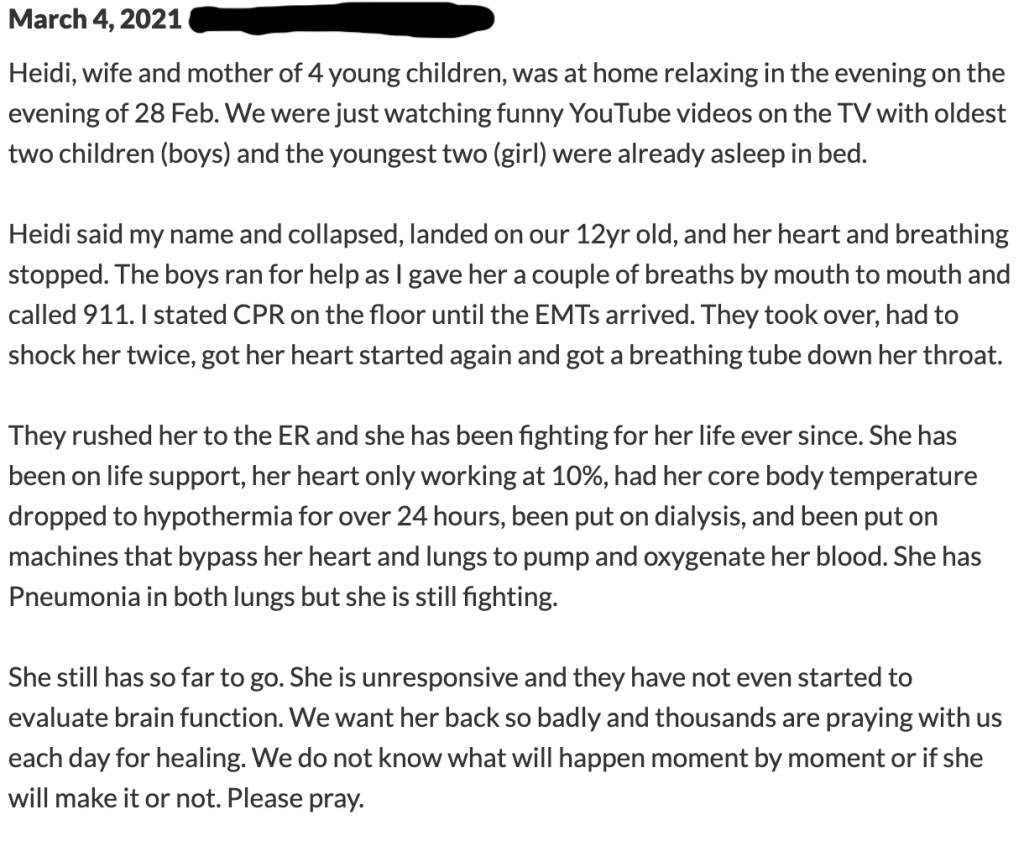
Hitting close to home… I have a friend in Scarborough, about my age. He and his wife contracted COVID days before they were eligible for their first vaccine shot. His wife died in hospital a few weeks later. We have a friend, a nursing specialist who worked on an isolation wing where bone marrow transplants are done. She contracted COVID from a parent visiting one of the children under her charge. For more than a week she had to sleep sitting up in a chair so that she could breathe. She was off work for six months recovering. We have a family friend in the US who contracted COVID, a young mother with four children. A few months later she collapsed and died from residual pneumonia from her COVID infection. Thankfully, she was brought back to life, placed on a heart-lung machine for many days, with hundreds of people around the world praying for her. Her kidneys took almost six months to resume normal function. Today she is again fit and well. A miracle.

I am but one person with such experiences to share. I am not an exception. As far as I am aware, every single person who ends up in a hospital ICU, or becomes chronically sick from COVID, has a change of mind and heart and becomes a vaccine advocate.

“Why is it you feel so many aren’t getting the covid shot?” I don’t know. I cannot logically comprehend it.

Truth, logic, understanding context, and pragmatism are all very important to me.

And so is emotion, especially that which comes from friendship.

Your friend, David

COVID-19 curves: Compare Canada and other key nations

The following link is to a CTV editorial first published April 3, 2020 (19 months ago) and updated today (November 20, 2021). I have included it because it is a good reminder of what we, and the rest of the world, have been going through. It also provides a range of interactive features that allow us to compare Canada’s (and our provinces’) performance to the rest of the world.


COVID-19 – CAN WE SUE OUR GOVERNMENT FOR INCOMPETENCE?

Screen Shot 2020-04-29 at 4.16.12 PM

Speaking as a Canadian, I have a significant beef with the current federal government and their so-called ‘experts’. It is my opinion that they have demonstrated complete incompetence from the earliest warnings that COVID-19 was an imminent threat to Canadians, and their totally inadequate response to it.

According to ABC News, “As far back as late November, U.S. intelligence officials were warning that a contagion was sweeping through China’s Wuhan region, changing the patterns of life and business and posing a threat to the population,”

“At the end of December, several weeks into a mysterious disease outbreak that was only starting to gain attention, an ophthalmologist in China’s central city of Wuhan sounded a stark warning. “A new coronavirus infection has been confirmed and its type is being identified. Inform all family and relatives to be on guard,” Li Wenliang typed into a chat group with his former medical school classmates on Dec. 30, 2019, according to Caixin, a Beijing-based media group. [But, alas, no freedom of speach in China.]  Soon, Li’s message would resonate much farther. As the spiralling crisis emerged, he came to be known as the whistleblower of a virus that ultimately took his life.”

In a Reuters’ report it was noted that Taiwan initiated screening passengers arriving from China by air on December 31, 2019, the same day they contacted the WHO for information on the virus breakout in China. “Health Minister Chen Shih-chung, sitting next to Chou, said Taiwan had fortunately decided that same day to begin screening passengers flying in from Wuhan, and activated its emergency operations center on Jan. 2, 2020 – a move experts say allowed Taiwan to effectively control the early spread of the virus.”
While Taiwan did send experts to China in January, they were not allowed to see any patients or to go to the market where the virus is believed to have originated, Chen said. That trip made Taiwanese officials realize they had to act quickly.
China confirmed human-to-human transmission on Jan. 20. The WHO said on Jan. 12 there was no clear evidence of human-to-human transmission.”

Because of Taiwan’s preparedness and the prompt implementation of their Emergency Response Plan (which included 124 discreet action items including travel restrictions), with a population of 23.78 million, as of today, they only have 429 confirmed cases (1 infection per 55,400 people) and 6 deaths (one death per 4 million people).

The glaring question that needs to be answered is, why didn’t the WHO (and Canada) follow Taiwan’s lead?  Is this not a case of astounding competence versus total incompetence?

On December 31, 2019 the WHO were first notified by China: “…the WHO China Country Office was informed of cases of pneumonia unknown etiology (unknown cause) detected in Wuhan City, Hubei Province of China. From 31 December 2019 through 3 January 2020, a total of 44 case-patients with pneumonia of unknown etiology were reported to WHO by the national authorities in China. During this reported period, the causal agent was not identified.”  The WHO issued their first Situation Report three weeks later, on January 21, 2020.

Politico wrote, “Without China’s deceit and WHO’s solicitude for Beijing, the outbreak might have been more limited, and the world at the very least would have had more time to react to the virus. China committed unforgivable sins of commission, affirmatively lying about the outbreak and punishing doctors and disappearing journalists who told the truth, whereas the WHO committed sins of omission—it lacked independence and courage at a moment of great consequence.”

“On Jan. 14, WHO tweeted that “preliminary investigations” by Chinese authorities had found no evidence of human-to-human transmission of the coronavirus. Several days later, it reported “limited” human-to-human transmission, although it downplayed the finding as typical of respiratory illnesses. So, the WHO endorsed China’s narrative during the crucial early days of its cover-up.”

On January 30, 2020 the WHO was still not recommending active screening of passengers from other countries.

Politico reported:  ‘Then, the WHO declined to call the outbreak in China a public health emergency of international concern on Jan. 22, at the same time there were confirmed cases in Taiwan, Australia, Japan, Thailand, and South Korea. After the WHO finally declared the emergency, it proceeded to drag its feet on declaring a pandemic, waiting until March 12.
Meanwhile, the WHO didn’t support restrictions on international travel. As a headline in Reuters put it in early February [February 3], “WHO chief says widespread travel bans not needed to beat China virus.”**
In effect, China and the WHO worked together to expose the rest of the world to the virus, at the same time they downplayed its dangers.’

**Interesting to note that COVID was referred to by the media as the “China virus.” in January, 2020 and nobody complained back then about racial bias.  Perhaps the US president was following their lead?

February 29, 2020 WHO continues to advise against the application of travel or trade restrictions to countries experiencing COVID-19 outbreaks.

CBC News reported, “At one of the recent daily ministerial media conferences, Health Minister Patty Hajdu said her first major briefing on the pandemic occurred in early January.

Canada’s Chief Medical Officer has been criticized for having tunnel-vision as a consequence of doggedly following WHO guidelines [even when clearly wrong], and where she serves as an advisor on the WHO Emergency Committee.

At a time when there were 17,238 confirmed infections in China including 361 deaths, as well as 151 confirmed cases in 23 countries, on February 3, 2020, World Health Organization chief Tedros Adhanom Ghebreyesus said  “…there was no need for measures that “unnecessarily interfere with international travel and trade”

March 18, 2020 the Government of Canada bars foreign nationals from all countries, except the U.S., from entering Canada via air travel.  On March 20, non-essential travel was banned between Canada and the USA .  Canada was still not implementing mandatory screening of passengers entering the country. Why did it take the Canadian government 50 days to follow Taiwan’s lead?

April 30, 2020, the WHO is recommending social distancing of only 3‘, “Maintain at least 1 metre (3 feet) distance between yourself and others.’

Now comes the question of what comes next?

This blog was initiated by the video presentation made by two California doctors.  In a matter of a few days the video had garnered well over 4-million views on YouTube.  It was then taken down for ‘breaching community guidelines’.  Then on April 27, 2020, without providing any specific evidence, the ACEP and AAEM released the following concerning the presentation made by the two doctors:

ACEP-AAEM Joint Statement on Physician Misinformation

The American College of Emergency Physicians (ACEP) and the American Academy of Emergency Medicine (AAEM) jointly and emphatically condemn the recent opinions released by Dr. Daniel Erickson and Dr. Artin Massihi. These reckless and untested musings do not speak for medical societies and are inconsistent with current science and epidemiology regarding COVID-19. As owners of local urgent care clinics, it appears these two individuals are releasing biased, non-peer reviewed data to advance their personal financial interests without regard for the public’s health.

COVID-19 misinformation is widespread and dangerous. Members of ACEP and AAEM are first-hand witnesses to the human toll that COVID-19 is taking on our communities. ACEP and AAEM strongly advise against using any statements of Drs. Erickson and Massihi as a basis for policy and decision making.

The controversial video can still be viewed on other sites.  The two doctors did make some errors in their presentation but much of what they said is grounded in reality.

Observations and investigation of ‘facts’:

  1. The doctors have been accused of ‘shoddy statistics and false claims’. Is this true?  From what I have seen, in the doctor’s use of statistics and their extrapolations, they have actually provided a worst-case scenario by applying the current results of COVID-19 testing and infection rates to all of California.
  2. Presently, 0.09% of Californians (33,865 out of a population of 39.5 million) have tested positive, leaving 99.91% of the population either uninfected or asymptomatic.
  3. We can never know the actual (total) rate of infection without testing 100% of the population or, at a minimum, testing a very large random sample of the population and the testing would only provide a snapshot at that moment in time. Extensive antibody testing would be the only way to accurately determine the total number of individuals who had been infected. So, it seems, even the ‘experts’ are guesstimating the status of COVID-19 around the world.
  4. We do know the death rate attributed to COVID-19, but only including comorbidities (significant underlying medical conditions), not without. Is this a critical failure in understanding the general impact of COVID-19?
  5. We can know the rate of hospitalization (although this is not currently publicized).
  6. Presently, in Canada, approximately 79% of new COVID deaths are within locations that care for the aged. Consequently, total deaths have doubled in the past three weeks.
  7. As a rule, of the general population, one in four Canadians will die in a nursing home, and of those, 70% will die in the nursing home, not a hospital.
  8. In a 2018 study of 690 participants, it was noted that the average life expectancy in a senior’s residence is 2.2 years, with a death rate of 31.8% per year.  In another study of 8,433 participants, 53% died within 6 months of nursing home admission.  Given such a high end-of-life fatality rate, what is the real impact of COVID-19 infections amongst residents of senior care facilities?  This needs to be quantified.  How do the numbers compare to common influenza outbreaks in nursing homes?
  9. The statement was made by the doctors: “COVID didn’t kill them, 25 years of tobacco use killed.” This is somewhat analogous to asking the question, ‘What killed the person, the shooter, the gun, or the bullet?’  Surely, the premeditation of the shooter was the cause of the killing.  In the same way, 25-years of smoking was the ‘premeditation’  and COVID was the bullet.  The two cannot be separated and yet COVID is almost exclusively reported as the cause of death.  Is this appropriate?
  10. The doctors talk at some length about isolation negatively impacting our immune systems. NASA research would seem to back up much of what they said.  Immune System Dysregulation During Spaceflight: “The immune system is highly sensitive to different types of stressors—psychological, physical, and local environmental (e.g., oxidative and radiation exposure). In healthy individuals, the flexibility and resilience of the immune system allow rapid recovery with little or no adverse effects. Yet, with high intensity and/or duration of extremes in environment, disrupted circadian rhythms, altered nutrition, and other factors that impact both physiological and psychological stress, adverse consequences to the immune system can occur (57). Environment, often considered as a combination of multiple “environmental exposures,” is defined as a “non-genetic” factor in the broad sense and is one of the three fundamental components of precision medicine: lifestyle, environment, and genetics (8). Autoimmunity, allergy, chronic infection, and other chronic diseases develop predominantly from a combination of environmental exposures with restrained genetic background influences.”
  11. The WHO states, “Worldwide, these annual [influenza] epidemics are estimated to result in about 3 to 5 million cases of severe illness, and about 290,000 to 650,000 respiratory deaths.” This extrapolates to a death rate of ‘serious’ incidents of 13%. The actual incidence of influenza is unknown and/or unreported.
  12. The WHO identifies the infection mortality rate for influenza, worldwide, is 0.1%. Referencing note 11., this would indicate that 1 case in 130 is severe, and from this, we can deduce that there are approximately 650 million cases of influenza each year, or 0.09% of the world’s population (which, coincidentally, is identical to the COVID infection rate quoted for California).
  13. The asymptomatic rate for influenza varies greatly from study to study, but the distillation of many studies would indicate a rate of 16%.
  14. The New England Journal of Medicine reports that the largest study concerning the asymptomatic rate for COVID-19, conducted thus far, has been in Iceland. In this study 13.3% of those tested were asymptomatic. They also noted that “The percentage of infected participants that was determined through population screening remained stable for the 20-day duration of screening.”
  15. Sweeping testing of the entire crew of the coronavirus-stricken U.S. aircraft carrier Theodore Roosevelt revealed and asymptomatic rate of 60%, but it should be noted that this is not a typical real-world environment.
  16. The global death rate from influenza types A and B is +/- 2% of all respiratory deaths, with 67% of these deaths being attributed to individuals 65 years or older.
  17. In the USA central reporting of deaths from influenza is not a requirement, so organizations such as the CDC can only guesstimate actual death rates. While it is reported that the death rate from influenza is 0.1% (or the refrain of COVID death rates being 10 times that of influenza) I could find no meaningful data to support these conclusions.
  18. Of critical importance to understand is the transmissibility of COVID. The New England Journal of Medicine notes, “What explains these differences in transmission and spread? A key factor in the transmissibility of Covid-19 is the high level of SARS-CoV-2 shedding in the upper respiratory tract,1even among pre-symptomatic patients, which distinguishes it from SARS-CoV-1, where replication occurs mainly in the lower respiratory tract.2Viral loads with SARS-CoV-1, which are associated with symptom onset, peak a median of 5 days later than viral loads with SARS-CoV-2, which makes symptom-based detection of infection more effective in the case of SARS CoV-1.3 With influenza, persons with asymptomatic disease generally have lower quantitative viral loads in secretions from the upper respiratory tract than from the lower respiratory tract and a shorter duration of viral shedding than persons with symptoms,4 which decreases the risk of transmission from pauci-symptomatic persons (i.e., those with few symptoms).”
  19. Artin Massihi, MD Artin Massihi is a Board Certified Emergency Room Physician. Emergency Physicians are qualified to diagnose, assess, and treat patients with acute trauma, illness and other life-threatening conditions. Dr Massihi has worked in level 1 as well as Level 2 trauma centers in many Emergency Rooms in the Los Angeles and Kern County regions. He received his undergraduate degree at the University of California at Irvine and attended Medical School at Loma Linda University. He then pursued internship training in General Surgery at the University of Southern California, and residency training in Emergency Medicine and Trauma at Kern Medical Center, an affiliate of the University of California at Los Angeles. Dr Massihi is also an Entrepreneur. He and his business partner Dr Daniel Erickson own the Accelerated Health Franchise, consisting of Accelerated Urgent Care, Accelerated Occupational Health and Accelerated Family Medicine. They have facilities throughout multiple cities and counties in the state of California. Dr Massihi is a fellow of the American Academy of Emergency Medicine and a proud member of the Armenian American Medical Society. He is also passionate about the Armenian Cause and helping those less fortunate globally.
  20. Daniel Erickson, DO is an emergency medicine specialist in Bakersfield, CA and has been practicing for 20 years. He graduated from Western Univ Of Health Sciences/College Of Osteopathic Medicine Of The Pacific, Western University Of Health Sciences in 2004 and specializes in emergency medicine.


What follows is a transcript of the presentation made by Dr. Erickson and Dr. Artin Massihi (it does not include the Q&As).

The transcript has been broken down into individual statements (given as fact), general questions and hypothetical questions.

Notes inserted [in red] were later clarifications or [corrected errors] in response to the Q&A session.

During the presentation Dr. Erickson and Dr. Massihi make 100+ statements, ask 18 general questions and 8 hypothetical questions:

“We’d like to look at how we’ve responded as a nation, and why you responded.

  1. Our first initial response two months ago was a little bit of fear: [the government] decided to shut down travel to and from China. These are good ideas when you don’t have any facts.
  2. [Governments] decided to keep people at home and isolate them. Typically, you quarantine the sick. When someone has measles, you quarantine them. We’ve never seen where we quarantine the healthy.

So that’s kind of how we started.

  1. We don’t know what’s going on, we see this new virus.

[QUESTION]: How should we respond?

  1. So, we did that initially, and over the last couple months we’ve gained a lot of data typically.
  2. We’re going to go over the numbers a little bit to kind of help you see how widespread COVID is and see how we should be responding to it based on its prevalence throughout society—or the existence of the cases that we already know about….
  3. So, if you look at California—these numbers are from yesterday—we have 33,865 COVID cases, out of a total of 280,900 total tested. That’s 12% of [those tested, as later clarified] Californians were positive for COVID.
  4. So, we don’t, the initial—as you guys know, the initial models were woefully inaccurate. They predicted millions of cases of death—not of prevalence or incidence—but death. That is not materializing.
  5. What is materializing is, in the state of California is 12% positives [of those tested, as later clarified].
  6. You have a 0.03 chance of dying from COVID in the state of California [based on 1,227 deaths, as later clarified, or 3 per 100,000 of the population].

HYPOTHETICAL QUESTION: Does that necessitate sheltering in place? Does that necessitate shutting down medical systems? Does that necessitate people being out of work?

  1. 96% of people in California who get COVID would recover [without intervention or hospitalization], with almost no significant sequelae; or no significant continuing medical problems. Two months ago, we didn’t know this.
  2. The more you test, the more positives you get. The prevalence number goes up, and the death rate stays the same. So [the death rate] gets smaller and smaller and smaller. And as we move through this data—what I want you to see is—millions of cases, small death. Millions of cases, small death.
  3. We extrapolate data, we test people, and then we extrapolate for the entire community based on the numbers.
  4. The initial models were so inaccurate they’re not even correct.
  5. And some of them [initial models] were based on social distancing and still predicted hundreds of thousands of deaths, which has been inaccurate.
  6. In New York the ones they tested they found 39% positive.

HYPOTHETICAL QUESTION: So, if they tested the whole state would we indeed have 7.5 million cases? We don’t know; we will never test the entire state.

  1. So, we extrapolate out; we use the data we have because it’s the most we have versus a predictive model that has been nowhere in the ballpark of accurate.
  2. How many deaths do they have? 19,410 out of 19 million people, which is a 0.01% chance [should be 0.1%, and is 10 times the national average] of dying from COVID in the state of New York.
  3. If you are indeed diagnosed with COVID-19, 92% of you will recover [without intervention or hospitalization].
  4. We’ve tested over 4 million… which gives us a 19.6% positive out of those who are tested for COVID-19.

HYPOTHETICAL STATEMENT: So, if this is a typical extrapolation [based upon test data] 328 million people times 19.6 is 64 million. That’s a significant amount of people with COVID; it’s similar to the flu. [US national COVID death rate is currently 0.0133% of the population]

  1. If you study the numbers in 2017 and 2018, we had 50 to 60 million with the flu. And we had a similar death rate in the deaths the United States were 43,545—similar to the flu of 2017-2018. We always have between 37,000 and 60,000 deaths in the United States, every single year. No pandemic talk. No shelter-in-place. No shutting down businesses…
  2. We do thousands of flu tests every year. We don’t report every one, because the flu is ubiquitous and to that note we have a flu vaccine.

[QUESTION:] How many people even get the flu vaccine?

  1. The flu is dangerous, it kills people. Just because you have a vaccine doesn’t mean it’s going to be everywhere, and it doesn’t mean everyone’s going to take it…

[HYPOTHETICAL] I would say probably 50% of the public doesn’t even want it. Just because you have a vaccine—unless you forced it on the public—doesn’t mean they’re going to take it.

  1. Norway has locked down; Sweden does not have lock down.

[QUESTION:] What happened in those two countries? Are they vastly different?

[QUESTION:] Did Sweden have a massive outbreak of cases?

[QUESTION:] Did Norway have nothing?

Let’s look at the numbers.

  1. Sweden has 15,322 cases of COVID—21% of all those tested came out positive for COVID. [April 29 20,302 cases and 2,462 deaths.]
  2. What’s the population of Sweden? About 10.4 million.
  3. So, if we extrapolate out the data about 2 million cases of COVID in Sweden. They did a little bit of social distancing; they would wear masks and separate; they went to schools; stores were open. They were almost about their normal daily life with a little bit of social distancing. They had how many deaths? 1,765.
  4. California’s had 1,220 with isolation.
  5. [Sweden] No isolation: 1,765. We have more people. Norway: its next-door neighbor. These are two Scandinavian nations; we can compare them as they are similar. 4.9% of all COVID tests were positive in Norway. Population of Norway: 5.4 million. So, if we extrapolate the data, as we’ve been doing, which is the best we can do at this point, they have about 1.3 million cases. Now their deaths as a total number, were 182. So, you have a 0.003 chance of death as a citizen of Norway and a 97% recovery. Their numbers are a little bit better. Does it necessitate shutdown, loss of jobs, destruction of the oil company, furloughing doctors? [April 29 7,660 cases and 206 deaths.]

[Note: % of population infected with COVID-19: Norway 0.14%, Sweden 0.19%.  Deaths (as percentage of those infected): Norway 2.7%, Sweden 12%.] 

I wanted to talk about the effects of COVID-19, the secondary effects.

  1. COVID-19 is one aspect of our health sector.

[QUESTION:] What has it caused to have us be involved in social isolation?

[QUESTION:] What does it cause that we are seeing the community respond to?

  1. Child molestation is increasing at a severe rate.
  2. We could go over multiple cases of children who have been molested due to angry family members who are intoxicated, who are home, who have no paycheck.
  3. Spousal abuse: we are seeing people coming in here with black eyes and cuts on their face. It’s an obvious abuse of case.
  4. These are things that will affect them for a lifetime, not for a season. Alcoholism, anxiety, depression, suicide. Suicide is spiking; education is dropped off; economic collapse.
  5. [In the] Medical industry we’re all suffering because our staff isn’t here, and we have no volume. We have clinics from Fresno to San Diego and these things are spiking in our community. These things will affect people for a lifetime, not for a season.
  6. I’d like to go over some basic things about how the immune system functions, so people have a good understanding.
  7. The immune system is built by exposure to antigens: viruses, bacteria.
  8. When you’re a little child crawling on the ground, putting stuff in your mouth, viruses and bacteria come in. You form an antigen antibody complex. You form IgG IgM. This is how your immune system is built.
  9. You don’t take a small child put them in bubble wrap in a room and say, “go have a healthy immune system.”
  10. This is immunology, microbiology 101.
  11. This is the basis of what we’ve known for years.
  12. When you take human beings and you say, “go into your house, clean all your counters—Lysol them down you’re going to kill 99% of viruses and bacteria; wear a mask; don’t go outside.”

[Question] What does it do to our immune system? [Reference Comment 10. above]

  1. Our immune system is used to touching.
  2. We share bacteria. Staphylococcus, streptococcal, bacteria, viruses.
  3. Sheltering in place decreases your immune system.

[HYPOTHETICAL QUESTION]: And then as we all come out of shelter in place with a lower immune system and start trading viruses, bacteria—what do you think is going to happen?

  1. Disease is going to spike.
  2. And then you’ve got diseases spike—amongst a hospital system with furloughed doctors and nurses.
  3. This is not the combination we want to set up for a healthy society. It doesn’t make any sense.

[HYPOTHETICAL QUESTION]: …Did we respond appropriately?

  1. Initially the response, fine shut it down, but as the data comes across—and we say now, wait a second, we’ve never, ever responded like this in the history of the country why are we doing this now?
  2. Any time you have something new in the community medical community it sparks fear—and I would have done what Dr. Fauci did—so we both would have initially.
  3. Because the first thing you do is, you want to make sure you limit liability—and deaths—and I think what they did was brilliant, initially.
  4. But you know, looking at theories and models—which is what these folks use—is very different than the way the actual virus presents itself throughout communities….
  5. Nobody talks about the fact that coronavirus lives on plastics for three days and we’re all sheltering in place. Where’d you get your water bottles from? Costco. Where did you get that plastic shovel from? Home Depot.
  6. If I swab things in your home, I would likely find COVID-19.
  7. And so, you think you’re protected.

[QUESTION:] Do you see the lack of consistency here?

[QUESTION:] Do you think you’re protected from COVID when you wear gloves that transfer disease everywhere?

  1. Those gloves have bacteria all over them.
  2. We wear masks in an acute setting to protect us.

[QUESTION]: We’re not wearing masks. Why is that? Because we understand microbiology; we understand immunology; and we want strong immune systems.

  1. I don’t want to hide in my home, develop a weak immune system, and then come out and get disease.
  2. When someone dies in this country right now, they’re not talking about the high blood pressure, the diabetes, the stroke. They say they died from COVID.
  3. We’ve been to hundreds of autopsies. You don’t talk about one thing; you talk about comorbidities.
  4. COVID was part of it, it is not the reason they died folks.
  5. When I’m writing up my death report, I’m being pressured to add COVID.

[QUESTION]: Why is that? Why are we being pressured to add COVID?

[HYPOTHETICAL QUESTION]: To maybe increase the numbers, and make it look a little bit worse than it is?

  1. We’re being pressured in-house to add COVID to the diagnostic list when we think it has nothing to do with the actual cause of death.
  2. The actual cause of death was not COVID, but it’s being reported as one of the disease processes and being added to the death list. COVID didn’t kill them, 25 years of tobacco use killed.
  3. There’s two ways to get rid of virus: either burns itself out or herd immunity.
  4. For hundreds of years we relied on herd immunity.
  5. Viruses kill people, end of story.
  6. The flu kills people.
  7. COVID kills people.
  8. But for the rest of us we develop herd immunity.
  9. We developed the ability to take this virus in and defeat it and for the vast majority 95% of those around the globe.

[HYPOTHETICAL QUESTION]: Do you want your immune system built or do you want it not built? [Reference comment 10. above]

  1. The building blocks of your immune system is a virus and bacteria.
  2. There are normal bacteria in normal flora that we have to be exposed to bacteria and viruses that are not virulent are our friends. They protect us against bad bacteria and bad viruses.
  3. Right now, if you look at Dr. Erikson’s skin or my skin, we have strep, we have stuff—they protect us against opportunistic infections.
  4. That’s why for the first three to six months [babies are] extremely vulnerable to opportunistic infection.
  5. Which is why, when we see a little baby in the ER with fever who is one month old, you do a spinal tap, you do a chest x-ray, you do blood cultures, you do urine cultures.
  6. But if you [adults] had a fever I wouldn’t do that for you.
  7. Why? Because that baby does not have the normal bacteria and flora from the community, whereas you do.
  8. I guarantee when we reopen there’s going to be a huge, huge amount of illness that’s going to be rampant because our immune systems have weakened. That’s just basic immunology.

[QUESTION]: Do we need to still shelter in place?

  1. Our answer is emphatically no.

[QUESTION]: Do we need businesses to be shut down?

  1. Emphatically no.

[QUESTION]: Do we need to have it, do we need to test them, and get them back to work?

  1. Yes, we do.
  2. The secondary effects that we went over—the child abuse, alcoholism, loss of revenue—all these are, in our opinion, a significantly more detrimental thing to society than a virus that has proven similar in nature to the seasonal flu we have every year.
  3. We also need to put measures in place so economic shutdown like this does not happen again.
  4. We want to make sure we understand that quarantining the sick is what we do, not quarantine the healthy.
  5. We need to make sure if you’re going to dance on someone’s constitutional rights you better have a good reason.
  6. You better have a really good scientific reason, and not just theory.
  7. One of the most important things is we need our hospitals back up.
  8. We need our furloughed doctors back.
  9. We need our nurses back.
  10. Because when we lift this thing, we’re going to need all hands on deck.
  11. I know the local hospitals have closed two floors.
  12. Folks, that’s not the situation you want.
  13. We’re essentially setting ourselves up to have minimal staff, and we’re going to have significant disease. That’s the wrong combination.
  14. I’ve talked to our local head of the Health Department and he’s waiting… for the powers that be to lift. Because the data is showing its time to lift.
  15. I would start slowly [open up schools sporting events] I think we need to open up the schools start getting kids back to the immune system you know and the major events the sporting events these are non-essential let’s get back to those slowly let’s start with schools let’s start with cafe Rio and the pizza place here…

[QUESTION]: Does that make sense to you guys and I think I can go into Costco and I can shop with people and there’s probably a couple hundred people, but I can’t go in Cafe Rio so big businesses are open little businesses are not….

  1. Eventually we treat this like we treat flu. Which is if you have the flu and you’re feeling fever and body aches you just stay home if you have coughing or shortness of breath—COVID is more of a respiratory thing—you stay home.
  2. You don’t get tested, even when people come with flu a lot of times, we don’t test them. We go, “you have flu. Here’s a medication.” You have COVID, go home, let it resolve and come back negative.
  3. If you have no symptoms you should be able to return to work.

[QUESTION]: Are you an asymptomatic viral spreader?

  1. Maybe, but we can’t test all of humanity.
  2. Sure, we’re going to miss cases of coronavirus, just like we miss cases of the flu.
  3. It would be nice to capture every coronavirus patient, but is that realistic?

[QUESTION]: Are we going to keep the economy shut down for two years and vaccinate everybody?

  1. That’s an unrealistic expectation.
  2. You’re going to cause financial ruin, domestic violence, suicide, rape, violence and what are you going to get out of it?
  3. You’re still going to miss a lot of cases.
  4. So, we need to treat this like the flu, which is familiar, and eventually this will mutate and become less and less virulent…
  5. I don’t need a double-blind clinically controlled trial to tell me if sheltering in place is appropriate, that is a college-level understanding of microbiology.
  6. A lot of times in medicine you have to make you have to make educated decisions with the data that you have.
  7. I can sit up in the 47th-floor in the penthouse and say we should do this, this, and this, but I haven’t seen a patient for 20 years—that’s not realistic.
  8. If you’re healthy and you don’t have significant comorbidities and you know you’re not immunodeficient and you’re not elderly, you should be able to go out without any gloves and without a mask.
  9. If you are those things you should either shelter in place or wear a mask and gloves.
  10. I don’t think everybody needs to wear the masks and gloves because it reduces your bacterial flora… and your bacterial flora and your viruses your friends that protect you from other diseases [if they] end up going away and now you’re more likely to get opportunistic infections that are hoping you don’t have your good bugs fighting for you.


Are Atheism and Religion the Ultimate Forms of Arrogance?

coexist

In these days of social media news cycles, one needs a dramatic headline if one is to have any hope of the story being read.  It is my hope that this headline will do more than just grab your attention, I hope it will cause you to consider what you believe and why you believe it.

One of the meanings of the word ultimate is ‘the most extreme of its kind’. The word ‘arrogance’ is described as ‘an attitude of superiority manifested in an overbearing manner or in presumptuous claims or assumptions’.  Are my choice of words correct, or even fair?

I am writing from the perspective of one who knows God.  I, like billions of other Christians, enjoy (or enjoyed in past millennia) a personal relationship with God.  This is not just a head-knowledge, an observed reality, an emotional relationship, or a divine revelation, no, it is all four!  Do we know everything there is to know about God?  Absolutely not.  The more God reveals Himself to those of us who have trusted Jesus Christ as their Saviour, the more each of us realizes how impossible it is to comprehend the infinite majesty of the Creator of all that exists.  That He would even choose to extend His grace to us is beyond comprehension, but accept it we have.  This is what differentiates Christianity from all other religions.

If religion is summarized as a set of beliefs that result in “the service and worship of God or the supernatural.” then this definition is quite contrary to the relational focus that is emphasized by the God of the Bible. Some religions state that it is categorically impossible to ‘know God’ personally; atheism, Islam, Jehovah’s Witnesses, to name a few.  James, the brother of Jesus, described religion this way, “Religion that God our Father accepts as pure and faultless is this: to look after orphans and widows in their distress and to keep oneself from being polluted by the world.”  James 1:27, but this pure form of religion is distilled from one’s intimacy with God, not as a sense of duty to a supreme deity, or simple goodwill towards one’s fellow man, rather it is a response of gratitude to being the recipient of God’s grace, an attitude of extreme thankfulness.

According to Adherents, an independent, non-religiously affiliated organization that monitors the number and size of the world’s religions, there are some 4,300 religions (22 major religions) of the world.  Can all the religions and atheism possibly be wrong?  You might even challenge me and ask, is it not the ‘Ultimate Arrogance’ to infer that they are and that Christianity lays hold to absolute truth?  And why would I not refer to Christianity as a religion?  A major tenet of atheism is that Christianity and other religions are delusions, there is no god. Could they possibly be right, or is this a presumptuous claim?

I tend to be a pragmatist by nature.  I like to look at things logically, setting emotion aside, to draw an eventual conclusion. Years ago I used to own an audiovisual company and we installed sophisticated remote control systems.  When we programmed these systems we first created a ‘truth table’, a simple logic program.  Below is an example of a very simple logic program.

computational_logic_flow_chart.png

Logic relies on absolute truths.  In this example, the question is, ‘Is today a weekend?’  Logic requires yes and no binary answers.  In computer programs, YES is defined by the numeric value, 1, and NO by the numeric value, 0.  The question was not, ‘Do I feel like today is a weekend?’, which may invoke a relative/emotional response depending on whom you ask and when you ask them.

Truth is always an absolute, YES/NO, 1/0, TRUE/FALSE condition.  Logically, something cannot be true and false at the same time.  The statement, “Today is a weekend” (assuming it is a weekend) is an absolute truth.  The statement, “I feel like today is a weekend” is a relative truth.  A relative truth can be absolutely true (I feel like today is a weekend and it is a weekend) and relatively true (I feel like it is a weekend even though it is a Wednesday) at the same time, but a relative truth can never change the state of an absolute truth.

It is self-evident that truth exists.  What’s the alternative? If truth doesn’t exist, then it would be true to say that truth doesn’t exist, and once again we arrive at truth.  There is no alternative; truth must exist.

Several years ago a friend at church shared his testimony of how he came to believe in God and, subsequently, become a Christian.  Peter shared how he had evaluated atheism and the major world religions and came to the “logical conclusion” that God existed and that the God of the Bible had to be the one true God. Once he reached this conclusion he had to make some logical choices that also involved a great deal of emotion.

Jesus claimed, “I am.. the truth.” John 14:6.  In making this statement He was inferring a number of exclusive, factual claims that are elaborated throughout the Bible:

  1. Whatever He says is truthful and can be validated as truthful – He is never wrong or contradictory;
  2. All religions that fail to acknowledge the essence of who Jesus is are false [untruthful] belief systems;
  3. There is only one true God and He is the God of the Bible;
  4. The Bible is the revealed Word of God and can be implicitly trusted;
  5. No one has a valid excuse [reason] for not knowing God;
  6. Anyone who earnestly seeks God, “with all your heart and soul” is guaranteed to find Him;
  7. The pre-incarnate Jesus exists outside of time.

When an atheist denies the existence of God, he, or she, is not thinking or reasoning rationally. Their god is science, often interpreted theoretically and selectively.  Since God is Spirit and His existence cannot be proven by the scientific method [this is actually a falsehood – see references to the Law of Large Numbers], they choose to believe that He does not exist. It is as though they are looking down a microscope and refusing to believe what they see.  Truthful, sincere scientists will explore all options in determining the facts, they will not leave out critical evidence just because it does not fit their paradigm.  Further, atheists will use the evidence of the spiritual/moralistic realm, specifically the existence of evil, as an argument to deny the existence of God (or any supreme being).  The following is one of their ‘false logic’ charts that can be found at ThinkAtheist.com.  Their starting premise is that ‘Evil Exists’ (an absolute truth?).  The chart then presents five YES/NO, 1/0, TRUE FALSE questions: Can God prevent evil? Does God know about all the evil? Does God want to prevent evil? Why is there evil? And, Could have God created a universe without evil?  The chart’s creator also asks, two additional questions: Then why didn’t He [create a universe without evil]? And, Could God have created a universe with free will but without evil?

AQuickandEasyGuidetoGod.Yourthoughts.png

The problem with this kind of reasoning is that the chart, and others like it, contains ‘logic statements’ that are in themselves false. False logic in = False logic out.

The first statement is EVIL EXISTS.  In making such a statement, an equally valid statement, GOOD EXISTS, is missing.  If we were using programming logic we would be using an AND gate (evil AND good exist).  So, what distinguishes evil from good, or good from evil?  Try answering the following questions: Is cold the opposite of heat, or is cold the absence of heat? Is evil the opposite of good, or is evil the absence of good? 

Scientifically, there is no such thing as cold, only heat which has an absolute bottom limit of -273.15 degrees Celcius.  Any number above absolute zero means the object must generate a certain amount of heat.  Until one reaches this bottom limit, an object can be colder than another and yet both objects contain some heat.  Until one reaches absolute zero, cold is completely subjective. 

Conversely, in the Bible, good has an upper limit but no lower limit. Man’s depravity clearly shows that there is no lower limit to evil.  But,  Jesus said, “Greater love [good] has no one than this: to lay down one’s life for one’s friends.”  God, in the person of Jesus Christ, demonstrated this ultimate good, this ‘upper limit’ by laying down His life for the sake of mankind (you and me).  Somewhere along the line of morality (the determination of good and evil), one crosses from good, through the neutral line (of an action being neither good nor bad), into the realm of bad, or evil.

Consider this: if there is a moral law then logically there must be a Moral Law Giver, an entity that is able to judge, without discrimination or partiality, between good and evil, and have the ability to impart this Moral Law to us.  If there is no Moral Law Giver then morality is a relativistic construct of man’s imagination and it has no means to establish a distinction between good and evil. For example, one person may argue that abortion is inherently evil and another argues that abortion is a woman’s right to choose and therefore inherently good.  Without an absolute moral law, both of these moral concepts can change on a whim.  If this argument for a relativistic moral law is taken to its logical conclusion, one could make the statement ‘There is no such thing as evil.’ and be logically correct.  A constant Moral Law dictates that there must be a Moral Law Giver and, in order to dispense perfect justice without discrimination that a Moral Law requires, that Moral Law Giver must be God.  If there is no [need for] consequential justice then morality serves no ultimate purpose.

If the chart’s creator had started with the question, DOES GOOD EXIST, then his line of questioning would have had to take a completely different line of reasoning and he would have logically found himself coming to the opposite conclusion.

Morality is just one of many topics that need to be looked at logically [scientifically] when one investigates the reality of God.  The absolute accuracy of biblical prophecy and the concept of evolution both collide with the mathematical limits of chance, that is the Law of Large Numbers.  Further, a prophecy of any kind (accurately foretelling a humanly unknowable, specific future event) dictates that the one who prophesies must exist outside of ‘linear time’, just as Jesus claimed to do.

When we examine the attributes of God as described in the Bible we quickly realize that this is not the same god espoused by other religions.  The following are just some of the attributes of God as presented in the Bible (additional information can be found here):

  1. He presents Himself as Father, Son, and Holy Spirit [which Christians refer to as the Trinity]
  2. He is perfectly Holy
  3. He is perfectly just (breaking any Moral Law dictates punishment)
  4. He is perfectly righteous
  5. He is the Creator of all that exists
  6. He exists outside of time (as previously noted)
  7. He is eternal
  8. He is omnipresent
  9. He is omniscient
  10. He is omnipotent (all-powerful and having ultimate authority)
  11. He is the foundation of all truth (no falsehood exists in Him)
  12. He is relational (personally knowable)
  13. He is gracious and merciful
  14. He is the essence of love
  15. He is generous
  16. He has power over death

Again, using  YES/NO, 1/0, TRUE/FALSE logic, any religion that excludes any one of these attributes cannot be the same god as the God of Christianity, the God of the Bible.  Jesus responded to some [non-believing] Jewish teachers, even though they were steeped in head-knowledge of the Old Testament, “You belong to your father, the devil, and you want to carry out your father’s desires. He was a murderer from the beginning, not holding to the truth, for there is no truth in him. When he lies, he speaks his native language, for he is a liar and the father of lies.”  John 8:44.

The world’s many religions, all in some way or another, believe in a system of checks and balances… enough good deeds will balance out one’s bad deeds.  So long as enough good deeds are accumulated** (I’m basically a good person) I should be Heaven bound, arrogantly assuming that God is somehow morally obliged to forgive them.  The problem with this line of reasoning is that all such belief systems eventually run into a  ‘brick wall’ of logic:

  • If a Moral Law exists there must be a Moral Law Giver [God].
  • A Moral Law dictates the need for a system of justice [deeds that break the Moral Law must be punished]
  • Good deeds do not need any form of justice to be invoked
  • The need for justice (punishment of bad deeds) remains.

This is the ‘brick wall’ of morality and justice with which they must contend.

Rather than acknowledge their sinful condition before a holy God, and their dependence on God to show grace and mercy, in their pride they elevate their own ideas of what God must be like and impose their own ideas of justice on the god they have created.  In creating their own imaginary gods, they become gods themselves – the ultimate form of arrogance.

**Consider this: How many old ladies must you help across the street to substitute for the penalty of failing to pay legally required taxes on that recent purchase?

Additional thoughts for consideration:

Another example concerning the [limitations] of the Law of Large Numbers is found in creation itself.  According to Dr. Ken Dill [biophysicist who is a member of the U.S. National Academy of Sciences], “You have more machines in the tip of your little finger than all manmade machines that exist in the world.”  Given that the odds of 40 [preexistent] molecules lining up, in the correct order to create a single simple protein, is greater than one in all the atoms in the known universe, then imagine the odds of the trillions of proteins in your body coming into existence! Consider a somewhat more complex protein, Cytochrome c oxidase, which is essential to all life (illustrated below), made up of countless [preexistent] chemical compounds.  You cannot draw a breath without it! Surely, the “4-million years of life’s existence” is but a blink in the theoretic evolution of even a single protein.

Cytochrome_C_Oxidase_1OCC_in_Membrane_2

The Wonder and Frustration of Living in a Two-Dimensional World

bayeux-tapestry.jpeg

The one, significant identifier of a true prophet is that they must be 100% correct, 100% of the time.  Anything else and they’re just guessing.  This is one of the unique attributes of the Bible – the more than one-thousand prophecies it includes are ‘right on the button’ every single time!

In order to prophesy, one must be able to view events from outside of the normal two-dimensional timeframe in which humans exist.  The Bayeux Tapestry illustrated above is some 70-metres (230-feet) long.  Created sometime between 1066 and 1077, its embroidered image tells the story of the Norman invasion of England from beginning to end.

We can look at the tapestry and view its message linearly, from beginning to end.  We can also stand at a distance from it and view it as a whole, but we humans can only view the message looking backward in time.  When King William started his plans for invading England there was no way he could know what the eventual outcome would be.  William was constrained by living in a two-dimensional world.

God, on the other hand, exists outside of time.  Time is a construct God created for the benefit of us humans and our limited understanding.  To simply describe God as ‘eternal’, which He is, is to put a significant limitation of how we perceive His existence.  God lives outside of time in a continual state of ‘present’.  In the Bible, we get a glimpse of time and creation, our existence, from God’s perspective.  God’s tapestry is different from the Bayeux Tapestry, it illustrates the future as much as it does the past.  From God’s vantage point there is no essential difference between events that have happened in the past and events [from a human viewpoint] that will happen sometime in the future.  All events exist in a singular ‘now’, even though God relates events to us in a past-present-future timeframe.

Some Bible scholars suggest there are more than 300 individual prophecies concerning Jesus, some being a little vaguer than others. Virtually all Bible Scholars agree on the 55 specific prophecies concerning Jesus’ birth, ministry, death and resurrection and His role in the church.

How is one able to ‘prove’ that these are real prophecies?  Because we have tangible, historical evidence.  Included amongst the Dead Sea Scrolls is a complete scroll of the Book of Isaiah, transcribed [copied] by the Essenes people, some 200-years prior to Christ’s birth, and contains many individual prophecies.

How specific, and what are the odds, of so many prophecies being fulfilled – ever – let alone in a single individual prophecy.  In the Book of Micha, a prophet who lived approximately 750-years BC, he states that the Messiah [Jesus] would come from Bethlehem.  Consider the odds of predicting a specific person’s place of birth, 750-years from now, out of all the thousands of towns and villages worldwide.  The odds of such a prediction are not one-in-one (right or wrong), rather the odds of a single prediction such as this are astronomical.  Now, start multiplying the odds of countless, specific future events.  Science has not created numbers sufficiently large to describe such odds.  Imagine dropping several hundred, 10-sided dice from the top of a building and having each one land with the number 7 facing upward.  Well, such a scenario does not begin to scratch the surface of biblical prophecy probability.

Even in our time, we continue to see detailed prophecies fulfilled.  In Isaiah 66:7-8 we read, “Who has ever heard of such a thing? Who has ever seen such things? Can a country be born in a day or a nation be brought forth in a moment? Yet no sooner is Zion in labor than she gives birth to her children.” and then on May 14, 1948, the country of Israel [Zion] was reborn.  In fact, there are at least ten prophecies relating to the establishment of Israel in 1948.

What are the odds of all remaining prophecies being fulfilled?  Based on God’s current track record, the odds of fulfillment are 100%.  Are you equipped and ready for when they happen?

But the wonder, the real wonder, of grasping the significance of living ‘Beyond Space and Time’, as Ray C. Stedman writes in his book, God’s Final Word – Understanding Revelation, is this:

“Notice the phrase: The Lamb that was slain from the creation of the world.Revelation 13:8.  This statement confirms again that time is not a factor in eternity.  The death of the Lamb actually took place in time, on earth, at a specific date on the calendar – yet it is reckoned here as an eternal event which has meaning for people who have lived ever since the beginning of time. That is why an Old Testament saint such as Abraham could be born again by grace through faith just like a New Testament saint – even though the tree which would be hewn into the cross of Christ had not even been planted in Abraham’s time!  The death of Christ was an event fixed at a particular set of coordinates in space and time – yet it is also the summit of God’s eternal program, utterly transcending both space and time.  Thus the cross casts a shadow over all creation.”

In relating all of this, I would not presume to boast that I have more than an inkling of God’s perspective on time – except that which I can glean from the Good Book.

Leviticus 18:22, Part 1: Leviticus, God’s love story. The Gospel in the Old Testament.

Preface: In his book, God’s Final Word – Understanding Revelation, author Ray C. Stedman gives an excellent outline of Jesus’ words to the Seven Churches.  He notes that the church in Pergamum was flirting with corruption and immorality.”  Even though, as Stedman explains, we are presently living in the ‘Laodicean church age’, many, if not most, church congregations ‘flirt with immorality’, opening their arms to everyone in the name of acceptance and inclusivity, tolerating in their midst that which God calls “an abomination”.  The crucial question we need to ask ourselves are, ‘Is our church [and/or denomination] denomination deliberately, or misguidedly, flirting with immorality’? And, if the answer is yes, should we expect God to ‘spit us out of His mouth’, or expect God’s rebuke and discipline?

I am a huge proponent of always reading and understanding Scripture in context. Read each word in the context of the verse, read each verse in the context of the whole chapter, read the chapter in the context of the whole book and read each book in the context of the entire Bible.  Failure to do so inevitably leads to a corrupt understanding of who God is, His love, His holiness, His Law and the life-lessons He wants us to learn and act upon, and our devotion towards Him.  Heeding my own advice I started my study on what Scripture teaches us about homosexuality at Leviticus 1:1 and found myself reading a love story.  The very same love story I had found in the gospels.

I am not a biblical scholar and have not attended a theological seminary – but, with my tax-funded high school education, I did learn a little comprehension.  Regrettably, some choose to dwell in blissful and/or willful ignorance of what God is actually trying to teach them in the Scriptures.  Believe it or not, the Book of Leviticus is all about God drawing people back into a covenant relationship, a precursor to that which He would fulfill with His incarnation in Jesus Christ.

King David wrote in Psalm 1:1-3 “Blessed is the one who does not walk in step with the wicked or stand in the way that sinners take or sit in the company of mockers, but whose delight is in the law of the Lord, and who meditates on his law day and night. That person is like a tree planted by streams of water, which yields its fruit in season and whose leaf does not wither— whatever they do prospers.”

How often have you personally regarded the Book of Leviticus as a litany of ritual offerings and sacrifices? An endless inventory of do’s and don’ts?  Bloody and painful stonings or burnings for those who fail to follow God’s laws?  What do you mean, I can’t wear a denim shirt with leather elbow patches?
As I started reading, looking beyond the do’s and don’ts, I found phrases like, “…it will be accepted on your behalf to make atonement for you”, “fellowship offering”, “he will be forgiven”, “they will be forgiven”, “the priest will make atonement for them for any of these sins they have committed, and they will be forgiven”, “an expression of thankfulness”, “freewill offering”, “Season all your grain offerings with salt. Do not leave the salt of the covenant of your God out of your grain offerings; add salt to all your offerings,” “They shouted for joy…” “Be assured that I will send my blessing for you…” And on and on it goes.
Throughout Leviticus, as in the Gospels and the rest of Scripture, God is calling His people back into a right relationship with Himself, calling them to be holy, reminding them that He is holy and their sin needs to be confessed and atoned for in order for an intimate relationship to be possible.  In His divine wisdom and perfect sense of justice, God established that a blood sacrifice was the only way for sin to be dealt with; ultimately shedding His own blood so that the sin of anyone, who acknowledges the lordship of Jesus Christ, may be forgiven. 
God is not petty.  He doesn’t make rules just to keep you in check, to ‘yank your chain’ whenever He feels you’ve strayed too far.  We must always remember God is love. This must be the foundation of our understanding of how we expect Him to act.  Equally imperative is the fact that God is perfectly holy and perfectly just.  We cannot isolate one aspect of who we understand God to be from any of the others, as soon as we do our understanding of what God is teaching us in Leviticus will fall apart.  We cannot isolate God’s love from His justice and holiness.
There are four realities that God would have us understand in interpreting and understanding His ‘lessons’ or statutes:
  • God is love.  This means that His motivation in establishing ‘rules’ for us to live by is ultimately for our benefit and His subsequent joy.  As any loving parent will caution a child, “Don’t touch that, it’s hot.  If you do you’ll get burned.”  God’s love for us is the ultimate form and expression of love.  It is selfless love.
  • God is Holy.  This means no sin can come into His presence.  Every sin must be atoned for (dealt with).
  • God is just.  Every decision God makes is perfectly just – the punishment must fit the crime.  This can only be understood in the context of God’s absolute holiness.
  • God, out of His grace, chose Abraham’s descendants, the Jewish people, to be set apart.  In this setting apart, this choseness, God wanted the Jewish peoples to be a living example to the rest of the world; being visibly distinct in living lives that reflected God’s covenant relationship with them, to keep themselves unpolluted by the world and free from sin.
Not a single one of these characteristics of God can be detached or isolated from the other.  God’s sense of justice is in no way diluted by His love and his love is not diluted by His justice.  Ultimately, justice for mankind’s sin has [had] to be meted out and it cost God the death of His Son.
As we read through Leviticus you will discover different kinds of statutes:
  • Instructions for restoring our relationship with God; acknowledgement/confession of our sin to Him and offering a blood sacrifice (in Christ, God provided the ultimate blood sacrifice, negating the need for animal sacrifices).
  • Instructions on how to bring gifts of thanksgiving to God for His love and benevolence.
  • Instructions for those who were set apart to lead and teach His people (the Levites).
  • Instructions for daily living (how to best take care of ourselves).
  • Actions that are sinful, detestable or abominable to God.

[Wilful] ignorance of God’s Word is nothing new.  Jesus told the Pharisees You nullify the Word of God for the sake of your traditions [opinions and ideas]” Matthew 15:6.  In addressing a number of Sadducees (who were posing a hypothetical question to Him) Jesus replied, “You are in error because you do not know the Scriptures or the power of God.”  Matthew 22:29  How often do we put God in a box, assuming our reading of what God has said is in error (or that the text or translation is in error) because it does not match our paradigm, our preconceived notions or beliefs?  Heaven forbid! Who are we to instruct God on what is right or wrong?

© David Harrison 2015


The Carbon Tax and ‘Noble Cause Corruption’

The Carbon Tax and ‘Noble Cause Corruption’

Just so you know where I stand on global warming, climate change and CO2 issues, I would consider myself a pragmatic sceptic. I prefer to rely on peer-reviewed facts – not opinions. I like to review facts in context – not in isolation. I find this helps me to see past much of the political bluster and extremist propaganda (on both sides of an argument).

The Carbon Tax is supposed the change our habits so that we limit our ‘carbon footprint’, that is, to reduce the amount of CO2 we are individually responsible for being emitted into the atmosphere. Is the Carbon Tax actually an effective means of changing our habits? If there is no change in our individual and corporate habits then the Carbon Tax is a pointless and expensive burden placed upon Canadians by the current Liberal Government. Is the Carbon tax, in effect, a political corruption of a noble cause?

Statistical Sleight of Hand?

British Columbia, which is often held up as the ideal example, being the first province to introduce a Carbon Tax in Canada. This was back in 2008. What was the outcome? According to official statistics, gasoline purchases in 2014 were approximately 200-megalitres lower (from 10,800 ml down to 10,600 ml), an imperceptible 0.19% drop, than in 2008. As you will see in the chart below, sales of gasoline in BC actually started their decline in 2004, 4-years prior to the introduction of the tax. Two very important observations need to be made: first, the dramatic drop in 2008 was a near-universal reduction as a consequence of the worldwide 2008/2009 recession, and second, back in 2013 the Business Council of BC reported, “same-day trips to the US from the lower mainland region have risen from 2.3 million trips annually to nearly 5.7 million last year.” [Note: more current data is being sought]. The BC numbers are on the left of the chart, rest of Canada on the right.

Today, the cost of a litre of gasoline in Vancouver is $1.48, compared with +/- CDN $0.93 per litre (US $2.69/gal) just across the border. If one is to assume that each same-day traveller filled up with 50-litres of gasoline, this would indicate purchases of 285-megalitres of gasoline made in the USA, representing a dramatically higher level of consumption than official statistics recognize (almost 65% more than the supposed reduction). The simple truth is that gas consumption in ‘eco-friendly’ BC does not seem to have had its driving habits impacted beneficially by the Carbon Tax in any way at all.

Behavioural Change?

The primary argument against a Carbon Tax, especially a tax gradually increasing over a number of years, is that it is very unlikely to affect individual Canadians’ behaviour, which is the desired outcome. The following is a case-in-point: “From 1990 to 2013, per capita VKT [Vehicle Kilometres Travelled] increased by 2.56%, reaching 9,014 km travelled per person in 2013. During this time, inflation-controlled gas prices in Canada grew by approximately 38%, peaking in 2008.” Shenstone/Harris 2016 As with gradual price changes, people are unlikely to change their eating habits (during the long Canadian winter virtually all fresh produce is imported by truck, with only a small percentage of truck km actually driven in Canada), and Canadians will continue to heat their homes, in winter and cool them in the summer, etc., as a consequence of basic necessity.

Hurting the Most Vulnerable?

Even though the Liberal Government is promoting the argument that families will receive a rebate at the end of the year, it is taking that cash out of Canadians paycheques every month, typically when they need it the most. Given the recent headline that, ‘40% of Canadians are $200 away from insolvency’ [another statistic fraught with skepticism], means that cashflow is all important to families, and not a year-end rebate. Given that Canada’s largest industrial polluters are exempt from, or pay reduced Carbon Taxes, only a very direct ‘carrot and stick’ solution will change individual habits.

What can we do to make measurable changes in Canada’s Carbon Footprint?

No. 1. Improve public transit. There is a direct correlation car usage and the availability and efficiency of public transit. In the chart below compare Prince Edward Island to British Columbia. This chart also shows the dip in most provinces caused by the 2008/2009 economic crisis.

No. 2. Encourage the use of electric vehicles. Placing a premium ( an ‘ICE Tax’) on vehicles with Internal Combustion Engines and using that same tax to subsidize Zero Emissions Vehicles. 2.038 million new vehicles were sold in Canada in 2017. Placing a graduated tax, starting at $500 and rising to $2,500 for the worst polluters, would bring in approximately $3-billion in revenues that could be used to subsidize ZEVs. The revenues would be on a declining scale as more and more ZEVs are purchased.

No. 3. Use the same incentive principle for the purchase of transport trucks. Most major truck manufacturers are investing in ZEV technology. An ICE Tax would accelerate their introduction.

No. 4. Invest more in nuclear and hydro technology.

No. 5. Incentivise people towards personal energy efficiency. For example, using a $99 programmable timer on an electric hot water tank (so that it is off during peak periods) and can save $200+/yr.

No. 6. Incentivise Canadian (local) manufacturing. This is usually done by cutting through the ‘red tape’ (unnecessary rules and restrictions) and reducing corporate taxes for manufacturers. When an individual purchases products from outside of Canada, transportation is one of the most significant CO2 contributors to a product’s carbon footprint. Canada as a whole doesn’t emit a lot of CO2 compared to other manufacturing countries like China and India. Establishing a Carbon tax in Canada will have a miniscule effect on worldwide CO2 emissions while other countries do not have to pay that Carbon tax. The Carbon Tax will stifle our industries while other countries are be producing the same goods at a significantly lesser cost.
The following is a simple example:

Today 1-pound of steel costs +/-$0.35. Assuming the base-cost remains the same, when the Carbon Tax is fully implemented in 2021, Canadian produced steel will cost $0.38 cents/pound, while imported steel remains at $0.35.

No. 7. Level the playing field. If there is going to be a Carbon Tax, apply it to all imports. As of 2017, only 65 jurisdictions, representing about 15% of global GHG emissions, have put a price on carbon.

A Few ‘DID YOU KNOW’ Facts:

(from the EDGAR database)

“A conservative estimate of Canada’s existing carbon-absorption capacity, based on land area and the global carbon-absorption average, indicates that Canada could already be absorbing 20 to 30 per cent more CO2 than we emit. Using the same calculation, the “Big Four” polluters of China, the U.S., the European Union, and India, which together are responsible for a whopping 60 per cent of global CO2 emissions, release 10 times more CO2 than their combined land area absorbs. Canada doesn’t seem very dirty now, do we?” Financial Post

1. Canada ranks 9th in the world on total CO2 emissions, and 12th on individual emissions.

2. Canadians produce 62t of CO2/sq Km/yr. This compares to Russia 103t, New Zealand 136t, Mexico 258t, USA 519t and Holland a whopping 4,176t. Denmark, the land of wind turbines, produces 779t. Canada, is blessed with having the 2nd largest landmass in the world.

3. Canada’s 33-million individuals each produce 16.9t of CO2 per year. This is in spite of two very important facts: we live in a country with annual temperature extremes*, especially in the winter, and we live in a country of extreme distances**. In comparison, individual Danes produce 5.9t of CO2 per year, Australians 16.4t, and South Koreans 13.2t.

* Canada’s temperatures have a huge impact on individual energy consumption. In Winnipeg, MA, mid-winter temperatures average -21.4C and summertime temperatures of +25.9C. Denmark averages +1.5C in winter and +17.2C in summer.

** A direct flight from St. John’s Newfoundland to Victoria, BC, takes 8 hrs and 20 min, covering a distance of 6,800 km. Denmark by comparison is a country that has 0.43% of Canada’s land mass, and the farthest distance you can travel in one direction is 385 km .

undefined

4. Did you know that 76% of Canada’s electricity is from zero CO2 producing sources?

undefined

5. Did you know that synthetic fabrics create a +/- 40% smaller carbon footprint than fabrics made from wool or cotton?

Transportation – Going All-Electric would reduce Canada’s CO2 emissions by 28% in about 10-years.

WHY OVERTAXING THE RICH IS A BAD IDEA – A PARABLE

Is this a fair statement?

I felt it was so important that people understand why a socially conservative approach to taxation is not only the fairest approach, but also the essential approach, that I am reproducing a feature article from the Globe and Mail by Tim Cestnick:

The nice thing about an election year that’s accompanied by federal budget surpluses is that it’s fertile ground for tax cuts – and both the Conservatives and Liberals have promised that tax savings are on the way. But who should really benefit from tax cuts? While it might not seem politically correct to suggest that the rich should get the lion’s share of tax breaks, let me share a story that I first shared many years ago that provides food for thought here.

The cost of dinner – A parable

Each and every day, 10 men go to a restaurant for dinner together. The bill for all 10 comes to $100 each day. If the bill were paid the way we pay our taxes, the first four would pay nothing; the fifth would pay $1; the sixth would pay $3; the seventh $7; the eighth $12; the ninth $18. The 10th man – the richest – would pay $59. Although the 10 men didn’t share the bill equally, they all seemed content enough with the arrangement – until the restaurant owner threw them a curve.

“You’re all very good customers,” the owner said, “so I’m going to reduce the cost of your daily meal by $20. I’m going to charge you just $80 in total.” The 10 men looked at each other and seemed genuinely surprised, but quite happy about the news.

The first four men, of course, are unaffected because they weren’t paying anything for their meals anyway. They’ll still eat for free. The big question is how to divvy up the $20 in savings among the remaining six in a way that’s fair for each of them. They realized that $20 divided by six is $3.33, but if they subtract that amount from each person’s share, then the fifth and sixth men would end up being paid to eat their meals. The restaurant owner suggested that it would be fair to reduce each person’s bill by roughly the same percentage, and he proceeded to work out the amounts that each should pay.

The results? The fifth man paid nothing, the sixth pitched in $2, the seventh paid $5, the eighth paid $9, the ninth paid $14, leaving the 10th man with a bill of $50 instead of $59. Outside the restaurant, the men began to compare their savings. “I only got one dollar out of the $20,” said the sixth man, pointing to the 10th man, “and he got $9!” “Yeah, that’s right,” exclaimed the fifth man. “I only saved a dollar, too! It’s not fair that he got nine times more than me!” “That’s true,” shouted the seventh man. “Why should he get back $9 when I only got $2? The rich get all the breaks!” “Wait a minute,” yelled the first four men in unison. “We didn’t get anything at all. The system exploits the poor!”

The nine outraged men surrounded the 10th and brutally assaulted him. The next day, he didn’t show up for dinner, so the nine sat down and ate without him. But when it came time to pay the bill, they faced a problem that they hadn’t faced before. They were $50 short.

The moral

There are a couple of lessons to be learned here. The first is an observation from my wife: If the 10 individuals had been women, they probably would have figured things out. But in all seriousness, I’m going to suggest that the approach taken by the restaurant owner in the story is exactly the right approach to divvying up tax cuts. It’s how our system should work. The people who pay the highest taxes should get the greatest relief from a tax cut, in absolute dollars.

The fact is, if you overtax the rich, they just might not show up for dinner next time. After all, there are plenty of good restaurants around the world.

This story is relevant today because both the Conservatives and the Liberals have proposed to cut taxes – in different ways. The Liberals have said that they would offer no tax cuts to the rich, but would instead increase the tax burden on the highest earners. The problem with this, of course, is that pushing any taxpayer’s marginal tax rate to 50 per cent or higher (which would be the case for many Canadians, particularly in provinces that also have taken steps to increase the marginal tax rate for the highest earners) will absolutely cause those folks to explore new ways to bring the tax burden down. And in the end, it may drive some to leave.

Tim Cestnick is managing director of Advanced Wealth Planning, Scotiabank Global Wealth Management, and founder of WaterStreet Family Offices.


Blatant Religious Discrimination: Quebec Bill 21 Bans Religious Symbols for Frontline Government Employees

Perhaps in response to Bill 21 all other Canadian provinces should ban Quebec MPs from entering their territories unless these MPs only communicate in English while in those territories.  Certainly, this is no more discriminatory than what the government of Quebec is proposing in their prohibition of individuals wearing religious icons while in the employ of the Quebec government.  Each province can use the Notwithstanding Clause to overrule the Official Languages of Canada section of the Charter to enforce this reactive discrimination.

As the Supreme Court of Canada has already noted, “the secular is the realm of competing belief systems… [including atheism and agnosticism].” per Justice Gonthier.  For those who have deeply held religious beliefs, the open display of certain icons or emblems are fundamental to, and inseparable from, their belief systems and to outlaw such icons or emblems while working in a government job is clearly a blatant form of discrimination.  The Quebec government is in fact saying, you cannot be a government employee because you are… Muslim, Sikh, Hindu, Jewish, etc. – pick one.  It is the most blatant form of government discrimination one can imagine.

Secularism means that governments should remain neutral on the matter of religion and should not enforce nor prohibit the free exercise of religion, leaving religious choice to the liberty of the people. 

One manifestation of secularism is asserting the right to be free from religious rule and teachings, or, in a state declared to be neutral on matters of belief, from the imposition by government of religion or religious practices upon its people.  This is not what is happening.  Obviously, if a Sikh removes his turban while at work, while it may violate his religiously held beliefs, it will not separate his Sikh-held beliefs from his interpretation of his working environment.  The same can be said for a Moslem woman being forced to remove her hijab, or a Jewish man forced to remove his kippah.

Canada is a democracy with a Charter of Rights and Freedoms.  The Charter reads in part: Everyone has the following fundamental freedoms: (a) freedom of conscience and religion [that is freedom of – not freedom from]; (b) freedom of thought, belief, opinion and expression, including freedom of the press and other media of communication;…”.

Canada is a nation founded of Christian principles and Judaeo-Christian law.  Indeed, the very first words written in the Canadian Charter are, “Whereas Canada is founded upon the principles that recognize the supremacy of God:”  According to Statistics Canada (2011 Census) persons who identified themselves as specifically atheist or agnostic were 0.11% and 0.14% respectively.  In the same census report 67% identified themselves as being Christian (all flavours) and 24% identified themselves as having no religious affiliation without expressing a belief in God one way or the other.

The Supreme Court has defined ‘The essence of the concept of the freedom of religion is: the right to declare religious beliefs openly and without fear of hindrance or reprisal; and the right to manifest religious belief by worship and practice or by teaching and dissemination.’  This is where the Quebec government is picking its fight.

Secularism is not the realm of unbelief.  In 2002, the Supreme Court of Canada (Chamberlain v. Surrey School District No. 36) clearly agreed that “secular principles” must include—and not exclude—religious believers, because the secular is the realm of competing belief systems and atheism and agnosticism are belief systems.  Justice Gonthier wrote 137 Re: assumption that “secular” effectively meant “non‐religious”. This is incorrect since nothing in the Charter, political or democratic theory, or a proper understanding of pluralism demands that atheistically based moral positions trump religiously based moral positions on matters of public policy. I note that the preamble to the Charter itself establishes that “. . . Canada is founded upon principles that recognize the supremacy of God and the rule of law”. According to the reasoning espoused by Saunders J., if one’s moral view manifests from a religiously grounded faith, it is not to be heard in the public square, but if it does not, then it is publicly acceptable. The problem with this approach is that everyone has “belief” or “faith” in something, be it atheistic, agnostic or religious. To construe the “secular” as the realm of the “unbelief” is therefore erroneous. Given this, why, then, should the religiously informed conscience be placed at a public disadvantage or disqualification? To do so would be to distort liberal principles in an illiberal fashion and would provide only a feeble notion of pluralism. The key is that people will disagree about important issues, and such disagreement, where it does not imperil community living, must be capable of being accommodated at the core of a modern pluralism.” 

**Also from the 2011 Census (other major religions): Buddhist 1.1%, Hindu 1.5%, Jewish 1.0%, Muslim 3.2% and Sikh 1.4%.

BLOG INDEX