Category Archives: Uncategorized

Thoughts on Leviticus 18:22, Part 3: What did Jesus say about Leviticus 18:22?

In an email exchange, a professor at a Christian college asked me, “How much do we cherry pick when it’s convenient and on what basis do we make those decisions?”  He then went on to argue what Jesus did not say, that Jesus did not regurgitate all the commandments found in Leviticus, as if Jesus had somehow invalidated the Book of Leviticus by not doing so.  How often have you heard people randomly quote other verses from Leviticus, ‘Do not wear clothing woven of two kinds of material’ 19:22 as being a meaningless commandment we do not follow today, as if a random verse taken out of context somehow invalidates the command in 18:22.  The professor misses the point entirely, that God introduces the section that includes 19:22, saying, “Be holy because I, the Lord your God, am holy.”  Not wearing clothing made from more than one fabric was just one of many examples God provided to the children of Israel, to be a constant visual reminder that they were to keep themselves unpolluted by not following the practices of the nations around them, to keep themselves holy. Today, born-again-Christians (there is no other kind according to Jesus), have the constant indwelling of the Holy Spirit to be their reminder to live holy lives.
Throughout the gospels Jesus repeats again and again that the essence of God’s Law will not be repealed until the end of time.  Jesus becomes visibly angry at those who disparage and discount God’s Law, especially those who would consider themselves scholars of God’s Word – ‘Teachers of the Law’.
In Matthew 15:19 Jesus directly addresses sexual immorality, “For from the heart come evil thoughts, murder, adultery, all sexual immorality, theft, lying, and slander.”  Seeing as the pre-incarnate Jesus wrote and instituted Levitical Laws in the first place, including what we now identify as Chapter 18, it is irrational to suppose He somehow forgot what He wrote and is now invalidating these laws by not regurgitating each one word-for-word.  To the contrary, not only is He validating these laws, Jesus identifies the source of our desire to break these laws.  Our corruption of God’s law originates in the heart.

Matthew 15:1:20 Some Pharisees and teachers of religious law… asked Jesus, “Why do your disciples disobey our age-old tradition? ….”Jesus replied, “And why do you, by your traditions [your own concepts, ideas and beliefs], violate the direct commandments of God? …….you cancel the word of God for the sake of your own tradition. You hypocrites! Isaiah was right when he prophesied about you, for he wrote, ‘These people honor me with their lips, but their hearts are far from me. Their worship is a farce, for they teach man-made ideas as commands from God.’”Then Jesus called to the crowd to come and hear. “Listen,” he said, “and try to understand. It’s not what goes into your mouth that defiles you; you are defiled by the words that come out of your mouth.”

Thoughts on Leviticus 18:22, Part 4: Judging others? Or simply pointing them in the right direction?


Jesus said, “For you will be treated as you treat others. The standard you use in judging is the standard by which you will be judged.”  Matthew 7:2
Jesus also said, “For the Son of Man will come with his angels in the glory of his Father and will judge all people according to their deeds.”  Matthew 16:27
How often have people wagged a boney finger in your direction and chastised you for simply having an opinion, especially one that is biblically contrary to their opinion?  “Who are you to judge me for by beliefs or actions?  What gives you the right?”
Thankfully, I don’t have to judge anyone – that is Jesus’ exclusive prerogative. And I hope that I treat others as I would want to be treated, with respect and in a Christ-like way  by people who will point me in the right direction when I go off course.  I have been blessed by many godly individuals in my life who have done just that. But please note, Jesus was not prone to using mushy platitudes. I hope nothing I have written here is construed as judgmental. Factual, yes. Judgemental, no.

© David Harrison 2015

Thoughts on Leviticus 18:22, Part 5: It’s not that kind of love.

 
Some have inferred there was some kind of homosexual relationship between David and Jonathan and used this as the basis for arguing God’s condoning of such relationships.  This, as with many other ‘proof texts’, is pure manipulation of the text.  The Hebrew word ahab is used of the love of Isaac for his wife Rebekah (see Genesis 24:67), of parents for children, for example Abraham for his son Isaac (see Genesis 22:2), and of Jonathon for David, his closest friend (see 1 Samuel 18:1). Jonathon’s totally unselfish treatment of David is a human example of the type of love God has for us, agápe love as it is used in the gospels. Jonathon put David’s interests before his own.  The Hebrew word dôd is the erotic form of the word love as found in the Song of Solomon – not the kind of love shared between David and Jonathon.  As the text describes, it was the highest form of love, “…better than that of a love between a man and a woman.”  Agápe love is a choice, not a feeling.
The Greek language distinguishes at least four different ways as to how the word love is used and has four distinct words for love: agápe, éros, philía, and storgē. However, as with other languages, it has been historically difficult to separate the meanings of these words when used outside of their respective contexts. Nonetheless, the senses in which these words were generally used are as follows:

Agápe (ἀγάπη agápē) means “love: esp. brotherly love, charity; the love of God for man and of man for God.” Agape is used in ancient texts to denote feelings for one’s children and the feelings for a spouse, and it was also used to refer to a love feast. Agape is used by Christians to express the unconditional love of God for his children. This type of love was further explained by Thomas Aquinas as “to will the good of another.”

Agápe does not have the primary meaning of affection nor of coming from one’s feelings.  Jesus displayed this Agápe kind of love by going to the cross and dying even though He didn’t feel like dying. He prayed, “O my Father, if it be possible, let this cup pass from me: nevertheless not as I will, but as thou wilt.” Matthew 26:39. Jesus sought the betterment of mankind, regardless of His feelings.

We, too, can agape (love) our enemies, even though we don’t have any warm feelings of affection towards them. If they are hungry, we can feed them; if they thirst, we can give them a drink. We can choose to seek the betterment and welfare of others regardless of how we feel.  The Apostle John said, “Let us not love in word, neither in tongue; but in deed and in truth” 1John 3:18. Jesus referred to His love for others (John 13:34; 15:9, and 12), but He never directly told anyone, “I love you.”

Eros (ἔρως érōs) means “love, mostly of the sexual passion.” The Modern Greek word “erotas” means “intimate love.”

Philia (φιλία philía) means “affectionate regard, friendship,” usually “between equals.” It is a dispassionate virtuous love, a concept developed by Aristotle. In his best-known work on ethics, Nicomachean Ethics, philia is expressed variously as loyalty to friends, family, and community, and requires virtue, equality, and familiarity. Furthermore, in the same text philos denotes a general type of love, used for love between family, between friends, a desire or enjoyment of an activity, as well as between lovers.

Although phileo-love is encouraged in Scripture, unlike agápe-love, it is never a direct command. God never commands us to phileo (love) anyone, since this type of love is based on feelings. Even God did not phileo the world, He operated in agápe love toward us.

Storge (στοργή storgē) means “love, affection” and “especially of parents and children” It’s the common or natural empathy, like that felt by parents for offspring.

Nowhere in all of Scripture do the words dôd or eros denote erotic love between two people of the same sex.  Nowhere.

I would like to conclude this section by quoting a few excerpts from a totally unrelated topic, The Delight of Giving, an article by John G. Stackhouse Jr., printed in Faith Today.

“Many of us have been told that agape love is the highest and best because it is.  Erotic or friendly love provide enjoyment, but agape is utterly self-forgetful and entirely concerned with the welfare of the other.  God loves this way and so should we.

The problem is, God does not love this way. God does not love without regard for His own pleasure or purpose. What sense would that even make? I want to help these people because – well why? Whether God loves us because He enjoys our delight, or because He wants to bring glory to Himself, or because it’s just the right thing to do, God is still getting something out of the bargain.

And there is nothing wrong with that.

Hebrews 12 directs us to consider, “Jesus, the pioneer and perfecter of our faith… [who] for the joy set before Him endured the cross, scorning its shame, and sat down at the right hand of God.”

Love is not a zero-sum game, despite Darwinist or agapist reductionists.  Love is a circle of reinforcing delight, a spiral of ever-increasing joy in mutual concern for everyone’s welfare.  It’s a win-win-win situation.

I would like to add that the only thing that can corrupt and collapse this ‘ever increasing spiral of joy’ is our disobedience and rejection of God’s commands.

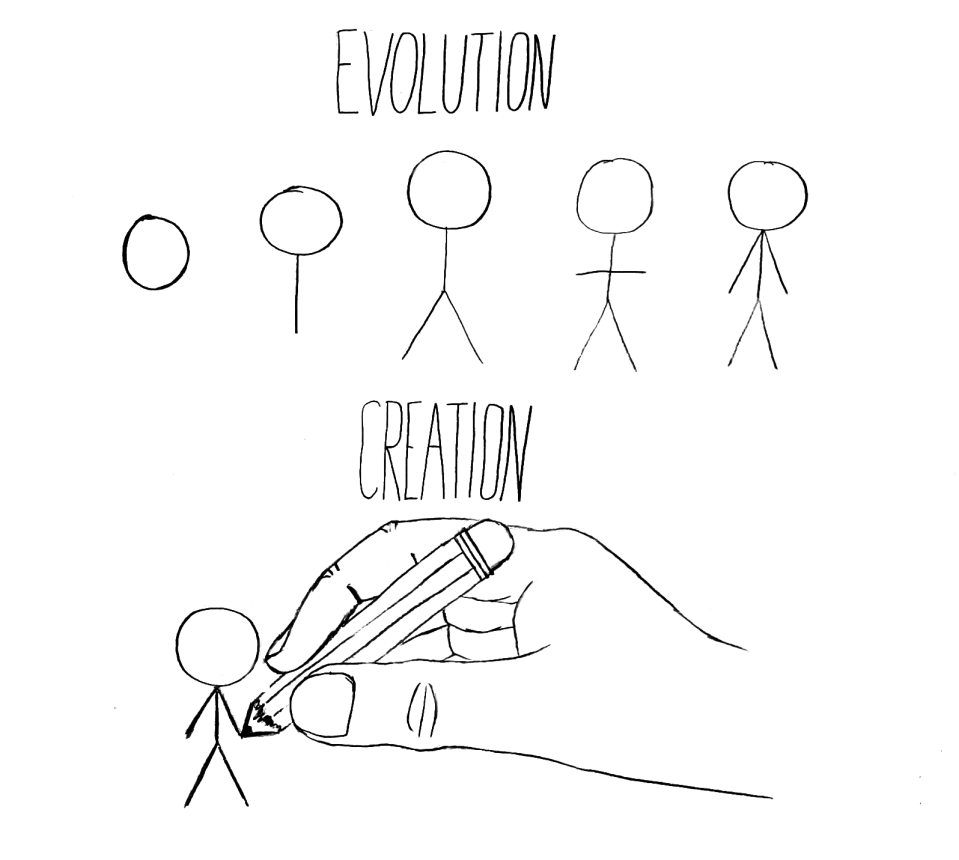
NO, NO, NO! EVOLUTION IS STILL A THEORY!

Evolution

Evolutionary Mutation – What is it?

In biology, a mutation is a permanent change of the nucleotide sequence of the genome of an organismvirus, or extrachromosomal DNA or other genetic elements. Mutations result from damage to DNA which is not repaired or to RNA genomes (typically caused by radiation or chemical mutagens), errors in the process of replication, or from the insertion or deletion of segments of DNA by mobile genetic elements. Mutations may or may not produce discernible changes in the observable characteristics (phenotype) of an organism. Mutations play a part in both normal and abnormal biological processes including: evolutioncancer, and the development of the immune system, including junctional diversity.

Mutation can result in several different types of change in sequences. Mutations in genes can either have no effect, alter the product of a gene, or prevent the gene from functioning properly or completely. Mutations can also occur in nongenic regions. One study on genetic variations between different species of Drosophila suggests that, if a mutation changes a protein produced by a gene, the result is likely to be harmful, with an estimated 70 percent of amino acid polymorphisms that have damaging effects, and the remainder being either neutral or weakly beneficial. Due to the damaging effects that mutations can have on genes, organisms have mechanisms such as DNA repair to prevent or correct (revert the mutated sequence back to its original state) mutations. Ref. Wikipedia.

Beneficial mutations

Although mutations that cause changes in protein sequences can be harmful to an organism, on occasions the effect may be positive in a given environment. In this case, the mutation may enable the mutant organism to withstand particular environmental stresses better than wild-type organisms, or reproduce more quickly. In these cases a mutation will tend to become more common in a population through natural selection.

For example, a specific 32 base pair deletion in human CCR5 (CCR5-Δ32) confers HIV resistance to homozygotes and delays AIDS onset in heterozygotes. One possible explanation of the etiology of the relatively high frequency of CCR5-Δ32 in the European population is that it conferred resistance to the bubonic plague in mid-14th century Europe. People with this mutation were more likely to survive infection; thus its frequency in the population increased. This theory could explain why this mutation is not found in southern Africa, which remained untouched by bubonic plague. A newer theory suggests that the selective pressure on the CCR5 Delta 32 mutation was caused by smallpox instead of the bubonic plague.

Another example is Sickle-cell disease, a blood disorder in which the body produces an abnormal type of the oxygen-carrying substance hemoglobin in the red blood cells. One-third of all indigenous inhabitants of Sub-Saharan Africa carry the gene, because, in areas where malaria is common, there is a survival value in carrying only a single sickle-cell gene (sickle-cell trait). Those with only one of the two alleles of the sickle-cell disease are more resistant to malaria, since the infestation of the malaria plasmodium is halted by the sickling of the cells that it infests.

Note: The Sickle-cell mutation is nonetheless a loss of information. The hemoglobin’s normal function is impaired, not improved, and the protection from malaria is simply an incidental side benefit — the pathogen happens to be destroyed along with the person’s own defective cells. This mutation does not introduce a new level of complexity; there is no new functional information or novel structural feature for evolution to build on. Considered in itself, this mutation is destructive and harmful, as are so many others. It is difficult to see how any genetic change of this sort could lead to a true evolutionary advance.

My argument against the theory of ‘beneficial genetic mutation’ and how it forms that basis for theory of evolution is multi-faceted:

Fruit fly experiments.  In a recent study, also published in Nature, University of California Irvine researcher Molly Burke led research into the genetic changes that occurred over the course of 600 fruit fly generations.  After the equivalent of 10,000 years of human evolution the fruit flies showed surprisingly few differences. And, of course, it is still a fruit-fly.  It was not a new creature – it was not even a ‘different kind of fly’.

E. coli long-term evolution experiment.  This is an ongoing study in experimental evolution led by Richard Lenski that has been tracking genetic changes in 12 initially identical populations of asexual Escherichia coli bacteria since 24 February 1988. The populations reached the milestone of 60,000 in April 2014, the equivalent of 1-million years of human evolution (based on 16-years between generations).  Lenski and his colleagues have reported a wide array of genetic changes. Some changes have occurred in all 12 populations and others have only appeared in one or a few populations. At the present time though, the E-coli bacteria are still E-coli bacteria.  Not one of them has grown fins to swim around the petri dish or limbs to help it climb out.

Mendel’s Law: According to the Mendel’s Law”. “Evolution has taken place by the incorporation into the race of those mutations that are beneficial to the life and reproduction of the organism”. Injurious mutations have practically no chance of becoming established.  The unaddressed issue is the grievous lack of the generation of new genetic material required for speciation.  There simply is no evidence for it, or of the spectacular number of iterations that are required to fulfil the evolutionary process.

The numbers: There are 37.2 Trillion Cells in Your Body. That is 37,200,000,000,000 cells.  Personal weight variation can make the spread 15 to 70-trillion.  There are over one-hundred distinct kinds of cells in your body.  Evolutionary scientists estimate that the first ‘simple cells’ appeared 3.6-billion years ago and complex cells 2-billion years ago.  Given that human cells are extremely complex, this would require the addition of 18,600 new cells, every single year for 2-billion years, to the specie that would eventually become a human.

Some scientists believe that more than 99-percent of all species, amounting to over five billion species, that ever lived on Earth are estimated to be extinct. That’s 5-Billion extinct species and modern scientists have not observed the creation of a single modern specie, man-made or otherwise (see e-coli experiment above).

Irreducible Complexity. I addressed this issue in a previous blog, THE CHICKEN OR THE EGG? CREATION OR EVOLUTION?

Compounding Complexity.  Not only does one have the task of trying to reconcile each of these individual realities, each one compounds the other.  Not only does one have a very short timeline (yes, 2-billion years is very short) to go from a complex single cell to a fully developed human, one has to contend with the fact that virtually all genetic mutations are destructive and do not advance anything, that they must speciate and have competing ‘beneficial mutations’ occurring in unimaginable numbers concurrently.

Debunking Darwin’s Theory (of evolution):

The theory of evolution is simply a theory which cannot be proven. What has been proven time and time again to be 100 percent accurate is Natural Selection, which is often mistaken as being “evolution” of species.

If primates breed and undergo changes via “natural selection” over millions of years they will not become humans. They will not “evolve” into humans.

Species cannot change and evolve into a totally new specie over thousands or millions of years. They can however, change their “existing features” through natural selection over hundreds or thousands of years and become a different looking version of the SAME SPECIE and not a new one.

Consider this, finches on an island, the ones with smaller beaks could not survive to eat the food, the ones with bigger beaks did, so the ones with smaller beaks died out, leaving the ones with bigger beaks behind, they then interbred, resulting in the next generation – a finch specie with big beaks, because they inherited the big beaks from both parents. The future finches did not become a new type of bird, they did not evolve into something else. Simply natural selection let the bigger beaked finches take over.

So the finch did not evolve from a small beak finch to a big beak finch.

THE LAW, THE CHARTER AND LUNACY


The old adage goes, ‘It’s the exception that makes the rule.’ Sometimes the exception can be a little far-fetched but it is no less valid for validating the rule.

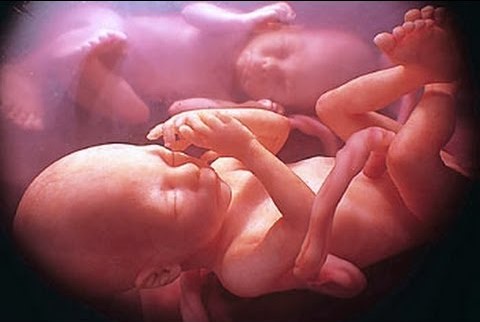
Based on Section 223 of the Criminal Code and the lack of any Canadian Law with regard to limits on abortion, it is theoretically possible for a woman to be pregnant with twins, for the woman to give birth to the first child (who is now fully protected by the Law as a human being) and then for the same doctor to kill (abort) the second twin so long as he or she does so while the child’s umbilical cord is unsevered (even though the baby may be breathing and crying) and will face no legal consequences whatsoever. Like I say, a far-fetched scenario but valid according to Canadian Law.

Given the Charter protections offered to the first twin are sacrosanct, that is,
“Everyone has the right to life, liberty, and the security of the person and the right not to be deprived thereof except in accordance with the principles of fundamental justice.” andEvery individual* is equal before and under the law and has the right to the equal protection and equal benefit of the law without discrimination and, in particular, without discrimination based on race, national or ethnic origin, colour, religion, sex, age or mental or physical disability.”
does this not make Section 223 of the Criminal Code contradictory to the Charter and clearly unconstitutional? Is the second twin not an individual*?
Section 223 of the Criminal Code reads:
When child becomes a human being:
Child
(1) A child becomes a human being within the meaning of this Act when it has completely proceeded, in a living state, from the body of its mother, whether or not
(a) it has breathed;
(b) it has an independent circulation; or
(c) the navel string is severed.
*Note: the word ‘human’ appears nowhere in the Canadian Charter.

Additional thought/question: What is the difference between a cesarian birth and a cesarian abortion?  I recently read the following, “Hysterotomy Abortion Method: An early C-section is performed, usually after the baby has been killed by brain aspiration, intracardiac injection (causes the baby to have a heart attack), or cutting the umbilical cord and allowing the baby to bleed to death.”  Is this not literally murder in the womb?

The Criminal Code goes on to note:

Killing child

(2) A person commits homicide when he causes injury to a child before or during its birth as a result of which the child dies after becoming a human being.

This is why the abortionist must kill the baby prior to cutting the umbilical cord.

What do you think?


WHO FLIPPED THE COIN TO CREATE THE UNIVERSE? THE ATHEISTS NIGHTMARE

 
Excerpts from The Battle for the Beginning by John McArthur:

Either there is a God who created the universe and sovereignly rules His creation, or everything was caused by blind chance. If God rules, there is no room for chance.  God’s rule and chance are mutually exclusive and inherently incompatible.  If chance causes or determines anything, God is not truly God.
But chance is not a force and cannot make anything happen.  Chance is nothing. It does not exist. And therefore has no power to do anything.  The outcome of the flipping of a coin is not a matter of chance, rather, the outcome is exactly determined by all the laws of physics associated with the flipping of the coin and the properties of the coin itself.  Under precise laboratory conditions the outcome of a coin-toss will be predictable and repeatable. The only variable, where the laws of physics do not apply, is the decision to toss the coin—or not.  Without this initiative there can be no outcome.
Chance is contrary to every law of science (chance precludes anything from being observable and repeatable), every principle of logic, and every intuition of common sense.  The most basic principles of thermodynamics, physics and biology suggest that chance simply cannot be the determinative force that has brought about the order and interdependence we see in our universe.
God is the uncaused cause.
“In the beginning God created the heavens and the earth.” The Bible: Genesis 1:1
____________

WHAT IS CHANCE?
Randomness – a lack of pattern or predictability in events.
Probability – the measure of the likeliness that an event will occur.
Luck – a purposeless, unpredictable and uncontrollable force that shapes events favourably or unfavourably for an individual, group or cause.
Chance is a philosophical concept.

Anyone who has read or watched the Hitch-Hiker’s Guide to the Galaxy will know that at the end of the show, as Ford Prefect, on his Spaceship of Infinite Probability, ends his search for The Answer to the Ultimate Question of Life, the Universe, and Everything with the his answer – 42.  The question we all need to ask ourselves is, does the sum total of all my life experiences, all the highs and lows, the joys and sufferings, my childhood, my education, my career, all the good I have done, and the loves of my life, total nothing more than the roll of the dice? I hope your answer is, “No.”

____________

This is the typical non-theistic response: “Evolution is driven by mutation, selection in regard to the species environment, and reproductive success. It is absolutely not due to blind chance. It is completely run by specific events that lead to decent with modification.”  This statement is obviously self-contradictory!

It uses mutation as the basis for its argument.  The question has to be asked, what caused the mutation?  The environment? This then becomes a circular argument and leads to the next obvious question, what caused the changing environment if not chance?  


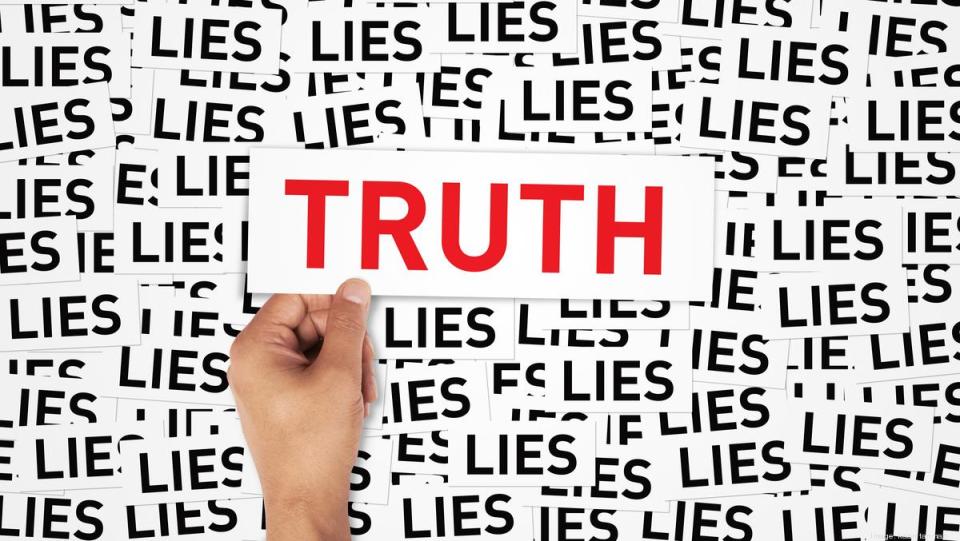
LIES, LIES AND MORE LIES

Lies
Lies, Atheism and the Pro-Abortion Movement

Not all atheists are pro-abortion and not all in the pro-choice movement are atheistic, but I have come to the conclusion that most are.  What drew me to this conclusion?  Let me explain…

In my position as president of Bus Stop Bible Studies I have had the opportunity to work with a number of crisis pregnancy centres, posting advertising panels inside buses with various Canadian transit companies to promote their compassionate ministries.  We first posted panels with the North York Pregnancy Care Centre (now Pregnancy Care Centre) back in 2010.  In the past five years there has been the occasional complaint but nothing of any consequence.  In that same time the number of PCC locations in the GTA has increased to six, such is the demand for their services.

In mid-May, 2015 a certain Linda Star started an on-line petition in an attempt to get the Toronto Transit Commission (TTC) to remove the current PCC advertising panels. “Remove anti-choice ads on the TTC” reads the petition headline. What I found so amazing, and so disturbing, is that one individual can post a petition, the basis for which are lies and fabrication, and get 15,000 signatures in a matter of days.  I guess this is one of the downsides of the social-media world in which we now live.

Below is the specific advertising panel used as the basis for the petition:

As I reviewed the written comments on the petition website I noted a number of recurring themes, so I copied and pasted a completely random selection of 1,090 comments into a spreadsheet and conducted some simple analysis based on key words.

Here are some conclusions I was able to draw:

The Pro-Choice community are not interested in choice – they are almost exclusively interested in access to abortion.  Even though the co-sponsor of the bus ads is the JFJ Hope Centre adoption agency, apparently this is not a viable ‘choice’ for the pro-aborts.  Of the 1,090 comments analyzed there were 18 references to adoption – all of them conveyed negatively:

“We don’t need Ads promoting Adoption on the TTC.”

“I think more woman should have abortions to help control the population. There are way to [sic] many people on this planet and I think if someone wants a kid they should adopt.”

“Pregnancy Care Centres are guilty of false advertising. They purport to provide information about options, but they only provide information about placing a baby for adoption, or raising it on your own. They do not provide information about the possibility of termination.”

The pro-abortionists are anti-religion or seemingly deny a moral compass.  Of the 1,090 comments there were 164 direct references to religion, again all in the negative.  100% of the comments deny or exclude that the life of the child has any bearing on the conversation – all that matters is the woman’s right (choice) to kill her unborn child.  The word choice was referenced to 412 times.

Reduced to an absolute, abortion is either moral or immoral.  It is either right or wrong. Why would I suggest that the choice of abortion is a moral absolute? Simply put, the outcome of an abortion is an absolute – a dead human (there is no other specie it could be).  One can argue the semantics of whether one calls this other living entity a child, a baby, a fetus or a zygote, but every living being has its origins at the moment of conception.

This bring us to question the definition and purpose of morality.  One dictionary definition of morality is “Principles concerning the distinction between right and wrong or good and bad behavior. A particular system of values and principles of conduct, especially one held by a specified person or society. The extent to which an action is right or wrong.”

Comment left on petition: “a mythical god should not be used to influence the right of personal choice.”

There are three possibilities with regard to (an individual’s) morality:

It’s personal.  My definition of what is right and wrong are the attributes that determine what I consider to be moral or immoral.  The only logical conclusion is anarchy – anything goes.  My sense of right and wrong is as valid as any other individual’s and therefore I am accountable to no one.

It’s societal.  A simple majority of 50 + 1 establishes the rules.  As goes the crowd goes (even when led by an articulate but deceptive ideologue such as the likes of Hitler and any number of the current political leaders) so goes right and wrong.  Unfortunately the silent (moral?) majority remains silent and the noisy few establish the rules.

It’s an absolute.  If morality is an absolute then there must be a Moral Law Giver.  This Moral Law is that which distinguishes those that are pro-life and those that are pro-death.  And let me be very clear, to be pro-choice is to be pro-death because the only ‘choice’ that is in question is death.

This brings us back to the reasoning for my drawing the conclusion that most pro-death/choice individuals are atheist, it is simply because they deny the reality of any moral absolutes.  Moral absolutes are completely contradictory to their whole worldview and belief systems.

Ignorance.  The other conclusion I have come to is that most pro-choice supporters are woefully and tragically ignorant of the facts and what an abortion entails.  In the United States (and one would assume that Canadian statistics are comparative) 36% of abortions are carried out when the baby is 9-weeks or older and requires the killing and dismemberment of the baby by one means or another.

Lies. It has been said the abortion industry could not exist were it not for lies.

“A friend of mine was intentionally lied to at one of these “Crisis Pregnancy Centres” when she was a vulnerable, scared teen-ager seeking information and options when faced with an unplanned pregnancy. These ads, and the well-funded deceptive organizations behind them, must be exposed, and stopped. All women have the right to make health decisions based on their own personal, moral, religious, and material circumstances – and have equal access to unbiased, honest information and services. Support “Options for Sexual Health”!

This is the typical rhetoric from the pro-death/choice camp.  Obviously, the most glaring lie is that PCC’s don’t present choices – this is exactly what they do – and they will encourage their clients to make ‘right choices’.

As for being ‘well-funded…organizations’… all abortions in Canada are 100% government funded.  Abortion clinics are for the most part very profitable companies pulling in an average of $2-million per year each.

Pregnancy Care Centres on the other hand are all not-for-profit, charitable organizations mostly run and supported by volunteers. Being ‘well-funded’ is as far from the truth as one can imagine.  One can view their financial statements of the Government CRA website.

“I find this false advertising offensive!” Of course, if this were false advertising one wouldn’t be allowed to post it on Canada’s transit systems. Typically it is statements such as these that are so patently false.

Below are the key words analyzed:

CHOICE/CHOICES

412

WOMEN

384

(ACCURATE) INFORMATION/INFORMED

353

ABORTION

178

DECIDE/DECISION

170

RELIGION/RELIGIOUS

164

FALSE

99

PROPAGANDA

96

(WOMAN’S) BODY

79

LAW/LEGAL

66

MISLEADING

55

ANTI-CHOICE

53

RIGHTS

39

PRO-CHOICE

23

GOD

17

LIES

16

MORAL/MORALITY

12

ANGRY

8

BIBLE

3


A Selection of comments posted on the petition:

“a public institution, in this case the TTC, should not be supporting a specific political viewpoint.”

“A publicly owned corporation like the TTC can not be allowed to propagate religiously inspired mis-information.”

“A safe abortion is a woman’s right in Canada and I oppose any organization that impedes a woman’s right to correct information and free choice. Please remove the offending adds.”

“A woman needs factual and unbiased opinion when facing such an important decision; this is NOT a religious issue, but a health issue. This organization’s position is the remove the constitutional right of women to make a well-informed decision.”

“A woman’s body is her own! SHE will decide what to do NOT anyone else!!”

“Abortion is a sin, but denial of choice is a greater, more venial sin!! If there was no sin in the world it would already be paradise.”

 “Abortion is a legal medical procedure and a basic human right for women and the shaming of women choosing this option HAS TO STOP.”

 “Advertising for places that lie to the public should not be allowed in Canada.”

“Anti-choice ads oppose public health policy and seriously endanger women’s psychological and physical health. It is scandalous that a public service like TTC would publicize such anti-health and anti-women advertisements. TTC must remove the advertisements immediately. Maybe TTC should also apologize to women and to public health authorities.”

 “Anything using religion as a weapon or providing incorrect information to force people into life choices, shouldn’t be allowed.”

 “As a Christian I am very opposed to the anti-choice groups presenting themselves as “the” Christian choice. It is not.”

 “As a physician, I’ve long wanted these ads gone, and am glad to sign this. The centres advertise that they’re there to “provide options,” but they’re not – instead, they present the option *they* think you should take, which is completely inappropriate. Currently, women in Canada are *technically* entitled to “safe and affordable” abortions, however, in reality, that doesn’t happen – the wait-times in Kingston are ridiculous, such that I’ve had to send patients to Toronto; we can’t even get a timely ultrasound to know if they’re far enough along to terminate. On top of that, any woman who’s been unlucky enough to have to face an unwanted pregnancy, and who has chosen to terminate, will probably agree with me that abortions in Canada are done without adequate analgesia – in the US, you have to pay for your abortion, but at least you have the option of anaesthetic. In Canada, you get given a token amount of medication, and contrary to what abortion clinic websites say, women do *not* describe the procedure as “uncomfortable,” but rather as “very painful,” and I base this on having worked at a Toronto clinic for 3 years. A bit off-topic, but worth adding! By all means, make your own choice, should you become pregnant, but just as God doesn’t belong in the bedroom, neither does he belong in the doctor’s office. Signed!”

“as a woman, i have the choice to act on my own body. brainwashing is unacceptable” 

“Because choice is paramount.”

WHY OVERTAXING THE RICH IS A BAD IDEA – A PARABLE


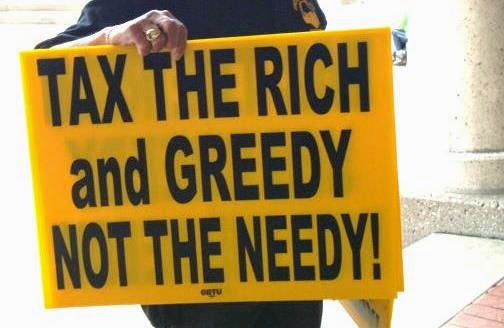
I felt it was so important that people understand why a socially conservative approach to taxation is not only the fairest approach, but also the essential approach, that I am reproducing a feature article from the Globe and Mail by Tim Cestnick:


The nice thing about an election year that’s accompanied by federal budget surpluses is that it’s fertile ground for tax cuts – and both the Conservatives and Liberals have promised that tax savings are on the way. But who should really benefit from tax cuts? While it might not seem politically correct to suggest that the rich should get the lion’s share of tax breaks, let me share a story that I first shared many years ago that provides food for thought here.

The cost of dinner

Each and every day, 10 men go to a restaurant for dinner together. The bill for all 10 comes to $100 each day. If the bill were paid the way we pay our taxes, the first four would pay nothing; the fifth would pay $1; the sixth would pay $3; the seventh $7; the eighth $12; the ninth $18. The 10th man – the richest – would pay $59. Although the 10 men didn’t share the bill equally, they all seemed content enough with the arrangement – until the restaurant owner threw them a curve.

“You’re all very good customers,” the owner said, “so I’m going to reduce the cost of your daily meal by $20. I’m going to charge you just $80 in total.” The 10 men looked at each other and seemed genuinely surprised, but quite happy about the news.

The first four men, of course, are unaffected because they weren’t paying anything for their meals anyway. They’ll still eat for free. The big question is how to divvy up the $20 in savings among the remaining six in a way that’s fair for each of them. They realized that $20 divided by six is $3.33, but if they subtract that amount from each person’s share, then the fifth and sixth men would end up being paid to eat their meals. The restaurant owner suggested that it would be fair to reduce each person’s bill by roughly the same percentage, and he proceeded to work out the amounts that each should pay.

The results? The fifth man paid nothing, the sixth pitched in $2, the seventh paid $5, the eighth paid $9, the ninth paid $14, leaving the 10th man with a bill of $50 instead of $59. Outside the restaurant, the men began to compare their savings. “I only got one dollar out of the $20,” said the sixth man, pointing to the 10th man, “and he got $9!” “Yeah, that’s right,” exclaimed the fifth man. “I only saved a dollar, too! It’s not fair that he got nine times more than me!” “That’s true,” shouted the seventh man. “Why should he get back $9 when I only got $2? The rich get all the breaks!” “Wait a minute,” yelled the first four men in unison. “We didn’t get anything at all. The system exploits the poor!”

The nine outraged men surrounded the 10th and brutally assaulted him. The next day, he didn’t show up for dinner, so the nine sat down and ate without him. But when it came time to pay the bill, they faced a problem that they hadn’t faced before. They were $50 short.

The moral

There are a couple of lessons to be learned here. The first is an observation from my wife: If the 10 individuals had been women, they probably would have figured things out. But in all seriousness, I’m going to suggest that the approach taken by the restaurant owner in the story is exactly the right approach to divvying up tax cuts. It’s how our system should work. The people who pay the highest taxes should get the greatest relief from a tax cut, in absolute dollars.

The fact is, if you overtax the rich, they just might not show up for dinner next time. After all, there are plenty of good restaurants around the world.

This story is relevant today because both the Conservatives and the Liberals have proposed to cut taxes – in different ways. The Liberals have said that they would offer no tax cuts to the rich, but would instead increase the tax burden on the highest earners. The problem with this, of course, is that pushing any taxpayer’s marginal tax rate to 50 per cent or higher (which would be the case for many Canadians, particularly in provinces that also have taken steps to increase the marginal tax rate for the highest earners) will absolutely cause those folks to explore new ways to bring the tax burden down. And in the end, it may drive some to leave.

Tim Cestnick is managing director of Advanced Wealth Planning, Scotiabank Global Wealth Management, and founder of WaterStreet Family Offices.

GOD SEND ME A SIGN!

 
How often have you seen someone walking around gazing at their smartphone and bumping into something?  There are statistics that indicate that 25% of all car accidents are smartphone related.  In London, England they are experimenting with wrapping lamp posts with foam pads to reduce the risk of injury.
 

From England’s Daily Mail newspaperResearch showed that Brick Lane in East London was the top spot for texting injuries… 68,000 such accidents last year… fractured skulls.

How often have you asked, “Please Lord send me a sign.” but never bothered to look up or look around?  How much do we really miss out on what God is trying to tell us or teach us because we aimlessly focus our attention on meaningless chit-chat?

Thankfully, when it comes to all the Bus Stop Bible Study panels we post, we are able to rely on God stepping into the picture.  We have received countless testimonies from people who have looked up, seen one of our panels, and God has spoken.

We once received a call from a woman who had just left Princess Margaret Hospital with a positive cancer diagnosis.  Can you imagine the devastating impact at just having received that kind of news?  Well, for this woman, God showed up.  She got on a TTC bus, looked up, and God spoke directly to her as she read His Word.  As soon as she got home she called our office to share her emotions; the devastating news of a positive diagnosis mixed with the joy of knowing that God cared about her so personally and in such an intimate way.

As we so often like to say, “At just the right time, just the right person will get on just the right bus, and a life is changed.”

Next time you want a sign from God, look up or look in your Bible.

ADVICE FROM AN OLD FARMER

1.   Forgive your enemies – it messes up their heads.

2.   Life is simpler when you plow around the stump.

3.   Keep skunks and bankers at a distance.

4.   Bees can fly considerably faster than a tractor.

5.   Your fences need to be horse-high, pig-tight and bull strong.

6.   Do not correct somethin’ that you know is more riled up than you are.

7.   Most of the stuff folks worry about aint gonna to happen anyway.


8.   Don’t judge folks by their relatives.

9.   Remember that silence is sometimes the best answer.

10. Don’t interfere with somethin’ that aint botherin’ you none.

11. Life is like a sandwich; birth as one slice, and death as the other. What you put in-between the slices is up to you.

12. Live a good life.  Then when you get older you can think back and enjoy it a second time.

13. Sometimes you get, and sometimes you get got.

14. If you find yourself in a hole, the first thin’ to do is stop diggin’.


15. Good judgement comes from experience and a lot of that comes from bad judgment.

16. Better to remain silent and be thought a fool, than to speak and remove all doubt.

17. When drinkin’ outside on a hot day, always dip your canteen upstream from the herd.

18. Lettin’ the cat outa the bag is a whole lot easier than puttin’ it back in.

19. If you thinkin’ you’re a person of some influence, try orderin’ somebody else’s dog around.

20. Nothin’s worse than that moment durin’ an argument when you realize you’re wrong.

Live simply.  Love generously.  Care deeply.  Speak kindly.  Leave the rest to God.