
Category Archives: Uncategorized

I AM RIGHTEOUS! – GOD IS GREATER THAN MY FAILURES – PART 5 OF 9

Dictionary definition of Righteous:
Righteous
  1. Morally upright; without guilt or sin: a righteous parishioner.
  2. In accordance with virtue or morality: a righteous judgment.
I am righteous – God gave me my righteousness as a gift and no one can take it from me!
Let’s read from Romans 3 in the New International Version and then read the same passage from the easy-to-understand language of The Message:
“But now apart from the law the righteousness of God has been made known, to which the Law and the Prophets testify. This righteousness is given through faith in Jesus Christ to all who believe.”  Romans 3:19-22 NIV
Now let’s read the same passage from The Message:
“Since we’ve compiled this long and sorry record as sinners and proved that we are utterly incapable of living the glorious lives God wills for us, God did it for us. Out of sheer generosity he put us in right standing with himself. A pure gift. He got us out of the mess we’re in and restored us to where he always wanted us to be. And he did it by means of Jesus Christ.”  Romans 3:19-22 The Message
This is what righteousness is – to be in ‘right standing’ with God.  When God looks at us He does so through what I like to think of as ‘Jesus coloured glasses’.  He sees us, the ‘new us’, clothed in Christ’s righteousness.
Like I said earlier, I believe this intellectually but the wonder, the huge ‘wow-factor’ of this truth, has yet to migrate from my brain to my heart. 

If you’re like most people I’ve asked these first four questions of, you’re probably zero for four.  Sometimes it’s good to be wrong, because when you find the right answer we can once again stand in awe of such a gracious God!

IT’S IMPOSSIBLE FOR ME TO DISAPPOINT GOD! – GOD IS GREATER THAN MY FAILURES – PART 6 OF 9


Let’s look at the principle topic of disappointing God and the “God that is greater than my failures.”

Do you disappoint God?  
Did you answer this question as ‘TRUE’?
Maybe you’re catching on to the idea that the answer is not that which is, at first glance, logical.
Let’s look into dictionary definitions once more…
Disappoint – Verb
  1. to fail to fulfill the expectations or wishes of – 
  2. to defeat the fulfillment of (hopes, plans, etc.); thwart; frustrate, 

It’s interesting that ‘to disappoint’ is a verb – it’s an action item.  


Verb: a word that is usually one of the main parts of a sentence and that expresses an action, an occurrence, or a state of being…

Most actions are voluntary or deliberate.  That is the essence of the meaning of a verb, it is ‘to do’ something.

I doubt very much if anyone of you set out on any given venture to deliberately disappoint God.  For you to think of yourself as a great disappointment, would infer that you have repeatedly, and deliberately, disappointed God.
Well, if this is what you think, I’m sorry to disappoint you with good news once again! 
This is how God sees us:
“For we are God’s masterpiece.” Ephesians 2:10 NLT 
Who are we to argue with God?  
Before you try and affirm that God might possibly be mistaken on this matter, and that He really should consider you a disappointment and a failure rather than a masterpiece, remember how sternly He answered Job, “Who is this that questions my wisdom with such ignorant words?” Job 38:2  I really don’t think we want to go down that road!
Lest I be accused of quoting Scripture out-of-context, let’s read Ephesians 2:10 in full.  You can read the entire letter of Ephesians here.
“For we are God’s masterpiece. He has created us anew in Christ Jesus, so we can do the good things he planned for us long ago.”  
There is a lot to unpack in this one verse:
  • We are God’s masterpiece
  • He has created us anew in Christ Jesus,
  • so we can do
  • the good things
  • he planned
  • for us long ago.
Each and every one of us is a masterpiece.
In Christ, we have been created anew – we’ve been born again!
We have been created anew for a purpose.
God says, “We can do…” He’s not looking for ‘why-not’ excuses.
We have been created to do ‘good things’ – things that will specifically bring glory to God.
These are things God has planned.  Don’t think you can be a spoiler just so you can disappoint Him.  He’s omnipotent and you’re not. 
To emphasize this point I will quote Jeremiah 29:11  [God says], “I know the plans I have for you.” – not just any plans!  God’s plans are to give us a hope and a future.  Not a future of disappointments but a future filled with hope and blessing! And, if you read this passage in-context you will see that God speaks this promise to the Israelites while they were suffering as a consequence of humungous failure on their part!
There is also the question of whether it is practically possible to disappoint God?  The paradigm-shifting answer is simply, NO!  By virtue of the very nature of God it is simply not possible.
You see, the definition of disappointment is, “an unfulfilled expectation”.  Now God is both eternal (He exists outside of time) and omniscient (He is all-knowing).  This means He knows everything that has ever happened or will ever happen.  This is why God can say, to Jeremiah, I knew you before I formed you in your mother’s womb. Before you were born I set you apart and appointed you…” Jeremiah 1:5 If God knows everything you are ever going to do – there can be no unfulfilled expectations, ergo, it is impossible to disappoint God.
It is not the prerogative of the Christian to say, “If only this or that, things would have been different.”

FAILURE IS CONQUERED BY GRACE – GOD IS GREATER THAN MY FAILURES – PART 7 OF 9

Getting back to Steve’s original email, he’s right, I am an expert in failure.  However, I am also an expert witness to God’s grace.  I feel as though I have received much, much more than my share.  Thankfully God does not apportion grace measure-by-measure, God’s grace is without limit to all who will receive!

Let’s look once more to the dictionary for a definition of failure:  Failure is the state or condition of not meeting a desirable or intended objective, and may be viewed as the opposite of success.
A sense of failure, or fear of failure, is probably the greatest weapon that Satan will draw from his arsenal in his attempt to incapacitate the child of God.  In Ephesians 2 Paul reminds us that, “we are God’s handiwork, created in Christ Jesus to do good works, which God prepared in advance for us to do.” Satan is scared poopless that we might even believe Jesus when He explicitly told us, “Very truly I tell you, whoever believes in me [note this is not a statement limited to just the disciples – it specifically includes YOU] will do the works I have been doing, and they will do even greater things than these, because I am going to the Father.” John 14:12. The IMAGINE! video is my personal testimony to this truth.
Imagine!  Imagine doing greater things than Jesus!  Now, don’t start making excuses – as to why you can’t – that is to make a liar of Christ.
Do you ever feel like this before God?
“Get away from me Lord, I am a sinful man.”
I know I do.  
Each time we try an use our sin as an excuse for not working to build up God’s Kingdom it seems as though Jesus simply covers His ears with His hands and shouts, “Na, na-na, na-na-na, I’m not listening!” 
Let’s read the whole interaction between Peter and Jesus:
When Simon Peter saw this, he fell at Jesus’ knees and said, “Go away from me, Lord; I am a sinful man!”  For he and all his companions were astonished at the catch of fish they had taken, and so were James and John, the sons of Zebedee, Simon’s partners.
Then Jesus said to Simon, “Don’t be afraid; from now on you will fish for people.” So they pulled their boats up on shore, left everything and followed him.
I feel like saying, “Jesus, didn’t you hear what Peter said? He’s a sinner for goodness sake.” Jesus chose to ignore Peter’s protestations just as He has chosen to ignore all of mine.
Jesus never seems to answer a question as we would expect.  Simon-Peter exclaims, “Go away from me, Lord; I am a sinful man!” and Jesus prefaces His reply with, “Don’t be afraid…”
Jesus is saying to Peter (and all you ‘Peters’ out there), “I know exactly who you are and what you are.  You are mine and I love you.  So, don’t be afraid, especially of me.  Roll up your sleeves, put you waders on, – we’re goin’ fishin’ – I’m going to show you how it’s done and we’re not stopping when we reach 143!”
I am not saying that willful sin does not impact our ability to serve God freely but I am saying that God does not accept failure as an excuse not to serve Him – it’s simply not an option!
Do you sometimes feel as though God has called you to carry out an impossible task?  One that seems doomed to failure?
I recently read a great quote by Oswald Chambers: “A saint’s life is in the hands of God like a bow and arrow in the hands of an archer. God is aiming at something the saint cannot see, and He stretches and strains, and every now and again the saint says–‘I cannot stand it anymore.’ God does not heed, He goes on stretching till His purpose is in sight, then He lets fly.”
Failure can take on many forms.  It comes in many shapes and sizes.  But God is SO MUCH GREATER than our failures.
In Proverbs 24-16a, God says, “…for though the righteous [the new you] fall seven times, they rise again…”
Personal sin almost certainly instills the greatest sense of failure in any child of God.  But, if we will receive it, when we sin, God gives us the gift of repentance, the ability to confess our sin to Him and for Him to bring about change in us.  When we confess our sin, God lifts us up by the hand, brushes the dirt off our knees, and then says, “Now, where were we? Ah, yes, we were building my Kingdom.  Let’s get back at it.”

In Romans 8:28 Paul emphatically states that God will work all things for the good of those that love Him.  Either this statement is true or it’s not.  ‘All things’ simply means, ‘all things’, not just some things or a few things.  This statement does not exclude sin, or failures, or disappointments.  Paul does not include any exceptions to this rule – quite the opposite.

A PERSONAL TESTIMONY, THE REDEMPTION OF FAILURE- GOD IS GREATER THAN MY FAILURES – PART 8 OF 9

I want to share a very personal testimony to illustrate the point – that God will work even our greatest failures for the good – simply on the basis of His love for us. 

I grew up in England.  As a family we went to church at Christmas, Easter and for weddings.  It was the thing to do.
In my teens and early adulthood I would have described myself as an atheist but could always be counted on to argue either side of the ‘God question’.  I have always enjoyed a good debate.
When I was twenty-one I immigrated to Canada, I couldn’t wait to find my independence.  The only so-called ‘spiritual experience’ I had in those years was when the plane touched down in Toronto and I had this overwhelming feeling of ‘being home’.
I worked primarily in sales and did quite well.  When I turned thirty I and two colleagues started up our own audio-visual company.  We were successful, brash and arrogant.  There was even appoint where the three of us were seriously considering leasing identical Porsche 928’s to make a public display of our success.
In four short years we has a staff of twenty-five and moved into our own new building.  Then came an economic turndown and we crashed with it.  In March of 1986 we filed for bankruptcy.
In this midst of this crisis, the greatest failure of my life, I cried out aloud, “God, if you’re there, help me!”  
I had completely come to the end of self and had nowhere else to turn. I had failed. Spectacularly. A cry from the heart of a wretched soul.  I like to refer to those six short words as my prayer of salvation.  
But God is so much bigger than my failure.  In that instant, in that split-second, in the blink of an eye, God showed up.
It would take many pages to explain all the details of what happened – but that evening, for the very first time, I prayed.  Don’t ask me what I prayed – I don’t remember.  I started to read the Bible and little-by-little I came to know God and the person of Jesus Christ.
A few weeks later I went to a local restaurant with my next-door neighbours, Wayne and Barbara.   We had become good friends.  I forget the context of our conversation but I do remember saying the words, “Since I have become a Christian…”  At that moment the Holy Spirit showed up.  The only way I can describe it is an overwhelming sense of peace and warmth.  It was as though I had just gulped down a swig of the finest single-malt whiskey and felt the warmth that radiates from within.
I must confess that in those few moments I had no idea what was happening to me.  There was no doubt in my mind though that this was a ‘God-thing’.
When I shared this experience with some friends, whom I knew to be Christians, they explained quoting Romans 10:9, “If you confess with your mouth that Jesus is Lord, and believe in your heart that God raised Him from the dead, you shall be saved.”
I want to briefly interject to say that this was my experience.  Not everyone will have the same experience as me.  There are probably many who read this testimony that have simply grown up knowing God and cannot remember a time when God was not present in their lives.
So there you have it, God had taken the greatest failure of my life, working it for my good according to His great promise, and giving me the greatest success of my life – to be made a co-heir with Christ in the Kingdom of God! 
And let me add that He didn’t stop there. The cascading blessings out of that cry for help have never ended.  Eighteen months later God brought Wendy into my life and this past September we celebrated 25-years of marriage.  
I hasten to add that when Wendy and I met, I had absolutely nothing.  God had plucked me clean and was starting a whole new rebuilding project which continues to this day.
In his generosity God provided me with a wife who, along with many other things, came with a cottage on Baptiste Lake, and many friendships including that of Steve and Angie Breathour, which brings me full-circle to the email from Steve that has given me the opportunity to share these precious lessons learned.

Being able to share these thoughts and short testimony with you is yet another of those things that I hope God is working together for our respective and collective good, for those of us who love Him and have been called according to His purpose.

IT’S ALL TRUE! – GOD IS GREATER THAN MY FAILURES – PART 9 OF 9

I pointed out previously that Paul is emphatic when he states that God will work all things for the good of those that love Him.  Either this statement is true or it’s not.  ‘All things’ simply means, ‘all things’, not just ‘some things’ or a ‘few things’.  This statement does not exclude sin, or failures, or disappointments.  Paul does not include any exceptions to this rule – quite the opposite in fact:

“We, too, wait with eager hope for the day when God will give us our full rights as his adopted children, including the new bodies he has promised us. We were given this hope when we were saved. (If we already have something, we don’t need to hope for it. But if we look forward to something we don’t yet have, we must wait patiently and confidently.)
And the Holy Spirit helps us in our weakness. For example, we don’t know what God wants us to pray for. But the Holy Spirit prays for us with groanings that cannot be expressed in words. And the Father who knows all hearts knows what the Spirit is saying, for the Spirit pleads for us believers in harmony with God’s own will. And we know that God causes everything [including all our failures] to work together for the good of those who love God and are called according to his purpose for them. For God knew his people in advance, and he chose them to become like his Son, so that his Son would be the firstborn among many brothers and sisters. And having chosen them, he called them to come to him. And having called them, he gave them right standing with himself. And having given them right standing, he gave them his glory.
What shall we say about such wonderful things as these? If God is for us, who can ever be against us? Since he did not spare even his own Son but gave him up for us all, won’t he also give us everything else? Who dares accuse us whom God has chosen for his own? No one—for God himself has given us right standing with himself. Who then will condemn us? No one—for Christ Jesus died for us and was raised to life for us, and he is sitting in the place of honor at God’s right hand, pleading for us.
Can anything ever separate us from Christ’s love [including all our failures]? Does it mean he no longer loves us if we have trouble or calamity [or failure], or are persecuted, or hungry, or destitute, or in danger, or threatened with death? (As the Scriptures say, “For your sake we are killed every day; we are being slaughtered like sheep.”) No, despite all these things, overwhelming victory is ours through Christ, who loved us.
And I am convinced that nothing can ever separate us from God’s love. Neither death nor life, neither angels nor demons, neither our fears for today nor our worries about tomorrow—not even the powers of hell can separate us from God’s love. No power in the sky above or in the earth below—indeed, nothing in all creation will ever be able to separate us from the love of God that is revealed in Christ Jesus our Lord.”

JE NE SUIS PAS CHARLIE HEDBO (I AM NOT CHARLIE HEDBO)

I am a staunch defender of free speech.  As a consequence of the ministry I work for I am probably more of a defender of freedom of expression than most.  But I am no Charlie Hedbo.

In eight years of ministry, having posted thousands of advertising displays with Scriptural content on Canada’s public transit systems, Bus Stop Bible Studies has not received a single complaint from any other religious group. This is how freedom of expression is supposed to be. Respectful.
There is a distinction between freedom of expression and freedom of deliberate offence.  When the Atheist Bus Campaign ran in Toronto and elsewhere in Canada several years ago many were offended – we were not.  When the Humanist Association of Ottawa proclaimed there is ‘probably no God’ and ran into resistance from Ottawa Transit we publicly defended their right to express their opinion.
On page A6 of today’s National Post [January 8, 2015] there was a reproduction of a Charlie Hedbo cartoon of Jesus sodomizing God the Father.  The distinction between this cartoon and the Atheist Bus Campaign should be obvious; one is a depiction intended to offend the other is an expression of opinion.  The latter is defended by the Canadian Charter of Rights, the former is not.
A red cape does not stop a bull, it simply goads it into charging.  To quote the apostle Paul, “…for whatever a man sows, that he will also reap.”  Charlie Hedbo is a professional goader. When the response from Islamic fundamentalists is a virtual forgone conclusion, is it reasonable to ask the questions: Did the Charlie Hedbo staff not just commit mass-suicide?  Were these not evil people murdered by evil people?  Is there anything defensible in the actions of the murdered or the murderers?
Christie Blatchford commented in the same edition of the paper, “I only wish there were more for whom nothing — nothing — was sacred, and properly so, because nothing is. But we aren’t all Charlie Hebdo, alas, and never will be.”  To Ms. Blatchford I would say, your freedom of thought and opinion are sacred and no one has the right not to be offended by your thoughts and opinions.  Conversely, your right to intentionally offend is not sacred nor defensible.  I hope you never get your wish!

All this jumping on Charlie Thebod’s bandwagon reminds me of what Paul said in Romans 1, “They invent ways of doing evil…” and “…they not only continue to do these very things but also approve of those who practice them.”

When there is a sudden and bloody mayhem the automatic response is for the body to start pumping adrenalin.  My mind goes into overdrive. As a Christian I struggle to come to grips with my own feelings surrounding these tragic events.  The taking of life, any life, is a tragedy.  As long as there is life there is hope.  Should I mourn the loss of these retched souls any more than the millions of lost who die every day?

CAUTION: If you are looking for samples of Charlie Hedbo’s cartoons on-line they are extremely offensive/pornographic.

PS  One incidental thought… A distinction between Islam and Christianity; my God does not need defending – He defends me!

JESUS – THE VICTIM OF A HOME INVASION!

If you read the Bible with any frequency you will probably be familiar with having a sudden revelation, a trivial comment that all of a sudden seems to be of great theological importance to you.  I had one of those moments yesterday.

We read in Mark 2:1-65 NLT When Jesus returned to Capernaum several days later, the news spread quickly that he was back home. Soon the house where he was staying was so packed with visitors that there was no more room, even outside the door. While he was preaching God’s word to them, four men arrived carrying a paralyzed man on a mat. They couldn’t bring him to Jesus because of the crowd, so they dug a hole through the roof above his head. Then they lowered the man on his mat, right down in front of Jesus. Seeing their faith, Jesus said to the paralyzed man, “My child, your sins are forgiven.”

We all know the story; it ends with the man walking home with his friends, his mat tucked under his arm.

What I have overlooked all these years is the significance of the first verse, ‘When Jesus returned to Capernaum several days later, the news spread quickly that he was back home.’  Capernaum was (is) a fishing town on the shores of the Sea of Galilee.  After John the Baptist was arrested, Jesus ‘moved’ from Nazareth to Capernaum.  This was Jesus’ new home base.  This is where Jesus ‘returned’ to.

Depending on the translation you choose, the word ‘home’ in Mark 2:1 is variously translated as ‘home’ or ‘the house’.  It seems apparent from Matthew 12:47 that Jesus family had moved to Capernaum also, so it seems reasonable that the context is that Jesus was living in the family home.  Capernaum is where Jesus called his first disciples, healed in the synagogue, where Peter lived, the disciples’ destination before they got caught in the storm, etc.

When I was in Israel a couple of years ago I had the opportunity to have a quiet walk along the beach, the very beach Jesus would have walked along so frequently.  I digress…

The key in all of this, the big thing I have consistently overlooked in this act of vandalism recorded in Mark 2:4, this ‘home invasion’, was that this was Jesus’ home they were invading!

Imagine having a house full of guests – so many that they’re sitting cross-legged on the floor, on the window ledges, standing outside on the deck leaning in to hear what you’re saying – when all of a sudden there’s a pounding on the ceiling, lumps of hardened clay, straw and plaster dust falling down on everyone, these four guys ripping the roof off your house to let in their quadriplegic friend.

It seems as though Jesus, unlike everyone else there, was delighted this intrepid-five showed up.

As I was reading about this home invasion another verse came to mind, Luke 16:16, a passage I had never understood before (I’m still not certain I’ve got it quite right) started to make sense, “Since that time, the good news of the kingdom of God is being preached, and everyone is forcing their way into it.”

As I marry Mark 2:4 and Luke 16:16, I think of the countless exploits of nameless individuals who forced their way into the Kingdom, Jesus commending them for assaulting Him with their faith.

Seeking Justice for God’s People – a Biblical Perspective


“For I, the LORD, love justice.  I hate robbery and wrongdoing.” Isaiah 61:8 NLT

The following narrative’s origin, while birthed out of an actual dispute amongst Christians and Christian organizations, does not pertain to any specific situation.  Rather, I have endeavoured to take a fresh, Biblical look at what Christians should do when Christian to Christian negotiations fail and justice has not been served.  The fundamental question being addressed here is, “Should Christians take other Christians to court; specifically secular courts?”
As you read through these thoughts please do so with your Bible at hand.  
While grappling with this issue I have had to contend with supposedly Bible-based and/or church traditions, and with serious questions such as “How can God possibly be glorified through this?”  Seeing as it is the most important, I will try and answer the last question first.  
I have struggled through many sleepless nights trying to discern whether actions being taken are appropriate.  Yet, it was when I was challenged by this most fundamental question of all, “How can God be glorified through this situation?”, that I realized the course of action decided upon could and hopefully will bring glory to God.
I have become convinced that God can be glorified through difficult and sometimes controversial situations by:
  • Being obedient to God’s leading as we discern it through His Word, prayer, the Holy Spirit, affirming circumstance and His people (none being acted upon in isolation of others).
  • How we conduct ourselves in any specific matter.  Holding one’s head high (as in trusting God), not falling into the trap of spreading rumours, exaggeration or speaking untruths, etc.
  • Opposing and exposing evil.
  • Seeking justice, especially for the orphan and widow.
  • Carefully and faithfully upholding what we learn in Scripture and applying it in context.
  • Not becoming judgemental.  God is the judge and will have the final say in any given situation.
  • Trusting God to defend one’s cause when others falsely accuse or spread lies, rumours and innuendos.
  • Praising God and giving Him glory regardless of any specific outcome.
I further believe that when a Christian(s) finds him or herself in an adversarial situation he or she can wave the banner of godliness and be an encouragement and example to those who have likewise been oppressed and/or wrongfully treated by others within the body of Christ.    The more I have meditated on these matters the more I have become convinced that those who are unjustly treated need to be defended in the presence of God and man.  It is a serious relinquishing of Biblically ordained responsibilities by Church leaders who fail to seek and uphold justice.  God did not call us to be dish rags – simply wrung out and thrown away.  No!  God, Himself is the greatest proponent of justice – Jesus sacrifice is absolute evidence of that.  Peacemaking [Matthew 5:9] should not be confused with seeking justice [Isaiah 1:17]. The difference is often overlooked to the detriment of the church.

This brings us to the second major topic, contending with traditions.
Two key passages of Scripture are repeatedly quoted in situations where there is conflict within the body of Christ; Matthew 18:15-17 and 1 Corinthians 6:1-7.  In both instances as I have read and re-read these passages in context, a whole new understanding has been realized. The importance of having a Berean attitude is of paramount importance. Verses or passages of Scripture read and quoted in isolation and out of context can establish dangerous precedents not supported elsewhere in Scripture.
The narrative in Matthew 18 actually starts off with disciples asking Jesus who will be the greatest in the Kingdom of Heaven and ends with Jesus telling Peter the parable of the unmerciful servant; the issue of ‘if a brother sins against you’ is placed in the middle of this extensive narrative.  Having reflected on my personal experiences, I found myself more and more identifying with the servants in verse 31, “So when his fellow servants saw what had been done, they were very grieved, and came and told their master all that had been done.”  In 1 Corinthians Paul chastises the church for their gross behaviour including sexual immorality, etc.  One of the offenses that grieved Paul was taking their brothers to court over ‘trivial matters’ (6:2).  The words ‘trivial matters’ must not be overlooked and be used as an argument against taking appropriate action in the secular judicial system when matters of a serious legal or criminal nature arise.
Paul appealed more than once to the legal system, exercising his right to defend himself under Roman law (Acts 16:37–40; 18:12–17; 22:15–29; 25:10–22). In Romans 13 Paul taught that God had established legal authorities for the very purposes of upholding justice, punishing wrongdoers, and protecting the innocent.
The following are just a selected few of the hundreds of passages of Scripture concerning God’s perspective on seeking, applying and upholding justice:
The significance of justice
Isaiah 9:7 “Of the increase of His government and peace there will be no end, upon the throne of David and over His kingdom, to order it and establish it with judgment and justice from that time forward, even forever. The zeal of the Lord of hosts will perform this.” 
Psalm 89:13 “Righteousness and justice are the foundation of Your throne; mercy and truth go before Your face.”
Proverbs 1:2-5 “To know wisdom and instruction, to perceive the words of understanding, to receive the instruction of wisdom, justice, judgment, and equity; to give prudence to the simple, to the young man knowledge and discretion— a wise man will hear and increase learning, and a man of understanding will attain wise counsel,…”
Seeking justice
You will note that there are thirteen imperatives in the following two passages.
Isaiah 1:16-17 Wash yourselves, make yourselves clean; put away the evil of your doings from before My eyes.   Cease to do evil, learn to do good; seek justice, rebuke the oppressor; defend the fatherless, plead for the widow.”
Psalm 82:2-4 “How long will you judge unjustly, and show partiality to the wicked?  Selah.  Defend the poor and fatherless; do justice to the afflicted and needy.  Deliver the poor and needy; free them from the hand of the wicked.”
Applying justice
Deuteronomy 16:18 “You shall appoint judges and officers in all your gates, which the LORD your God gives you, according to your tribes, and they shall judge the people with just judgment.”
See also Romans 13: 1-7 below.
Upholding justice
Deuteronomy 27:19 ‘Cursed is the one who perverts the justice due the stranger, the fatherless, and widow.’ [One can ‘pervert justice’ by simply failing to provide it.]
2 Samuel 8:15 So David reigned over all Israel; and David administered judgment and justice to all his people.
Psalm 10:17-18 LORD, You have heard the desire of the humble; you will prepare their heart; you will cause your ear to hear, to do justice to the fatherless and the oppressed, that the man of the earth may oppress no more.
Isaiah 56:1 Thus says the LORD: “Keep justice, and do righteousness, for My salvation is about to come, And My righteousness to be revealed.”
The Neglect of justice
Isaiah 1:21-22 How the faithful city has become a harlot! It was full of justice; righteousness lodged in it, but now murderers. Your silver has become dross, your wine mixed with water.
The secular judicial system has been established by God
Romans 13: 1-7 Let every soul be subject to the governing authorities. For there is no authority except from God, and the authorities that exist are appointed by God. Therefore whoever resists the authority resists the ordinance of God, and those who resist will bring judgment on themselves. For rulers are not a terror to good works, but to evil. Do you want to be unafraid of the authority? Do what is good, and you will have praise from the same. For he is God’s minister to you for good. But if you do evil, be afraid; for he does not bear the sword in vain; for he is God’s minister, an avenger to execute wrath on him who practices evil. Therefore you must be subject, not only because of wrath but also for conscience’ sake.  For because of this you also pay taxes, for they are God’s ministers attending continually to this very thing. Render therefore to all their due: taxes to whom taxes are due, customs to whom customs, fear to whom fear, honour to whom honour.
This viewpoint is further reinforced in 1 Peter 2:13, “Submit yourselves for the Lord’s sake to every authority instituted among men: whether to the king who has supreme authority, or the governors, who are sent by him to punish those who do wrong…”
Conclusion
As one considers a choice and course of action in a dispute or confronting an adversary, one should ensure that prudent steps have been taken:
  • Endeavour to find a ‘peaceful’ solution.  Matthew 5:9
  • Seek the counsel of the wise and godly.  Proverbs 9:9
  • Study the Scriptures so that you can be confident in your actions. Acts 17:11
  • Present your petition to God.  Philippians 4:6
  • Seek professional [legal] counsel so that you can act knowledgeably and wisely. Proverbs 4:7
  • Be prepared to submit your case to a tribunal of godly Christians and accept their judgement.  1 Corinthians 6:4
Having endeavoured to follow through on each of these steps, the right action may be to plead your case before the judicial courts so that your case may be determined by those who are skilled and knowledgeable in law to make a right judgement.
Even though you may be willing to abide by the aforementioned principles one cannot necessarily force one’s adversary to do so and, though you may feel uneasy about doing so, to neglect the seeking of justice cannot be biblically justified.
Evil men do not understand justice, but those who seek the LORD understand it fully. Proverbs 28:5.
David Harrison © 2010

The Colon [ : ] and the Charter. The most important punctuation mark in Canada


CHARTER+of+RIGHTS.jpg

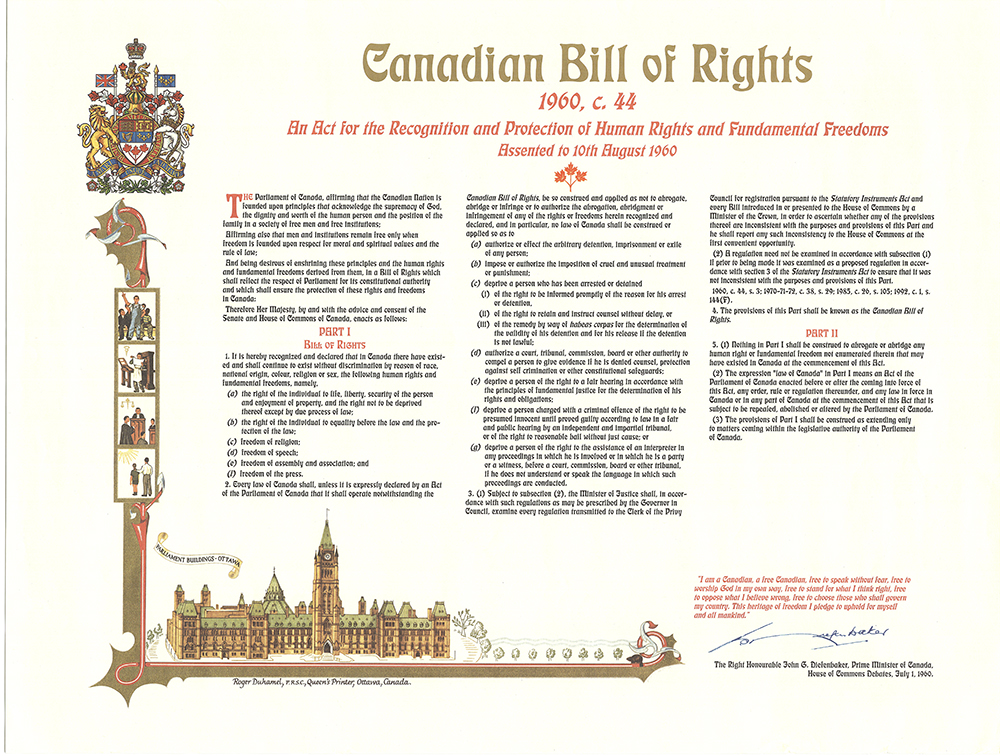
In 1960, a pivotal moment in Canadian history took place. It was the year when the Canadian Bill of Rights, officially titled “An Act for the Recognition and Protection of Human Rights and Fundamental Freedoms,” came into existence. This remarkable document was not only voted on but also signed into law by Prime Minister John Diefenbaker. And right above his signature, in a powerful statement, Diefenbaker boldly proclaimed:

“I am a Canadian, a free Canadian, free to speak without fear, free to worship God in my own way, free to stand for what I think is right, free to oppose what I believe is wrong, free to choose those who shall govern my country.  This heritage of freedom I pledge to uphold for myself and for all mankind.”

These words encapsulated the essence of what it meant to be a Canadian—a citizen of a nation that cherishes and safeguards individual liberties. The Canadian Bill of Rights, though partially absorbed into the Canadian Charter of Rights and Freedoms, still holds legal weight to this day. However, the Charter has surpassed its predecessor in significance. It now proudly stands as an integral part of the Constitution, the highest law of the land—a testament to Canada’s unwavering commitment to upholding the rights and freedoms of its people.
bill-rights-eng

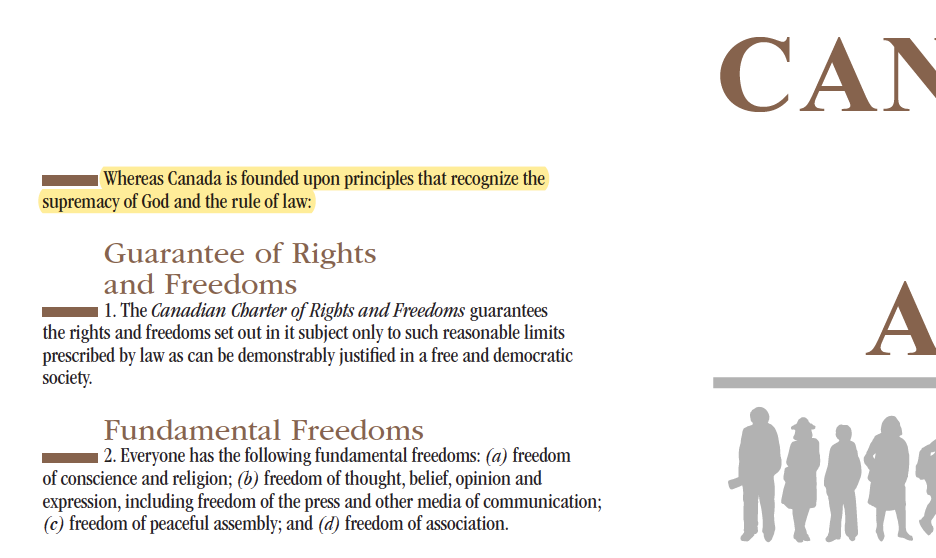
In the realm of legal documents, even the smallest details can hold immense significance. Such is the case with the Canadian Bill of Rights and the Charter of Rights and Freedoms. Interestingly, these two foundational texts share an almost identical introductory clause. It begins with the profound words: Whereas Canada is founded upon the principles that recognize the supremacy of God and the rule of law:”
Screenshot 2023-06-06 at 2.15.13 PM

What sets this clause apart is its concluding punctuation mark—a simple colon [:]. This unassuming symbol holds the key to understanding the profound nature of the text that follows. It signifies that the introductory clause is not a complete sentence but rather a contextual introduction to the subsequent list of articles. Everything that unfolds after those two vertically aligned dots must be comprehended in the light of the words that precede them. The absence of this contextual foundation renders the articles of the Charter devoid of meaning. For instance, the recognition of the rule of law is indispensable for the enforcement of any section within the Charter.

While commonly referred to as the preamble, labeling this clause as such undermines its true essence. It is the very heart and soul of the Charter—an embodiment of its principles and values. The heading that precedes this introductory clause amplifies its importance, boldly declaring: “CONSTITUTION ACT, 1982 (80) PART I CANADIAN CHARTER OF RIGHTS AND FREEDOMS.” This proclamation further solidifies the foundational nature of the introductory clause, emphasizing its indispensable role in shaping the Canadian legal landscape.

Imagine a charter as a powerful document, a grant of authority that bestows rights upon its recipient. In this case, it is the Federal and Provincial Governments of Canada who formally recognize and acknowledge the recipient’s prerogative to exercise those specified rights. However, it’s important to note that the granter retains superiority or sovereignty, while the recipient acknowledges a limited or inferior status within the relationship. This historical understanding of charters still holds true in modern usage.

Now, let’s delve into the controversy surrounding the introductory clause of the Charter, with its pivotal colon. Interestingly, the controversy primarily revolves around recognizing the supremacy of God and not, except for anarchists, the rule of law. Here’s the intriguing dilemma: regardless of its controversial nature, acknowledging the supremacy of God is the most crucial and fundamental aspect of the Charter. Ignoring it simply because it sparks debate would undermine the Charter itself. Just as removing recognition of the rule of law invalidates it, so too does the omission of God’s supremacy. It is through God’s supremacy that the rights listed within the Charter gain their context, and it is the rule of law that upholds and protects these very rights.

The statement affirming the supremacy of God remains etched into the original document, signed into law by Queen Elizabeth II and accepted on behalf of all Canadians by then Prime Minister Pierre Trudeau on April 17, 1982. It holds a permanent place within the Charter, as indelible as the ink used to print it. Even if there were attempts to remove God’s supremacy, it would require physically altering the document itself. No amendment, no matter how widely sanctioned by provinces and territories, could erase it. As long as the Canadian Charter of Rights and Freedoms exists, the interpretation of God’s supremacy must endure. In fact, back in 1999, NDP MP Svend Robinson proposed the removal of the mention of God from the preamble, but his efforts led to his relegation to the backbenches.

Some argue that recognizing the supremacy of God contradicts Section 2 of the Charter, which upholds freedom of thought, conscience, opinion, and religion. However, this is not the case. The Charter specifically grants the right to freedom of religion, not freedom from religion. Similarly, one is free to hold the opinion that the Charter may have flaws, but it does not grant the lawful right to ignore it. In a notable Alberta Court of Appeal case, Justice Belzil emphasized that the preamble of the Charter acknowledges Canada’s Christian heritage, and courts should not misuse Section 2’s right to freedom of religion to erode the traditions rooted in this heritage.

The concept of the “separation of Church and State” is often invoked in discussions, but it is important to note that this is an American idiom and is frequently used out of context. In Canada, the situation is quite the opposite. Through the Charter, the Federal and Provincial Governments implicitly recognize the supremacy of God and, by extension, His church.

The significance of the rule of law mentioned in the Charter’s preamble was carefully considered by the Supreme Court of Canada in the Manitoba Language Rights case (1985). The court underscored the importance of the Charter’s preamble by affirming that “The constitutional status of the rule of law is beyond question.” One cannot simply negate one part of the preamble while endorsing the other. The interconnectedness of the principles must be acknowledged.

Theologian Douglas Farrow astutely points out that the word “Whereas” indicates that all sections of the Charter should be understood in light of the principle recognizing the supremacy of God. This includes the rule of law, which follows the supremacy of God in the preamble. Farrow argues that the rule of law is difficult to explain, interpret, or uphold without reference to the supremacy of God, as the development of the rule of law stems from Canada’s religious foundations. Essentially, a consistent moral law or right cannot exist without a Moral Law Giver.

On their website, the Canadian Secular Alliance poses an intriguing question: “If Canada officially recognizes the supremacy of one particular God, in what sense are Canadians free to choose their own religion and follow their own conscience?” However, the Alliance overlooks an important aspect. Within the boundaries of the Charter, individuals are free to exercise and follow their religion or lack thereof, as well as their conscience. For example, one can practice witchcraft or Satanism, but offering child sacrifices as an expression of these beliefs is not protected by the law. The legal recognition of the Biblical principle “You shall not kill [murder]” (Exodus 20:13) reasonably places limitations on the rights of those who engage in such practices.

In a related vein, Section 7 of the Charter declares that Everyone has the right to life, liberty, and security of the person and the right not to be deprived thereof except in accordance with the principles of fundamental justice.”Additionally, Section 15 emphasizes that “Every individual is equal before and under the law and has the right to the equal protection and equal benefit of the law without discrimination.” Unfortunately, the Government of Canada has yet to recognize and include unborn children as part of the “Everyone” protected by the Charter. Unborn children are subject to significant discrimination based on age (their rights are typically only recognized at nine months), sex (gender-selective abortion), and mental or physical disability (with around ninety percent of children diagnosed with Down syndrome in Canada being aborted). It is worth noting that there is no explicit provision in the Charter granting anyone the right to end the life of a conceived child.

God, who is supreme, says of the unborn child, “Before you were in the womb, I knew you.” Jeremiah 1:5. 

We would be a much more virtuous country if we took the Charter’s colon seriously (no pun intended).


© David Harrison

The Canadian Bill of Rights – PDF download

The Canadian Charter of Rights and Freedoms – PDF download

 

This is my son whom I love.

I am on page 24 of Greg Paul’s book, Close enough to hear God breath.  Mid-sentence, talking of God, Greg refers to “His dear Son, Jesus.”

“His dear Son.”  I couldn’t help but think of my dear son, Daniel.  One needs to be a father to understand the essence of having a ‘dear son’.  I am sure every mother has mother-feelings.  Fatherhood, though, is a distinctly male emotion.
I had a flashback to when the Spirit of God overshadowed Mary.  It wasn’t sexual in any way; it was the act of fathering.  God had a son for the specific purpose of redeeming mankind but one cannot overlook the excitement of God becoming a father, having a son who will learn to call him Dad [Abba].
Daniel is our second child.  God had already given me ‘the desire of my heart’ in our daughter, Krista.  When Wendy became pregnant a second time, I said, “God, you choose this time.”   God chose a son for me; my son in whom I am well pleased, my son who will carry my genes and my family name to the next generation, my son in whom people [I hope] will see a shadow of his father.
I believe there is a natural pride a father has in his son; regardless of intellect, regardless of success or failure, regardless of anything.  There is an overwhelming pride I enjoy in the simple fact that Daniel is my son whom I love and in whom I am well pleased.
There is all kind of theology surrounding the second person of the Trinity, the mystery of Christ’s pre-existence before the world began, but I don’t think this in any way takes away from the joy and emotion God experienced in fathering his Son.