Brexit – "What was that all about?"


I was born in 1951, six years after the end of the Second World War.  I can remember as a young child seeing the charred remains of buildings in London that had not yet been torn down or reconstructed.  The significance of WWII has been lost on many; the blood, sweat and tears, the huge sacrifice to achieve victory forgotten.  Perhaps we would do well to remember Sir Winston Churchill’s famous wartime speech, when all seemed lost, and this truly great man stirred up a nation: 
“Even though large tracts of Europe and many old and famous States have fallen or may fall into the grip of the Gestapo and all the odious apparatus of Nazi rule, we shall not flag or fail. We shall go on to the end. We shall fight in France, we shall fight on the seas and oceans, we shall fight with growing confidence and growing strength in the air, we shall defend our island, whatever the cost may be. We shall fight on the beaches, we shall fight on the landing grounds, we shall fight in the fields and in the streets, we shall fight in the hills; we shall never surrender, and if, which I do not for a moment believe, this island or a large part of it were subjugated and starving, then our Empire beyond the seas, armed and guarded by the British Fleet, would carry on the struggle, until, in God’s good time, the New World (America), with all its power and might, steps forth to the rescue and the liberation of the old.”
As I followed the Brexit news coverage the day of the vote, there was a comment by a British MP that went to the very crux of why the exit side had a majority; the MP had been in a greengrocer the day before, talking with a shopper who asked the simple question, “What was that all about?” (referring to the WWII war and England’s ultimate victory).  Through the war Britain had kept its freedom, its sovereignty and its democracy, but in since its joining the Common Market and subsequently the European Union, its freedom, sovereignty and democracy have slowly been eroding away.
To all the commentators who berate the British people for their seeming stupidity, giving up seemingly assured wealth and prosperity, have missed the point completely.  To be rich but not truly free has zero appeal.  According to Time Magazine, “Among those who came of age before the E.U. was created, a staggering 59% wanted the country to leave.”  Though now living in Canada, I count myself among them.
It is the older generation who realize that wealth is not everything.  I am absolutely positive that the vast majority of those who voted to leave the E.U. were voting with their hearts, with sound minds and a desire to live in a true democracy – not with their wallets and a desire to be spoon fed by the state, even if the ‘state’ is not their own.

FIXING TORONTO AND THE GTA’S TRAFFIC PROBLEMS – QUICKLY, CHEAPLY AND EFFECTIVELY

Last week I was driving along the 407 toll highway across the top of the city, zooming along and trying to keep up with the slowpokes dawdling along at 130 km an hour, when I decided to save a couple of bucks and jog down Young Street to the 401, a distance of just under 9km, and then continue my eastward journey.  This journey should take 9 to 16 minutes according to Google Maps.  It took me more than 30 minutes. Gridlock all the way.  No accidents.  Just frustrating gridlock.
An out-of-town friend of ours frequently refers to the 401 highway as ‘the bowels of satan’ and worse they are frequently constipated for days on end. Getting up to 50km per hour across the top of the city on the 401 can be considered a good day.
So, why the big difference between the 407 cruising along 30 mph over the limit and the 401 just above a slow jog? The same question for most of the GTA’s city streets. The answer is as simple as the solution.  GTA streets and highways have simply exceeded capacity and the result is permanent gridlock.  Basic laws of physics apply.
There is no more space to build additional roads and toll systems only advantage the rich by driving the poorer folks off the road and padding government coffers, etc.
What most people don’t understand is that it only takes a small incremental increase over intended capacity to produce the gridlock effect.  Conversely, one only needs to introduce a relatively small decrease in the number of cars on the road at any given time to get traffic flowing again.  This TTC page (section ‘Unlocking Gridlock’) provides an excellent visualization.
The solution, whatever it is, needs to be fair, quick and easy to implement ideally at no or minimal cost and easy and inexpensive to enforce. My proposal fulfills each of these criteria.
All licence plates (apart from vanity plates) end with three numbers and the last number will be one of ten digits, 0 to 9, and each month (with the exception of February) have thirty or thirty-one days. So, if your licence plate ends in a 1 you will not be allowed to drive your car anywhere in the GTA, south of the 407, on the 1st, 11th, or 21st of the month. If your licence plate ends in a 2 the rule applies to you on the 2nd, 12th and 22nd of the month and so on.  Owners of vanity plates would not be allowed on the roads the same as those ending with a 1.
This simple system would immediately take ten percent of all private cars off the GTA roads. Traffic would instantly start flowing again at reasonable speeds. Yes, there would be slight inconveniences to work around but the benefits far exceed this cost.

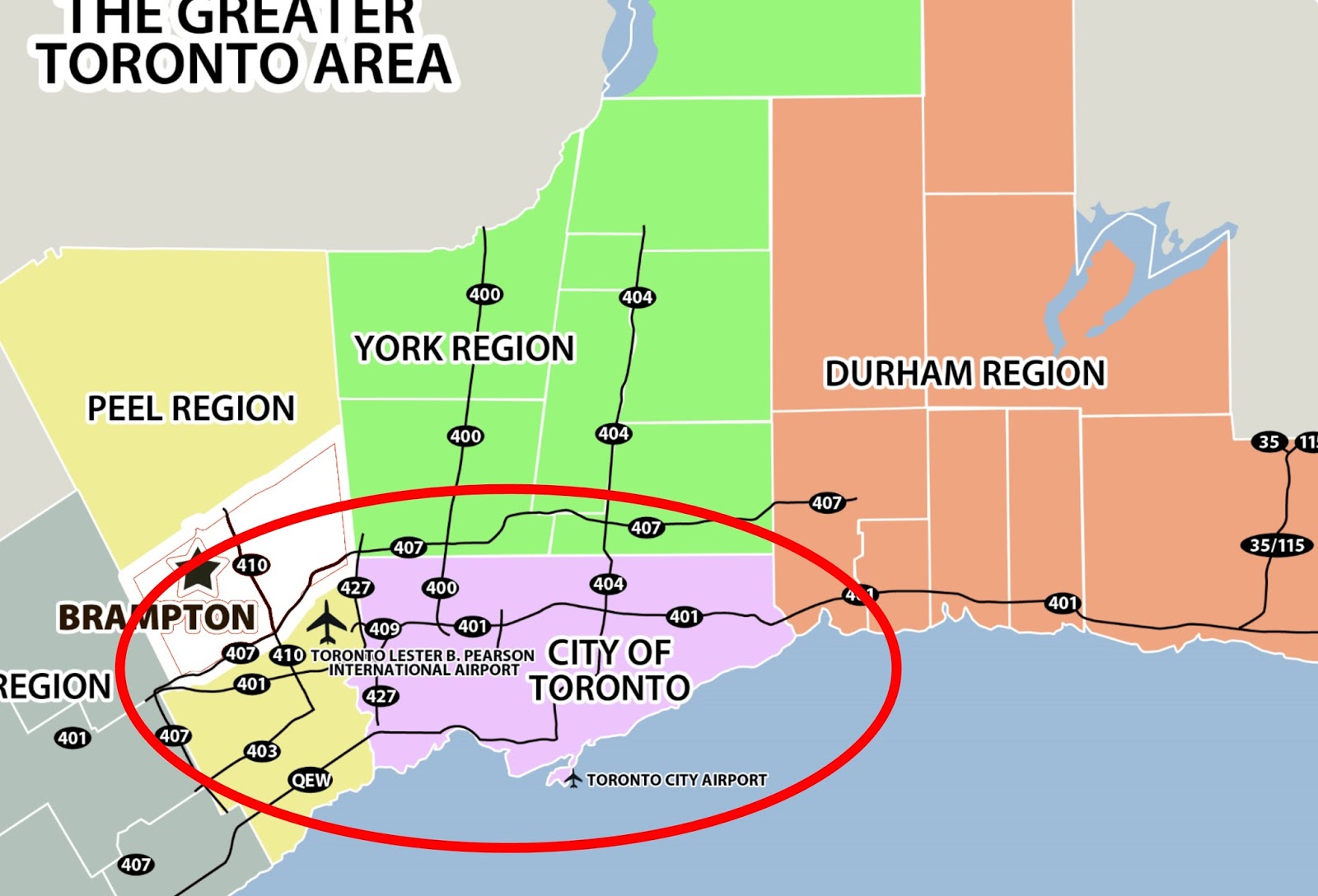
The map below shows the approximate extents of the program with the 407 highway as the north and west boundaries and Brock Road in Pickering to the east.

Here are my thoughts:
1.   The current cost of traffic gridlock to Toronto commuters has been estimated at between $7-billion to $11-billion annually. That frees up all that money to be used productively in the economy. Include the rest of the GTA and you can probably double that number.
2.   The mental health of the city would improve appreciably (reduction in road rage). Torontonians might actually start being polite to each other again. The average commute time in Toronto in 2014 was 63.6 minutes – that equates to 426 hours per month.
3.   Taking 10% of the vehicles off the road would reduce the pressure on emergency services by at least the same percentage and probably more. Another $billion or two? Lives saved due to faster response times of emergency vehicles – who knows?
4.   Taking 10% of the vehicles off the road would reduce road wear and tear by an appreciable amount, probably in the order of 5%-7%.
5.   It would force more commuters to occasionally take public transit, thereby increasing its efficiency and tilting it towards profitability. Presently, each TTC fair is subsidized by different levels of government to the tune of 26% of actual cost (2014 numbers). Increasing ridership by 7% would reduce the subsidy cost to 21%.
6.  The rules would apply to non-traditional taxi services (those without commercial plates) thereby giving traditional taxi drivers a leg up.
7.   Car sharing services such as Zip car and non-traditional taxi services such as Uber would be exempt if they purchased commercial plates.
8.   There would be a real impetus to promote car pooling, bike riding and alternate forms of commuting.  After all, it’s only two or three days per month (one of the three days will probably fall on a weekend).
9.   Those that currently car commute from locales such as Barrie or Burlington would not be allowed to drive any further south or west than the 407 (the same rules apply), thereby encouraging these individuals to use GO trains or buses, etc. This in turn would alleviate congestion on the 400 and QEW highways and other major north/south arteries.
10.  Out-of-country and out-of-province drivers would be exempt as would commercial vehicles.
11.  Because this plan affects both municipal and provincial roads it would require the support of both levels of government.
12.   The plan would be easy to implement and test for a month or two because there are no special infrastructure requirements.
13.  One of the significant side benefits of the plan is an immediate and significant reduction in greenhouse gas emissions.
14.  There might be initial feelings of inconvenience but once the system is implemented people will get used to marking their calendars with the three no-drive-days each month; sort of like remembering to put the garbage out.
15.  Companies can help by implementing work-from-home programs for employees three days per month where this is practical.
16.  To be effective there would need to be strict enforcement by police or traffic cameras with deterrent penalties.  The best deterrence from rule breakers would be shaming by fellow drivers; anyone who can read a calendar will know if you’re breaking the law.
17.  Other systems such as toll routes, rush hour tolls, etc. are expensive to implement and do not alleviate the congestion that goes from dawn to dusk in Toronto.
18.  The system would be in effect from 6:30am to 9:00pm.  This window can be fine-tuned over time once the basic principle is proven.
19.  Custom plates could be issued for handicap and special purpose vehicles.
20.   The final and key part of my plan, without it there is no hope of longterm success, is that on those months with 31 days none of these rules apply and it will be an emphatic reminder of why a system like this had to be implemented in the first place!
I welcome your feedback and other beneficial ideas on how this solution can be promoted.

THE BIBLE AND THE DILEMMA OF INERRANCY

It occurs to me that inerrancy is tragically misunderstood.


When we look at a beautiful object we will all see, analyze, criticize, objectify, and appreciate the beauty of that object from our own pre-existing paradigm. The truth that can never be changed are the inherent characteristics of that object.

For those who have experienced the intervention of the Holy Spirit, you will know that God speaks directly to you through the Sacred Scriptures and He will use that Scripture to address the particular situation at hand. Because it is God talking to you (which requires spiritual discernment that it is actually God doing the talking), and by virtue of His very Being, what God says must be inerrant.

When people quote and use Scripture out of context, e.g. using selective passages of Scripture to condone slavery [which is contradictory to the message that God is actually conveying], it is obvious that it is not God doing the talking and that which is quoted is no longer inerrant. Inerrancy, like the Bible, must be considered ‘in context’.

When Eugene Peterson wrote The Message, one could argue that his interpretation is not inerrant. If, as I believe, God inspired Eugene to write The Message, then, when I am being guided by the Holy Spirit, what I read in The Message is inerrant. Even having written The Message, I believe Eugene Peterson would still confirm the inerrancy of the original Scriptures as God authored them.

Although same may say these are circular arguments, the Bible itself speaks to its inerrancy:

2 Samuel 22:31
Psalms 12:6
Psalms 19:7
Psalms 119:160
Isaiah 40:8
Matthew 24:35
John 10:35
John 17:17
Hebrews 4:12
2 Timothy 3:16
2 Peter 1:20-21
James 1:22

…and so many more.

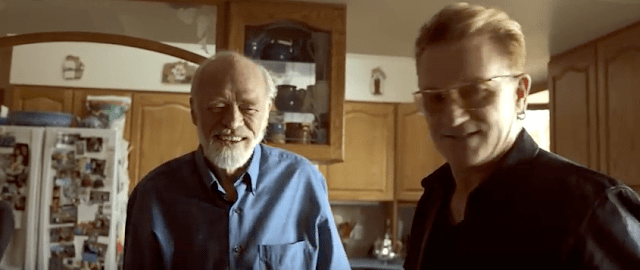
For those that are interested the following is a link to an interview with Bono (U2) and Eugene Peterson. Worth every minute of your time!


Faith is climbing out on a limb, cutting it off, and watching the tree fall away

People who deny miracles are those that either haven’t seen them, or they’ve seen a miracle but refuse to believe what they’ve seen.
Miracles come in all shapes and sizes.  God was never one to ‘put on a show’ for the sake of simply impressing His audience. God always has an ulterior motive.  The biggest miracle of all was Him [Jesus] rising from the dead. Unlike Lazarus walking out of the tomb there were no recorded firsthand witnesses, only those who saw Him after the fact.  This miracle has an ultimate purpose which is to provide faith – while at the same time requiring faith.
When God displayed so much of His glory and might to the Israelites He had a purpose.  When Jesus walked three and a half miles out across the Sea of Galilee to His disciples, in the middle of a storm (without losing His balance as far as we know), at the darkest time of the night, He had a purpose.  When God raised Jesus from the dead on Easter morning He had a purpose.  His ultimate purpose for every miracle is to instill or deepen the faith of the participant or observer.
I am in the middle of reading The Grave Robber by Mark Batterson.   In his book he quotes his favorite definition of faith:  faith is climbing out on a limb, cutting it off, and watching the tree fall away.  As I read this my initial reaction was this is crazy, but then the realization hit me that this was a truth I experienced in my own life – believing God and watching the impossible happen.
When I first had (was given?) the idea for Bus Stop Bible Studies everyone told me, implicitly or directly, that I was crazy.  This was an impossible idea.  The transit companies would not allow it, there would be too much public resistance, Canadian laws made it impossible, etc.  But this is where faith kicks in – do you choose to believe in a God who is able to keep a tree limb suspended in midair with you sitting on it, or do you believe that the tree trunk of opposition, impracticality and manmade laws make the mighty tree immovable.
Like Peter, who got out of the boat at Christ’s invitation, I chose to walk out on the limb.  I sawed through the branch which required both will and effort and watched as the tree slowly fell away.  Ten years later I am still enjoying the view from my perch on this tree branch… floating in midair.  The tree trunk is long gone.  Even the roots of the tree have vanished thanks to the Supreme Court of Canada.  And, as with all miracles, God had an ultimate purpose which was to share His love with the millions of commuters who ride public transit every day.  And, like the miracle of the loaves and fishes, with resources provided by a miracle-believing young lad, from my lofty viewpoint I am able to observe all kinds of miracles happening in other people’s lives.
Is God asking you to get off your sofa and climb a tree or to walk on water?  Are you simply going to change channels or are you going to turn the TV off and ask God, “What’s next?”  Trust me, the view from my perch up here is incredible!

“Roll the stone aside,” Jesus told them.

In your hearts revere Christ as Lord. Always be prepared to give an answer to everyone who asks you to give the reason for the hope that you have. But do this with gentleness and respect… 1Peter 3:15 NIV

My brother-in-law’s wife died suddenly this past week.  She had suffered with debilitating depression most of her life – her depression ultimately winning the battle but losing the war!

Donna Jean had a deep and abiding faith in her Savior, Jesus Christ.  We enjoyed many theological debates but I can never recall a single moment when we disagreed on the grace and glory of God.

Death is ugly however it comes.  Death and decay was never God’s intent for this world – He created it in perfection.  God also gave us freedom of choice – to choose intimate and abiding fellowship with Him, or rejection and sin.  Amazingly, Adam and so many others have chosen the latter.  And so we all suffer the consequences.

As I thought about Donna Jean’s death I was reminded of Jesus’ friend, Lazarus.  He died way too soon also.  Jesus got angry – very angry.  We pick up the story in the Gospel of John, Chapter 11.

When Mary arrived and saw Jesus, she fell at his feet and said, “Lord, if only you had been here, my brother would not have died.”

When Jesus saw her weeping and saw the other people wailing with her, a deep anger welled up within him, and he was deeply troubled. “Where have you put him?” he asked them.

They told him, “Lord, come and see.” Then Jesus wept. The people who were standing nearby said, “See how much he loved him!” But some said, “This man healed a blind man. Couldn’t he have kept Lazarus from dying?”

Jesus was still angry as he arrived at the tomb, a cave with a stone rolled across its entrance. “Roll the stone aside,” Jesus told them.

Most people know John 11:35, “Jesus wept.” as the shortest verse in the Bible.  Like those in the story, most interpret his weeping over the loss of his dear friend.  But this interpretation does not seem to make sense in the context of the whole narrative.  Jesus had known four days earlier that Lazarus was dead.  Why start weeping now?

I would suggest that Jesus’ anger and tears were over the tyranny of death itself.  I note elsewhere in Scripture that when Jesus got angry… He didn’t get mad – He got even!  He wasn’t about to let death get the better of Lazarus, or later Himself and us.  “Roll the stone aside!” Jesus commanded.  Then Jesus shouted, “Lazarus, come out!”

The next time we see the stone being rolled away it was in front of Jesus tomb.  Again, Jesus defeated His arch enemy – death.

For Donna Jean the stone was rolled away many, many years ago, the moment she acknowledged Jesus as her Savior.

And the dead man came out, his hands and feet bound in grave clothes, his face wrapped in a head cloth. Jesus told them, “Unwrap him and let him go!”  John 11:43

And now Donna Jean is enjoying the ‘hope’ of God’s promises.

And I heard a loud voice from the throne saying, “Look! God’s dwelling place is now among the people, and he will dwell with them. They will be his people, and God himself will be with them and be their God.  ‘He will wipe every tear from their eyes. There will be no more death’ or mourning or crying or pain, for the old order of things has passed away.”

He who was seated on the throne said, “I am making everything new!” Then he said, “Write this down, for these words are trustworthy and true.”  Revelation 21:3-5 NIV

I am ceaselessly in the wonder of God’s grace.


POLITICAL POLARIZATION – WHY HAS IT BECOME SO EXTREME?


A few years ago I was watching a television interview with a member of the new Trudeau government making the comment that they hoped there would be less partisanship and more cooperation in the next parliament.

I am a ‘social conservative’ and as such I foresee more partisanship, not less.  “Why?” you ask.  If I may be so bold, I suggest the answer lies with the left-leaning, liberal segments of society.
As a social conservative my viewpoint has for the most part been passed down from generation to generation.  The basic principles of what I deem to be right and appropriate are no different from my father’s or grandfather’s generations.  My sense of morality is based on absolutes rather than public or personal whim.  My sense of a civilized society is based upon respect for public order and the inherent responsibility that each individual has to the common good.  My sense of right and wrong are based on Judaeo-Christian principles that date back thousands of years.
Before someone throws in red-herring arguments, no, slavery is not acceptable to the social conservative.
A social conservative, who uses the Bible as his or her guide, has the privilege of being able to drive a stake in the ground to define a boundary beyond which he or she will strive not to venture.
A social liberal, on the other hand, has no such ideological point of reference; he or she will be swayed and motivated by personal or public opinion without the benefit of any [moral] constant 1.
Issues that would have been deemed socially and morally unacceptable by the majority of the Canadians just forty years ago are now promoted as ideals of modern liberalism; the demeaning of traditional marriage and family values, contempt for the sacred, sexual promiscuity, adultery, mass abortion, euthanasia, legalization of recreational drugs, celebration of homosexuality and transgenderism, rampant pornography, legalization of prostitution, and on the list goes.  The logical end for the social liberal’s ideal is total hedonism* and/or anarchy** – “The only person in the world that matters is me and you have no right to impose your values and opinions on me.”
Meanwhile I doggedly try and point out how far society is straying from the stake in the ground which safely tethers me to a righteous morality – not a relative morality.
On this basis, I propose that it is the social liberals who are turning the polarizing filter.  The further they turn the filter of liberalism the greater the degree of partisanship there will be.
Partisanship occurs when two parties move farther and farther away from each other. If the social conservative is firmly tethered to a stake in the ground, it must be the social liberal who is increasing the distance from that stake and correspondingly increasing the level of partisanship.  I don’t see that it can be explained any other way.

*Hedonism: the ethical theory that pleasure (in the sense of the satisfaction of desires) is the highest good and proper aim of human life.

**Anarchy: a state of disorder due to absence or nonrecognition of authority.

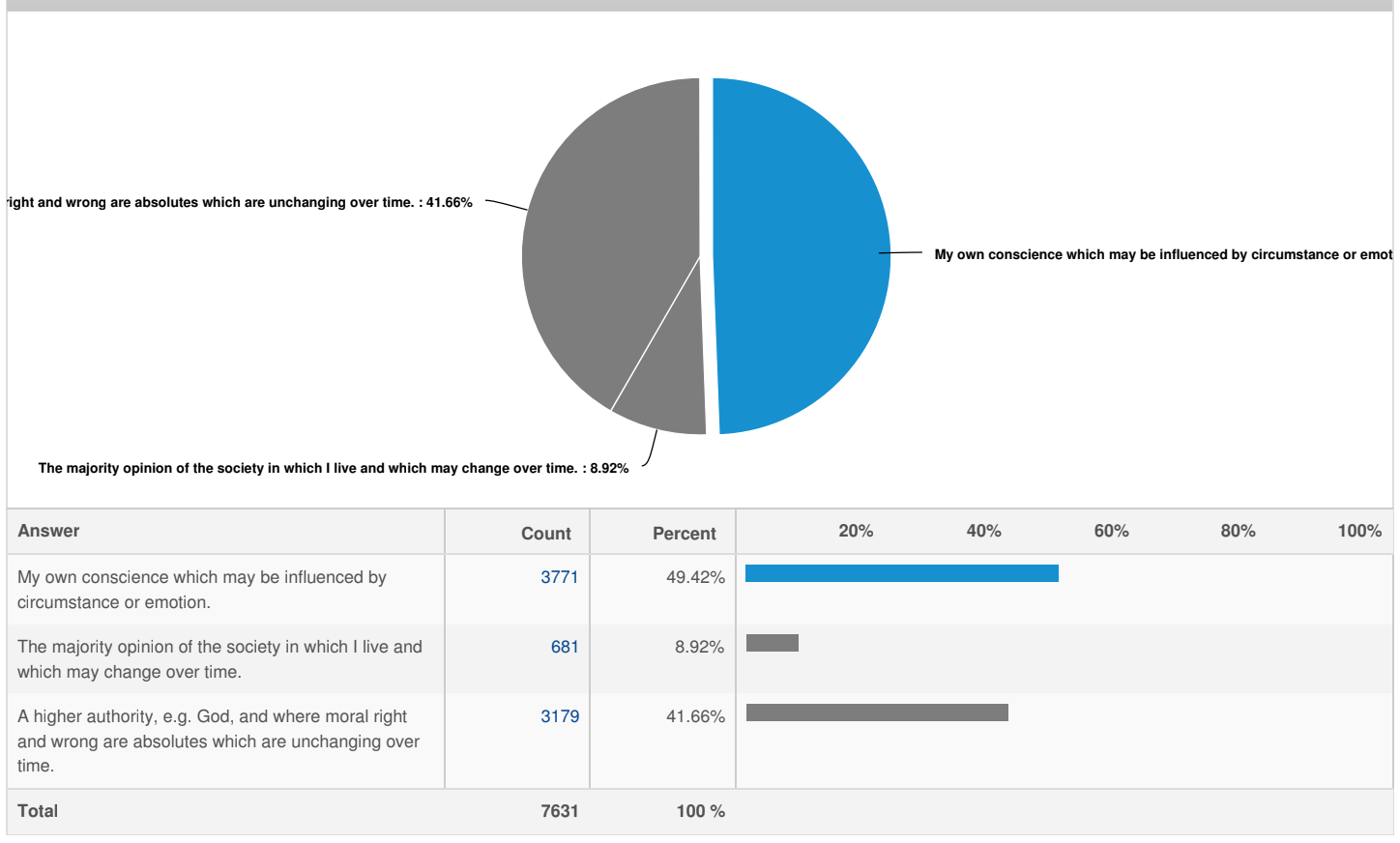
1 In a recent public online survey, more than 7,500 Canadians responded to the following multiple choice statement: “Morality is defined as the differentiation of intentions, decisions and actions between those that are ‘good’ (or right) and those that are ‘bad’ (or wrong). I believe morality is dictated by (check one):”  A graph of their responses is shown below. 


WHY DID THEY DIE? SO WE COULD LEGALIZE RECREATIONAL DRUGS?


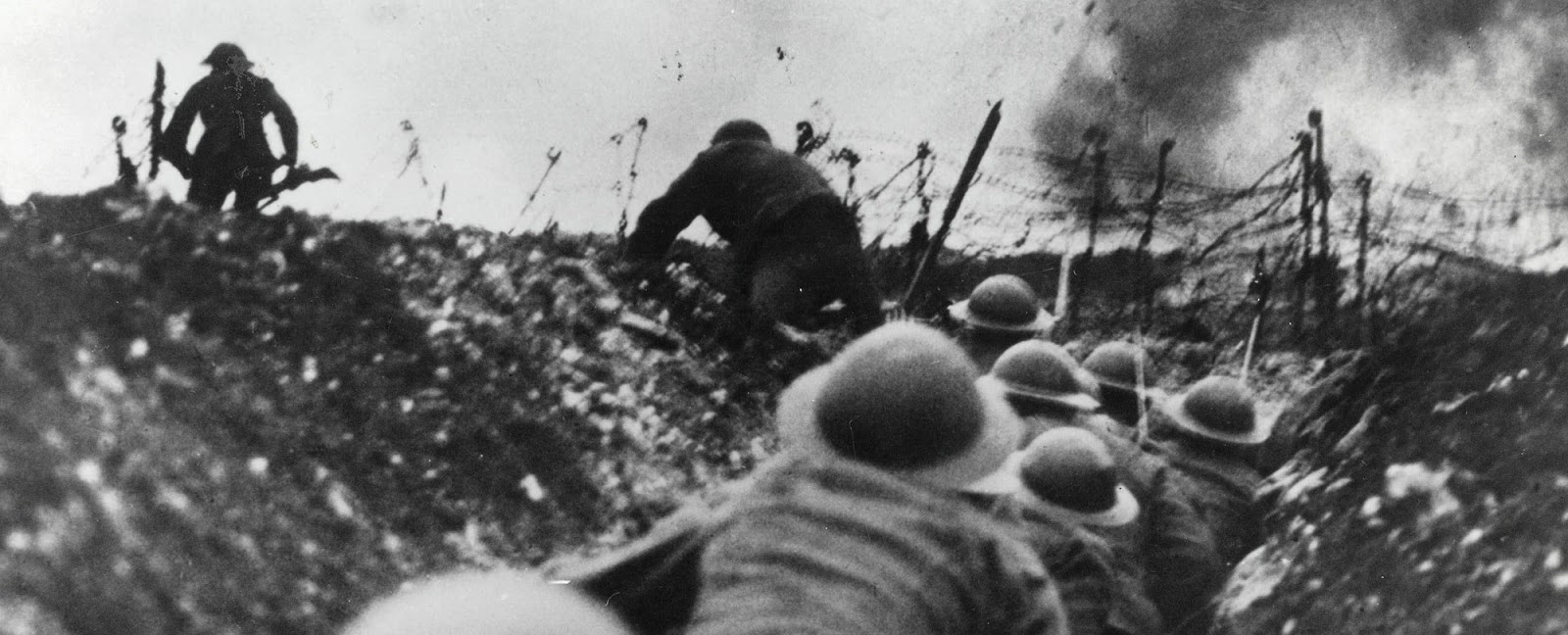
This morning our church held a Remembrance Service.  There were some moving images of our Veterans in battle from the First and Second World Wars and haunting reminders of those who returned from Afghanistan in flag draped boxes.

As the images came up on the screen I pondered what these heroic men and women, many of whom who paid the ultimate sacrifice, would think of the contempt with which we ‘honour’ the liberty they gave us?  We make it possible to kill our unborn children by the millions, legalize euthanasia, the Government proposing legislation to legalize the sale of mood altering drugs and of the segments of Canadian society who try and banish God from every aspect of public life?  

Tell me, what would they have thought of the contempt many of today’s generation show for the values they once held so dear?

After we stood for two-minutes of silence and reflection we sung Oh Canada, our National Anthem.  We, thankfully, sung the third verse as well.  The second and third stanzas, have too bee banished from the public square – the third honours God.

   Ruler supreme, who hearest humble prayer,  

   Hold our Dominion in thy loving care; 

   Help us to find, O God, in thee 

   A lasting, rich reward, 

   As waiting for the better Day, 

   We ever stand on guard.

We often sing, “God keep our land, glorious and free…” with great gusto at sporting and other events. Yet, with the rampant immorality we see in our society today, I no longer consider Canada to be glorious and the zealotry we see to keep God out of all things Canadian is not my definition of freedom.

I am glad most of these brave men and women are not hear to see the Canada we have become.  I fear they may have ultimately died in vain.

EVOLUTION’S GRAND CHALLENGE

Above: A cross-section through a blade of marram grass. Who says God doesn’t have a sense of humour?
I sometimes find myself struggling to explain my non-faith reasons for being a Creationist. Evolutionists and Creationists are both confronted with exactly the same material evidence, so why should I choose one argument over the other?  I stumbled(?) across this article on EvolutionNews.org, written by Steve Kaufmann, that articulates my arguments quite clearly. In the absence of any evidence to the contrary, I do not possess sufficient faith to believe that life ‘just happened’.  The article frequently uses the term ‘intelligent design’ which, as far as I am concerned, is a cop-out for giving the glory for the creation of life to Almighty God.
In a recent ENV article, mathematician Granville Sewell asked an intriguing question:
In the current debate between Darwinism and intelligent design, the strongest argument made by Darwinists is this: In every other field of science, naturalism has been spectacularly successful, so why should evolutionary biology be different? Even most scientists who doubt the Darwinist explanation for evolution are confident that science will eventually come up with a more plausible explanation. That’s the way science works. If one theory fails, we look for another one; why should evolution be so different? [Emphasis added.]
Dr. Sewell’s post mainly explored entropy and theory-based reasoning. From my own perspective as an architect of large information systems, I would like to suggest a different (but complementary) answer.
Enter Information, Stage Right
Evolutionary biology was very much like other sciences up until the 1950s, when the information-bearing capabilities of DNA and RNA were discovered inside living cells.
These discoveries fundamentally changed biology. And as the information payload is increasingly unraveled, we’re seeing ever more complex and interdependent assembly instructions, activation circuits, programming sequences, and message payloads. This information is decoded and operated on by molecular machines of similar complexity, and the whole (information + machines) is self-generating, self-sustaining, and self-replicating.
The information has some intriguing properties:
  • It must perform an astounding number of complex functions in order to create, sustain, and replicate life. Each function requires multiple distinct programs or sequences for the various phases of its lifecycle: assembly, operation, complex orchestration with other functions, error detection and correction, replication, and so on. These are functionally distinct types of activities, so it’s almost certain that they are encoded separately, perhaps with completely different coding structures and mechanisms.
  • It has no value without a complex collection of molecular machines, yet it must also include the instructions for generating those same machines. The result is an immensely complex choreography of separate but interrelated information and molecular machines. Neither can function without the other — a ginormous chicken-and-egg problem.
  • It exhibits the design properties of the best human-engineered software systems, yet its capabilities extend well beyond any current human-engineered systems. For example, no human-engineered system is capable of self-replicating both the software that operates on the machinery and the machinery that decodes the software.
Further, based on the observed functionality in living organisms, there are many undiscovered types of information that must be present in a living cell, but which haven’t been decoded or understood yet.
Kinesis [be sure to watch the video link!] offers a fascinating example of undiscovered information in action. What programs and machinery are required to assemble the structure and function of kinesin? What information is needed for kinesin to achieve its “runtime” functions? How does kinesin know where to go to pick up a load, what load to pick up, what path to take, and where to drop its load? How does it know what to do next? All this functionality takes information, which must be encoded somewhere.
Indeed, the level of complexity is monotonically increasing, with no end in sight.
With no possibility that new discoveries will ever decrease the observed complexity, it may not be long before we see a seismic shift in the research paradigm — from the study of biological systems that happen to contain information, to the study of information systems that happen to be encoded in biology.
Causal Requirements and Causal Forces
Aside from the obvious (and intriguing) challenge of understanding the enormous complexity of life’s information payload, evolution purports to explain its origins.
The origin of life is perhaps the most obvious example of information’s formidable hurdle to evolutionary explanations. First life requires all of the following:
    • Sufficient complex programs and sequencing to support first life’s complete lifecycle (i.e., the directions have to be complete and correct).
    • Sufficient machinery to interpret the programs and to operate life (i.e., the directions must have proper effect).
  • Sufficient programs and machinery to replicate both the programs and the machinery (i.e., the directions must be passed to the next generation).
And all this must be present at the same time, in the same place, in at least one instant in history, at which point the whole must somehow be animated to create life. And all this must occur, by definition, before an organism can reproduce. Without reproduction, there is no possibility to accumulate function, from simple to complex, as required by evolution. Hence, the programs must have contained all the complexity required for first life at inception.
By definition, then, the minimal programs and machinery required for first life must have predated any creative capabilities (real or imagined) of Darwinian processes.
Further, since the information necessary for first life must have been assembled prior to the animation of first life, the minimal information payload must have predated first life. And it must, therefore, have derived from a source beyond biology as we know it.
This poses a causal quandary for evolutionary biology. For there are only two known classes of causal forces, and these have dramatically different qualities.
First, there are physical laws, which include mathematics, physics, and chemistry. These are repeatable (i.e., the same inputs always produce the same results) and purposeless (i.e., the same inputs produce the same results, no matter who gets hurt). Their repeatability makes science effective. But physical laws are not capable of acting with intent, which limits their creative capabilities.
Operating within the physical laws are random events that can change the information payload of life in various ways. But these are constrained by the same physical laws, so are similarly incapable of acting with intent. Random events cannot create complex information, except in two circumstances: (a) there is some predefined notion of a desirable outcome, and (b) any “positive gains” toward that outcome are protected from random degradation through some external mechanism. Both of these special circumstances require intention, which the physical laws cannot offer.
Second, there are intelligent causes, which are purposeful and therefore not generally repeatable. The creation of complex programming requires non-repeatability. While intelligent causes are capable of generating the right kind of information, it’s difficult to pin down when and how their actions occurred, or what their intent might have been. All sciences that deal with intelligent causes (e.g., archaeology) are made more difficult by non-repeatability.
An Impending Worldview Crisis
The search for a purposeful cause that predates biology as we know it inevitably drives the conversation to metaphysics. And this places evolution (and biology) at the center of a conflict between worldviews.
For materialists, the first class of causal force is insufficient and the second is unacceptable. Materialist biologists are thus pressed to find a third class of causal force — one that works without purpose (required to adhere to materialist philosophy), yet produces purposeful outcomes (required to adhere to the observed world). As yet no reasonable candidate forces have been proposed.
So materialists face growing dissonance between their philosophical commitment and biology’s complex programming. As the quality and quantity of the discovered interdependent programs and processing machinery increases, the plausibility of material causation gets weaker. So the materialist position is weak, and going in the wrong direction (from their perspective).
On the other hand, for anyone not fully committed to materialist philosophy the options are much more interesting. For those willing to consider the second class of causal force, things begin to fall into place and the dissonance dissipates.
For theists, the second class of causal force is not only acceptable but expected. Further, theists are unsurprised to learn that the causal forces in class #1 are finely tuned to enable life, and they have no problem with the notion that random events are more likely to destroy information than create it (e.g., there are far more possible non-functioning programs than functioning programs).
Ongoing discoveries about the nature of the information at the core of life present a growing hurdle for the materialist worldview but are increasingly friendly to any worldview that’s open to a pre-biological intelligence with some means to assemble the programs and machinery minimally required for first life.
And this sets up a worldview collision.
Evolution’s Grand Challenge
Molecular biology is characterized by growing questions and shrinking answers.
It’s like the guy who, after untying his boat, finds himself with one foot on the dock and one foot in the boat. As the gap grows, it becomes increasingly hard to ignore. And uncomfortable. And temporary.
And this is evolution’s grand challenge: The complex programs and amazing molecular machines at the heart of life simply cannot be explained by any current or proposed theory of evolution, nor by any other completely material cause. Apologists for materialism cannot hide this fact much longer. Neither the volume of their arguments nor any level of vitriol can change the fact that the data is skewing against them.
Rarely has any field of science had to deal with questions so difficult, or that cut so deeply into the worldviews, minds, and hearts, of thoughtful men and women.
Evolution sits at the center of a front-and-center debate — with too much to explain, in too little time, with insufficient causal power, and with so many watching and so much at stake.
That, I would say, is what makes evolution different.


ARE ATHEISTS INTENTIONALLY IGNORANT?

 
To ask ‘are [all] atheists intentionally ignorant’ is not intended as an insult, rather, is it not a realistic statement of fact?  The reality is all atheists are ignorant of the existence of God. How could it be otherwise?  They openly promote this ignorance but would rather convey their message to their audience as denial.
Atheists must live with the dilemma that they are always having to ‘prove a negative’ even if they would deny that they have to actually prove anything.  The paradigm that divides non-believers and believers is that a non-believer must convince him or her self that God does not exist, while for those who seek God it is God who does the convincing.
Evolution is atheism’s single crutch and, simultaneously, its most effective weapon.  As with attacks on traditional marriage, euthanasia, pro-life proponents, religious conscience, etc., it is those who tend to ‘shout the loudest’ would seem to prevail – regardless of any factual evidence to the contrary.  
In Wm. Paul Young’s latest book Eve, Younge wrote, “Lilly, words like ‘God’ and ‘believe’ are often meaningless. I don’t believe God. I know God! Once you know someone, believing is no longer a concern.” 
Because I know God, it is a lot easier for me to place my faith in God’s description of Creation than in a manmade theory that requires one to stretch one’s faith to the infinite degree and still come up short on answers.  Every atheist must continually ponder the question: who or what is the uncaused cause of the universe and everything in it?  If there ever was a Big Bang who or what triggered it?  Apart from God, it is an unanswerable question.
Which requires the greater faith: believing a knowable, omnipotent, omniscient God who describes how He created all living things (plants and creatures) after their own kind and reveals Himself to those who choose Him, or a process spontaneously coming into existence, to create all matter and life which has unprovable theories as its very foundation?
That which physically exists (all living things, fossils, and geologic matter) is the physical evidence both Creationists and evolutionists are constrained and upon which they must base and argue their apologetics.  
Creationists do not discount natural selection and accept physical ‘evidence’ as it presents itself without having to apply theories of an evolutionary process to bring it about.  Conversely, evolutionists must prove two distinct processes: natural selection and evolution – the former in no way proving nor supporting the latter.
All scientific revelations only further persuade me of a Magnificent Creator, rather than the mind-bendingly complex processes theorized to argue how life might have come about.  
I have read arguments such as chimpanzees and humans having 90+% of their DNA in common – as if to prove that humans and chimpanzees have a common ancestry.  Such ‘evidence’ proves nothing.  It is equally reasonable to argue that the Magnificent Creator would share elements of His incredibly complex and intricate design throughout much of that which He created.
Just as troubling are commentaries that use a lack of evidence to support a thesis.  It is common sense that a lack of evidence cannot possibly prove anything.  Missing evidence can only mean one of three things: the evidence has been destroyed [erased], transformed, or has yet to be uncovered.  Science requires that evidence must be in evidence.
Both the Creation paradigm and evolutionary theory use the same fossil record to demonstrate their beliefs.  The Creationist can demonstrate that worldwide sedimentary deposits along with the fossil record exactly match the Biblical account of the flood, while the evolutionist will argue that the fossil record documents the sequence in which creatures ‘evolved’.  Further, the evolutionary expositor depends on ‘dating methods’ that are mostly theoretical in nature. 
The chasm an atheist must cross is as wide as his or her pride.  Jesus implied that it easier for a camel to pass through the eye of a needle than for a proud person to enter the Kingdom of Heaven; in short, impossible.  A proud person will seek any excuse (including arguing the theory of evolution) to avoid coming face-to-face with God.  Conversely, any person who recognizes his or her wretched condition is welcome to sit at the feet of God and receive unimaginable blessings as a consequence.


SIX DAYS FROM TODAY THE 70TH YEAR OF JUBILEE WILL START! WATCH FOR AMAZING THINGS TO HAPPEN ON THE WORLD STAGE.

Biblically, the Year of Jubilee occurs once at the end of every 49-year cycle. Each ‘cycle’ is made up of 7 years, the last year of the seven being the Sabbath year, or Shemitah.  At the end of a seven-Shemitah cycle (49 years), the next year, the fiftieth year (which is also the first year of the next 7-year cycle), is the Year of Jubilee.
Joshua crossed the Jordan and led the Hebrew nation into what is now Israel, in 1406 BC.  The first Year of Jubilee was celebrated in 1357 BC.  I am presently writing this blog on 24th of Elul, 5775 on the Hebrew calendar, or September 8th on the Gregorian calendar, or 5,775 years since the Year of Creation. 
Why should I, or anyone else, be paying attention to these facts?  Is something special going to happen soon? Let’s look back on recent history:

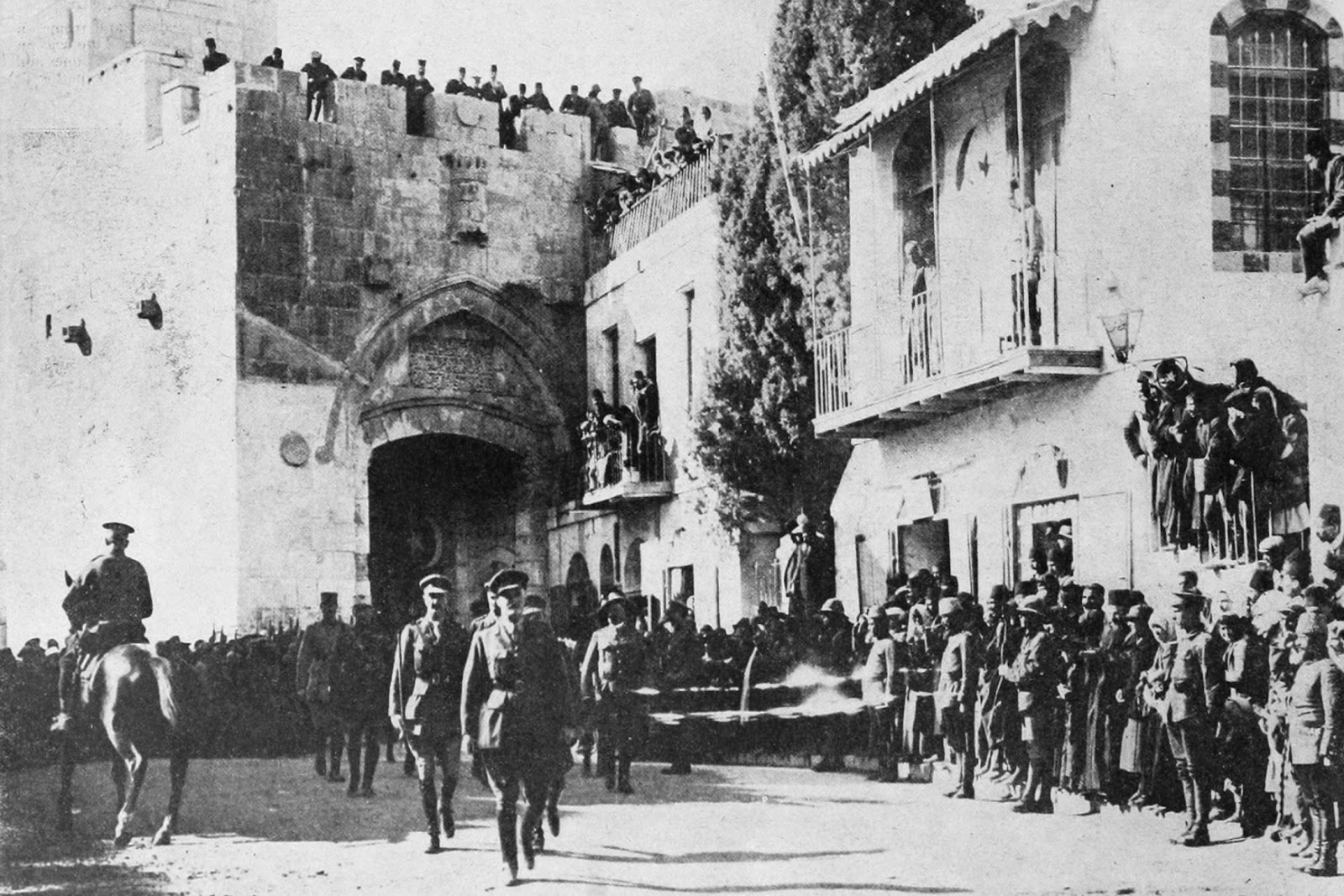
During what would have been the 68th Year of Jubilee, General Sir Edmund Allenby (above), commander-in-chief of the Egyptian Expeditionary Force, entered Jerusalem on foot, out of respect for the Holy City, on December 11, 1917, displacing the Turkish Ottoman invaders.  

Fifty years later Jerusalem, in the 69th Year of Jubilee, Jerusalem once again changed hands during the 1967 Six Day War (above) and the Israelites took control of the City of David for the first time since 586 BC (2,600 years).  

Six days from now the 70th Year of Jubilee will start on 1st of Tishrei, 5776, that is 6 days from now, Monday, September 14, 2015.  How do we know this? Simple calculation: 1407 years + 2016 years divided by 49 = 70.
 
This coming Year of Jubilee will also be the 40th since Christ’s death.
 
If such significant events happened in Jerusalem in 1917 and 1967 what does the 70th Year of Jubilee hold?  What do you think?  Leave your comments below.